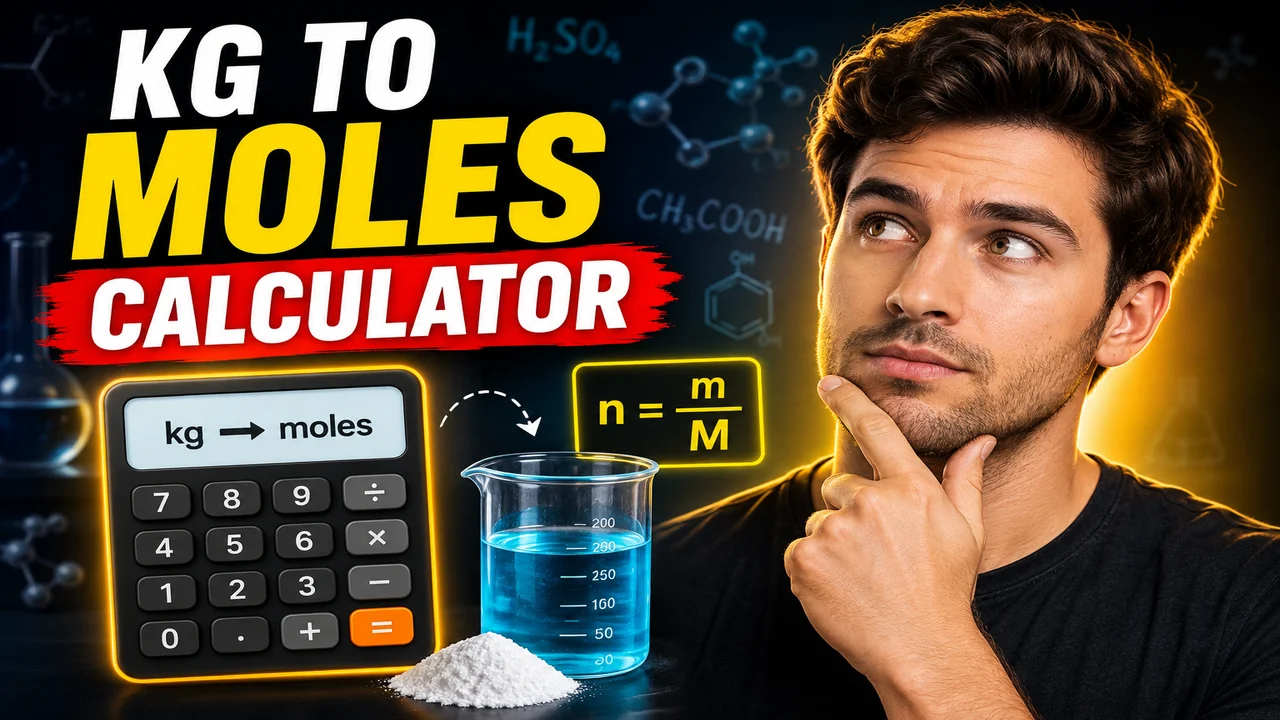
Kg To Moles Calculator For Chemistry Problems
Quick answer: The Kg To Moles Calculator For Chemistry Problems converts a substance's mass in kilograms into the amount of substance in moles using its molar mass. Enter the mass and the molar mass in grams per mole (g/mol) to calculate the result.
Converting kilograms to moles is a common chemistry calculation used in stoichiometry, chemical equations, laboratory preparation, and quantitative analysis. Mass measures how much matter is present, while the mole expresses the amount of a specified chemical entity. Because different substances have different molar masses, the same mass in kilograms can represent different amounts in moles.
The Kg To Moles Calculator For Chemistry Problems is intended for students, educators, and people solving chemistry exercises that provide a sample mass and a known molar mass. The essential requirement is to identify the substance correctly and use its appropriate molar mass. A mass value alone is not enough to determine the number of moles.
Key Takeaways
- Input: Mass in kilograms and molar mass in grams per mole.
- Output: Amount of substance in moles (mol).
- Conversion: Convert kilograms to grams before dividing by molar mass in g/mol.
- Main application: Chemistry homework, stoichiometry, and quantitative chemical calculations.
How to Use Kg To Moles Calculator For Chemistry Problems?
- Enter the mass: Provide the mass of the substance in kilograms (kg).
- Determine the molar mass: Obtain the molar mass of the specific element or compound in g/mol.
- Calculate the amount: Apply the mass-to-moles formula, ensuring the units are consistent.
- Review the result: Interpret the calculated amount in moles and consider the significant figures appropriate to the input data.
What inputs are required?
Mass (kg): This is the measured or given mass of the chemical sample. It should be a numerical value expressed in kilograms. For example, 0.250 kg represents 250 g.
Molar mass (g/mol): This is the mass of one mole of the specified chemical entity, expressed in grams per mole. It depends on the substance's chemical identity and, for compounds, its chemical formula. Use the molar mass of the correct entity, such as atoms rather than molecules when the problem specifies atoms.
Calculated amount (mol): The result represents the amount of the specified substance. It is not the mass in kilograms, a concentration, or the number of individual particles. To estimate the number of entities, multiply the amount in moles by the Avogadro constant.
Input and Output Example
Suppose a chemistry problem asks how many moles are present in 0.500 kg of sodium chloride (NaCl). The molar mass of sodium chloride is approximately 58.44 g/mol.
Given values
- Mass = 0.500 kg
- Molar mass = 58.44 g/mol
- Required output = Amount of NaCl in moles
Step 1: Convert kilograms to grams
Since the molar mass is expressed in g/mol, convert the mass into grams first.
Mass (g) = Mass (kg) × 1000
Mass = 0.500 × 1000 = 500 g
Step 2: Calculate moles
Amount (mol) = Mass (g) ÷ Molar mass (g/mol)
Amount = 500 ÷ 58.44 ≈ 8.556 mol
Result
A 0.500 kg sample of sodium chloride contains approximately 8.56 mol of NaCl, when rounded to three significant figures.
This example illustrates why the kilogram-to-gram conversion is essential when the molar mass is supplied in g/mol. Dividing 0.500 directly by 58.44 would produce an incorrect result because the mass and molar-mass units would not be consistent.
Formula for Converting Kilograms to Moles
The standard formula is:
n = (m × 1000) / M
Where:
- n = amount of substance in moles (mol).
- m = mass in kilograms (kg).
- 1000 = conversion factor from kilograms to grams.
- M = molar mass in grams per mole (g/mol).
The formula follows from the relationship between mass, amount of substance, and molar mass. Molar mass is defined as mass divided by amount of substance. Rearranging that relationship gives amount of substance as mass divided by molar mass. When mass is initially given in kilograms and molar mass is expressed in g/mol, the kilogram-to-gram conversion factor must be included.
Unit analysis
The calculation is dimensionally consistent:
n = (kg × 1000 g/kg) ÷ (g/mol)
After cancelling kilograms and grams, the resulting unit is mol.
Alternatively, molar mass can be expressed in kg/mol. If both the mass and molar mass use kilograms, use:
n (mol) = m (kg) ÷ M (kg/mol)
Do not apply the factor of 1000 twice. Choose the formula that matches the units supplied in the problem.
Kg to Moles Reference Table
The following examples use representative molar masses. Results are approximate and are intended to demonstrate the calculation rather than replace a substance-specific reference value.
| Substance | Mass (kg) | Molar Mass (g/mol) | Amount (mol) |
|---|---|---|---|
| Water (H₂O) | 1 | 18.015 | 55.51 |
| Carbon dioxide (CO₂) | 1 | 44.01 | 22.72 |
| Sodium chloride (NaCl) | 1 | 58.44 | 17.11 |
| Oxygen molecules (O₂) | 1 | 32.00 | 31.25 |
| Carbon (C), atoms | 1 | 12.011 | 83.26 |
| Calcium carbonate (CaCO₃) | 0.250 | 100.09 | 2.498 |
For example, 1 kg of oxygen molecules corresponds to approximately 31.25 mol when the molar mass is taken as 32.00 g/mol. The result would differ if the question concerned oxygen atoms rather than O₂ molecules because the molar mass of an oxygen atom is approximately 16.00 g/mol.
How the Calculation Works
The conversion involves two linked operations: a mass-unit conversion and a molar-mass calculation. First, multiply the mass in kilograms by 1000 to obtain grams. Next, divide the gram value by the molar mass of the specified substance. The quotient is the amount of substance in moles.
The method is based on standard chemical definitions rather than a substance-specific conversion constant. The International Union of Pure and Applied Chemistry (IUPAC) defines molar mass as mass divided by amount of substance. Its definition of the mole establishes the SI unit used to express the amount of a specified chemical entity.
For authoritative terminology, consult the IUPAC Gold Book definition of molar mass and the IUPAC definition of the mole.
Technical Edge Cases and Limitations
Zero mass
If the sample mass is zero and the molar mass is positive, the calculated amount is zero moles. A zero mass does not require a different conversion formula.
Negative mass
A negative mass is generally not a physically meaningful input for an ordinary sample-mass calculation. Check whether the value was entered with the wrong sign or whether the problem represents a different mathematical quantity.
Missing or invalid molar mass
If the molar mass is missing, unknown, or equal to zero, the amount of substance cannot be calculated using this formula. A valid positive molar mass for the specified entity is required. Do not substitute an arbitrary value merely to obtain a result.
Incorrect chemical identity
Similar names or formulas can refer to different entities. Oxygen atoms (O) and oxygen molecules (O₂), for example, have different molar masses. For ionic compounds, use the molar mass of the formula unit appropriate to the question. Verify the chemical formula before calculating.
Unit mismatch
Using mass in kilograms with molar mass in g/mol without converting the mass introduces a factor-of-1000 error. If molar mass is expressed in kg/mol, the mass can remain in kilograms, and the conversion factor should not be applied.
Rounding and significant figures
Keep additional digits during intermediate calculations and round the final answer according to the precision of the supplied measurements and the conventions required by the chemistry problem. The examples in this reference table use rounded molar masses, so their displayed results are approximate.
Mixtures and solutions
For a mixture containing several substances, the total mass alone does not determine the moles of each component. You need the mass of the particular component or enough composition information to determine it. For a solution, concentration and volume may be relevant when the mass of the solute is not known.
Practical limitations
- The formula calculates moles from mass and molar mass; it does not identify an unknown chemical from its mass alone.
- The result depends on the correctness of the supplied molar mass and chemical formula.
- The calculation does not independently account for sample purity, contamination, or measurement uncertainty.
- For precise laboratory work, use appropriate reference data, calibrated measurements, and the required significant figures.
Technical Disclaimer: This calculator's mathematical method provides an amount-of-substance calculation based on the supplied values. Confirm chemical identity, molar mass, sample purity, and measurement uncertainty before using a calculated amount in laboratory procedures or quantitative experiments.
Frequently Asked Questions
How do I convert kilograms to moles?
Multiply the mass in kilograms by 1000 to convert it to grams, then divide by the substance's molar mass in g/mol. The result is the amount of substance in moles.
Can I convert kilograms to moles without knowing the substance?
No. You need the molar mass of the specified substance. Different elements and compounds have different molar masses, so equal masses can correspond to different amounts in moles.
What is the formula for kg to moles?
When molar mass is expressed in g/mol, use n = (m × 1000) / M, where m is the mass in kilograms, M is the molar mass in g/mol, and n is the amount in moles.
Why must kilograms be converted to grams?
The conversion is necessary when molar mass is expressed in g/mol. Converting kilograms to grams ensures the mass units cancel correctly and the result is expressed in moles.
How do I find the molar mass of a compound?
Use the compound's chemical formula and add the atomic molar masses of all its constituent atoms, accounting for each subscript. Use an appropriate periodic table or authoritative chemical reference for the atomic values.
Does 1 kilogram always equal the same number of moles?
No. One kilogram corresponds to different mole amounts for different substances because their molar masses differ. A kilogram of water, for example, contains more moles than a kilogram of carbon dioxide.
How many particles are in the calculated number of moles?
Multiply the amount in moles by the Avogadro constant, 6.02214076 × 10²³ mol⁻¹. The resulting number of entities depends on whether the specified entity is an atom, molecule, ion, or formula unit.
Author Information
Author Name: Jordan Mitchell
Author Description: Chemistry educator focused on chemical calculations, dimensional analysis, molar mass, and introductory stoichiometry.
Technical Review: The formula, unit conversion, worked examples, and molar-mass terminology are presented in accordance with standard chemical relationships and the terminology defined by IUPAC.
