
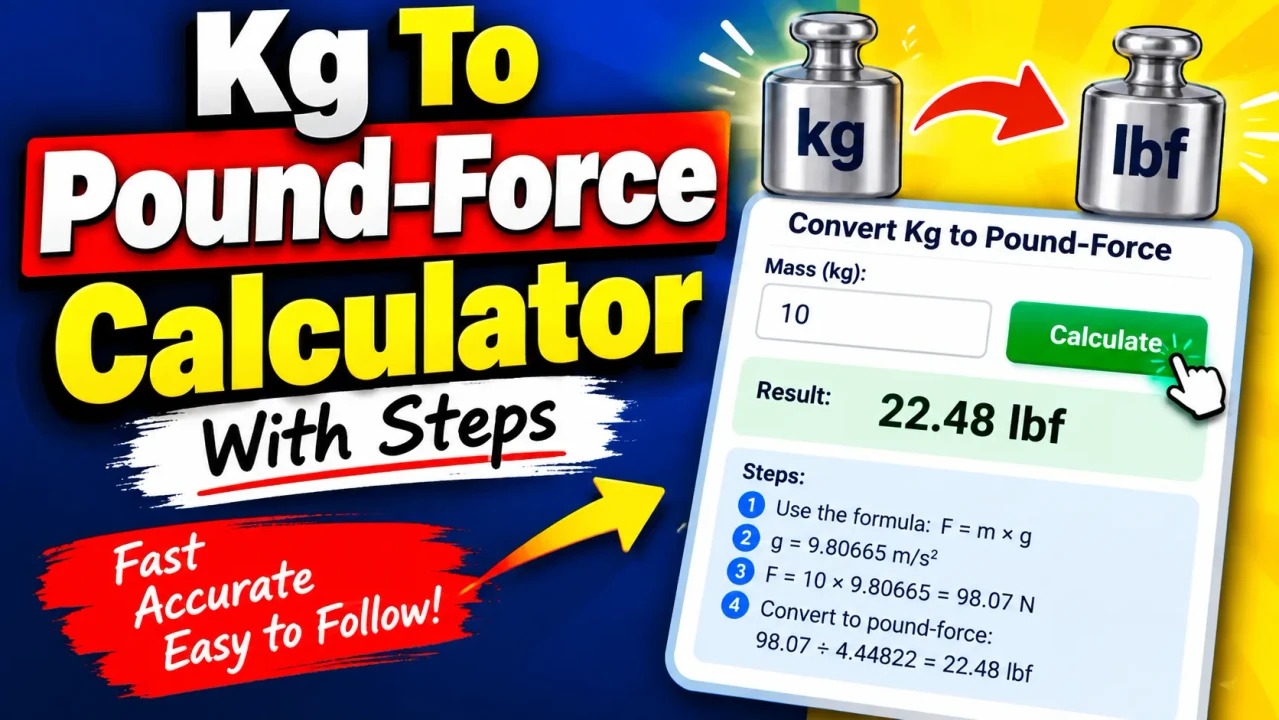
Kg To Pound-Force Calculator With Steps
Quick answer: The Kg To Pound-Force Calculator With Steps converts a kilogram-based input into an equivalent pound-force (lbf) value using a specified gravitational acceleration. Under standard Earth gravity, 1 kilogram-force (kgf) equals approximately 2.20462 pound-force (lbf). A kilogram measures mass, while pound-force measures force, so the conversion requires a clear distinction between mass and weight.
This calculator is intended for users who need to understand the relationship between kilogram-based weight measurements and pound-force. It is relevant to students, educators, engineers, mechanics, and anyone working with force values in different measurement systems.
TL;DR / Key Takeaways
- Primary Function: Convert a kilogram-based mass or kilogram-force value into pound-force.
- Conversion Factor: 1 kgf ≈ 2.20462 lbf under standard gravity.
- Core Output: An equivalent force value expressed in pound-force.
- Important Distinction: Kilograms measure mass; pound-force measures force.
How to Use Kg To Pound-Force Calculator With Steps?
- Enter the kilogram value you want to convert.
- Confirm whether your input represents mass in kilograms or force in kilogram-force.
- Use the standard-gravity conversion when converting mass to its weight force on Earth.
- Review the calculation and the resulting value in pound-force.
The precise input fields, gravity settings, rounding options, and displayed calculation steps depend on the calculator's implementation. These options should be described according to the actual interface rather than assumed.
What Is the Difference Between Kilograms and Pound-Force?
A kilogram (kg) is an SI unit of mass. A pound-force (lbf) is a unit of force used in the US customary system. Mass and force are different physical quantities, so converting kilograms directly into pound-force involves an assumption about gravitational acceleration.
For an object with a mass of 1 kg under standard Earth gravity, the weight force is approximately 9.80665 newtons. Since 1 lbf is approximately 4.4482216152605 newtons, that weight corresponds to approximately 2.20462 lbf.
If the input already represents kilogram-force (kgf), the conversion is simpler: multiply the kgf value by approximately 2.20462 to obtain lbf. If the input represents mass in kilograms and the object is under a different gravitational field, calculate its weight using the applicable gravitational acceleration first.
Input and Output Example
Consider an object with a mass of 10 kg on Earth, using standard gravity.
Input
- Mass: 10 kg
- Standard gravitational acceleration: 9.80665 m/s²
Calculation
First, calculate the weight force in newtons:
Force (N) = Mass (kg) × Gravitational acceleration (m/s²)
Force = 10 × 9.80665 = 98.0665 N
Then convert newtons to pound-force:
Force (lbf) = Force (N) ÷ 4.4482216152605
Force ≈ 98.0665 ÷ 4.4482216152605 ≈ 22.0462 lbf
Result
A 10 kg mass weighs approximately 22.0462 lbf under standard Earth gravity.
Kg to Pound-Force Formula
For mass measured in kilograms, the general formula is:
F(lbf) = m(kg) × g(m/s²) ÷ 4.4482216152605
Where:
- F: Resulting force in pound-force.
- m: Mass in kilograms.
- g: Gravitational acceleration in metres per second squared.
- 4.4482216152605: The number of newtons in one pound-force, approximately.
When standard gravity is assumed, the formula can be simplified to:
F(lbf) ≈ m(kg) × 2.20462
This simplified expression converts kilogram mass to its corresponding weight force under standard gravity. It should not be interpreted as a universal mass-to-force conversion independent of gravity.
Kg to Pound-Force Reference Table
| Mass (kg) | Equivalent Weight (lbf) | Assumption |
|---|---|---|
| 0.5 kg | 1.10231 lbf | Standard gravity |
| 1 kg | 2.20462 lbf | Standard gravity |
| 2 kg | 4.40925 lbf | Standard gravity |
| 5 kg | 11.02311 lbf | Standard gravity |
| 10 kg | 22.04623 lbf | Standard gravity |
| 20 kg | 44.09245 lbf | Standard gravity |
| 50 kg | 110.23113 lbf | Standard gravity |
| 100 kg | 220.46226 lbf | Standard gravity |
These values are calculated using standard gravitational acceleration and rounded for display. The underlying conversion is approximate only where decimal values have been rounded.
How the Conversion Works
The conversion can be understood as two linked operations:
- Calculate weight: Multiply mass by gravitational acceleration to obtain force in newtons.
- Change force units: Divide the force in newtons by the number of newtons in one pound-force.
The SI system defines the newton as the unit of force. NIST provides authoritative information on SI units and US customary units, including the conversion relationship between newtons and pound-force.
Reference: NIST Special Publication 811: Guide for the Use of the International System of Units (SI).
For the distinction between mass, weight, and gravitational force, consult the National Institute of Standards and Technology (NIST) for measurement guidance.
Technical Reference: kg, kgf, N, and lbf
| Unit or Quantity | Meaning | Conversion Relationship |
|---|---|---|
| Kilogram (kg) | Unit of mass | Mass is not itself a force |
| Kilogram-force (kgf) | Force equal to the weight of 1 kg under standard gravity | 1 kgf = 9.80665 N |
| Newton (N) | SI unit of force | 1 N ≈ 0.224809 lbf |
| Pound-force (lbf) | US customary unit of force | 1 lbf ≈ 4.448221615 N |
Edge Cases and Limitations
Zero input
A mass of 0 kg corresponds to a weight force of 0 lbf under any finite gravitational acceleration.
Negative input
Negative mass is not a normal physical input for this calculation. If a negative number is entered, verify whether the value represents a signed force or an invalid mass rather than assuming it is a meaningful physical mass.
Different gravitational environments
The weight force of the same mass differs with gravitational acceleration. The standard factor of approximately 2.20462 lbf per kilogram applies when using standard gravity, not every planetary or orbital environment.
Rounding and precision
Reference values may differ in the last displayed decimal place because of rounding. For engineering calculations, retain sufficient intermediate precision and round only the final result to the precision appropriate for the application.
Mass versus force input
Do not apply the mass-to-weight formula to a value that is already expressed as force. If the input is kilogram-force, use the direct conversion to pound-force instead of multiplying by gravitational acceleration a second time.
Technical Disclaimer
This calculator provides unit-conversion estimates based on the stated physical assumptions. Confirm whether the input represents mass or force and select the appropriate gravitational acceleration for the application. For safety-critical mechanical, structural, lifting, or load-rating decisions, verify the calculation against applicable engineering requirements and qualified professional judgment.
Author
Author Name: Michael Turner
Author Description: Technical writer specializing in measurement units, engineering calculations, and practical reference documentation.
Technical Review: This page explains the distinction between mass and force and documents the conversion from kilogram-based values to pound-force using standard gravity and the newton-to-pound-force relationship.
