
Kg To Newtons Calculator With Earth Gravity Online
Convert kilograms to newtons using standard Earth gravity (9.80665 m/s²). Enter a mass to calculate weight force in newtons and check practical conversion examples.
Please complete this field to continue.
Results
Kg To Newtons Calculator With Earth Gravity Online
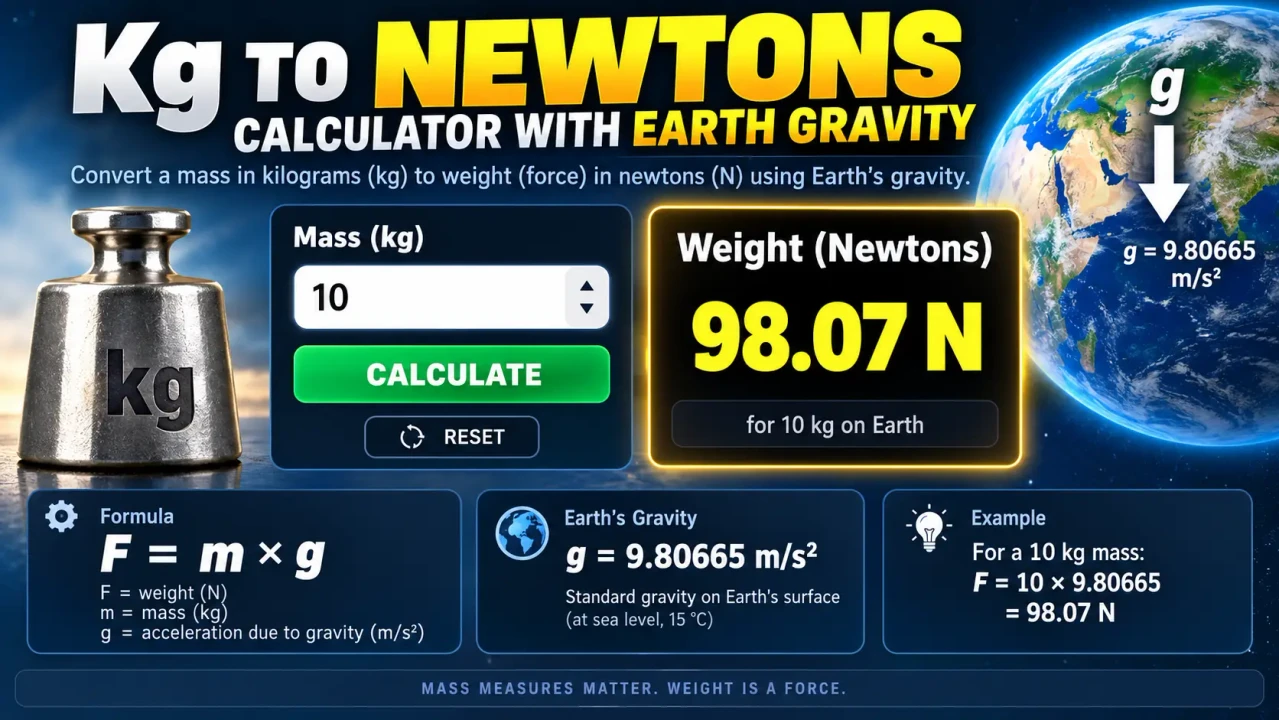
The Kg To Newtons Calculator With Earth Gravity Online is a physics calculator that converts mass measured in kilograms (kg) into weight force measured in newtons (N), using the standard acceleration due to gravity on Earth. Enter a mass to calculate the corresponding gravitational force without manually performing the multiplication.
Quick answer: To convert kilograms to newtons on Earth, multiply the mass in kilograms by 9.80665 m/s². For example, a mass of 10 kg corresponds to a gravitational force of 98.0665 N under standard Earth gravity.
Key Takeaways
- Input: Mass in kilograms (kg).
- Output: Weight force in newtons (N).
- Formula: Force = Mass × Gravitational Acceleration.
- Earth gravity value: 9.80665 m/s².
- Best suited for: Physics homework, classroom exercises, engineering estimates, and everyday force calculations.
How to Use Kg To Newtons Calculator With Earth Gravity Online?
- Enter the mass: Type the object's mass in kilograms, such as 5, 10, or 25.5.
- Calculate the force: Apply the standard Earth gravity value of 9.80665 m/s².
- Read the result: Interpret the answer in newtons, the SI unit of force.
- Check the calculation: Multiply the entered mass by 9.80665 to verify the result independently.
Use kilograms for the input. If your measurement is in grams, divide it by 1,000 before applying the formula. For example, 500 g equals 0.5 kg.
Input and Output Example
Suppose an object has a mass of 12 kg. To determine its weight force under standard Earth gravity:
Input: 12 kg
Gravitational acceleration: 9.80665 m/s²
Calculation: 12 × 9.80665 = 117.6798
Result: 117.6798 N, or approximately 117.68 N when rounded to two decimal places.
The result represents the gravitational force acting on the object under the stated assumption. It does not mean that the object's mass has changed from 12 kg.
Formula for Converting Kilograms to Newtons
The calculator uses the standard weight-force relationship:
F = m × g
- F: Weight force, measured in newtons (N).
- m: Mass, measured in kilograms (kg).
- g: Gravitational acceleration, measured in metres per second squared (m/s²).
For standard Earth gravity, use g = 9.80665 m/s². Because one newton is equivalent to one kilogram metre per second squared, multiplying kilograms by gravitational acceleration produces newtons.
This calculation distinguishes mass from weight. Mass describes the amount of matter and is measured in kilograms. Weight is a force caused by gravity and is measured in newtons. The same object can have approximately the same mass in different locations but a different weight force when gravitational acceleration changes.
Kilograms to Newtons Conversion Reference Table
The following values use standard Earth gravity of 9.80665 m/s². Results are shown to five decimal places where applicable; practical applications may require different rounding.
| Mass (kg) | Calculation | Weight Force (N) |
|---|---|---|
| 0.1 | 0.1 × 9.80665 | 0.980665 |
| 0.5 | 0.5 × 9.80665 | 4.903325 |
| 1 | 1 × 9.80665 | 9.80665 |
| 2 | 2 × 9.80665 | 19.61330 |
| 5 | 5 × 9.80665 | 49.03325 |
| 10 | 10 × 9.80665 | 98.06650 |
| 20 | 20 × 9.80665 | 196.13300 |
| 50 | 50 × 9.80665 | 490.33250 |
| 100 | 100 × 9.80665 | 980.66500 |
| 1,000 | 1,000 × 9.80665 | 9,806.65000 |
How the Calculation Works
The conversion is a direct multiplication rather than a change between two equivalent mass units. Kilograms measure mass, while newtons measure force. The gravitational acceleration supplies the factor needed to calculate the force associated with an object's mass.
- Take the mass value expressed in kilograms.
- Multiply it by 9.80665 m/s².
- Express the product in newtons.
- Round the displayed result to a suitable number of decimal places for the intended use.
For example, a 25 kg object has a calculated weight force of 25 × 9.80665 = 245.16625 N under standard Earth gravity. If a report requires two decimal places, the result is 245.17 N.
Edge Cases, Assumptions, and Limitations
Zero and Negative Mass Values
A mass of 0 kg produces a calculated force of 0 N. Negative mass is not a valid input for an ordinary physical object's mass in this calculation and should not be interpreted as a conventional weight measurement.
Local Gravity Versus Standard Gravity
The value 9.80665 m/s² is standard gravity, a conventional reference value. Actual gravitational acceleration varies with location and altitude. A calculation intended to represent a specific site or a different celestial body should use the appropriate gravitational acceleration instead.
Rounding and Precision
The multiplication can produce decimal results. Rounding to two decimal places is convenient for many everyday calculations, while scientific work may require additional digits. The number of displayed decimal places does not guarantee that the original mass measurement has equivalent precision.
Mass Units
The formula expects kilograms. Convert grams to kilograms by dividing by 1,000, and convert metric tonnes to kilograms by multiplying by 1,000. Entering a number expressed in grams as though it were kilograms will produce a result that is 1,000 times too large.
Force Is Not Always the Scale Reading
The result represents gravitational weight force under the chosen gravity value. A scale reading or the force measured by a sensor can differ in situations involving acceleration, support forces, or other applied forces. This calculator does not independently model those effects.
Technical Reference and Further Reading
For unit definitions and measurement conventions, consult the International System of Units (SI) Brochure published by the Bureau International des Poids et Mesures (BIPM). It provides authoritative information about SI units, including the newton and kilogram.
Technical Disclaimer: This calculator provides a force estimate using standard Earth gravity. For structural design, lifting equipment, load ratings, safety-critical calculations, or other engineering decisions, confirm the applicable local gravitational conditions, load assumptions, measurement uncertainty, and relevant engineering requirements.
Frequently Asked Questions
How many newtons are in 1 kg?
One kilogram corresponds to a weight force of 9.80665 N under standard Earth gravity. This is commonly approximated as 9.81 N.
Why do kilograms need to be multiplied by gravity?
Kilograms measure mass, whereas newtons measure force. Multiplying mass by gravitational acceleration calculates the gravitational force acting on that mass.
Does this calculator use Earth's exact gravity everywhere?
No. It uses the conventional standard gravity value of 9.80665 m/s². Actual local gravity varies slightly by location and altitude.
Can I convert grams to newtons with this formula?
Yes, after converting grams to kilograms. Divide the gram value by 1,000, then multiply the resulting mass by 9.80665 m/s².
Can the result be used on the Moon?
Not as a Moon-weight calculation with the Earth-gravity assumption. Use the Moon's gravitational acceleration instead of 9.80665 m/s² to estimate weight force there.
What is the difference between mass and weight?
Mass is measured in kilograms and describes an object's inertia. Weight is gravitational force, measured in newtons, and depends on both mass and gravitational acceleration.
Author Information
Author Name: Ethan Brooks
Author Description: Engineering Content Specialist focused on mechanics, measurement units, and applied physics calculations.
Technical Review: The calculation methodology is based on the standard relationship between mass, gravitational acceleration, and weight force. Users should verify assumptions and rounding requirements for their intended application.