
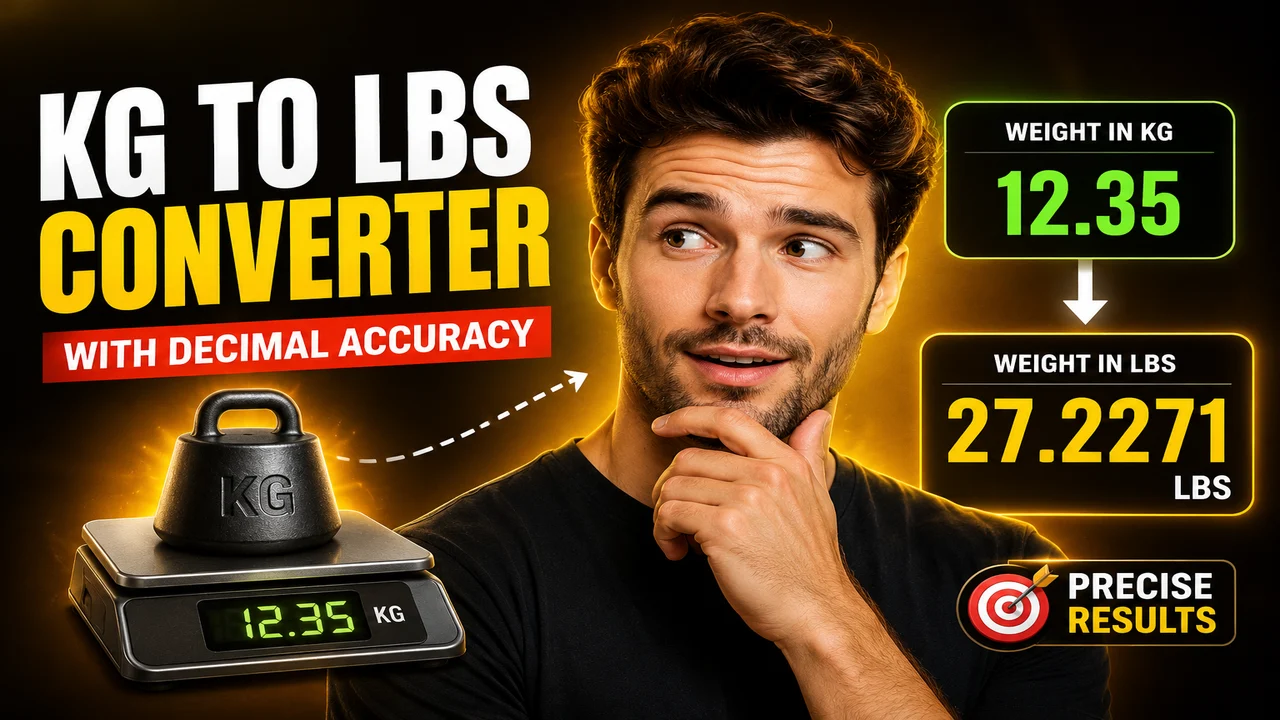
Kg To Lbs Converter With Decimal Accuracy
Quick answer: Kg To Lbs Converter With Decimal Accuracy is a unit conversion calculator that converts kilograms (kg) into pounds (lb or lbs) using the internationally defined conversion factor. It helps users convert body weight, luggage mass, package weights, fitness measurements, and other metric measurements into pounds with configurable decimal precision where supported by the tool.
The kilogram is the base unit of mass in the International System of Units (SI), while the avoirdupois pound is commonly used for everyday weight measurements in the United States and other contexts. Converting between them requires a fixed mathematical relationship, not an estimate based on a rounded value such as 2.2.
For a reliable kilogram-to-pound calculation, multiply the kilogram value by approximately 2.20462262185. The exact relationship is defined by 1 pound = 0.45359237 kilograms, making 1 kilogram equal to 1 / 0.45359237 pounds. The number displayed after conversion depends on the decimal precision selected or supported by the calculator.
What Can You Convert?
- Body weight: Convert a metric scale reading into pounds for personal records or fitness tracking.
- Shipping and luggage: Translate kilograms into pounds when checking package specifications or baggage allowances.
- Fitness equipment: Compare metric weight plates and equipment specifications with pound-based labels.
- Product specifications: Convert listed mass values for household goods, appliances, and other products.
- Education: Verify unit conversion exercises using the standard kilogram-to-pound relationship.
TL;DR / Key Takeaways
- Primary Function: Convert kilograms into pounds.
- Input: A numeric mass value in kilograms.
- Output: The equivalent mass in pounds.
- Conversion Formula: Pounds = Kilograms × 2.20462262185…
- Precision: Displayed decimal places determine how many digits are shown, not whether the underlying conversion factor is exact.
How to Use Kg To Lbs Converter With Decimal Accuracy?
- Enter kilograms: Type the mass value you want to convert into the kilogram input field.
- Choose precision, if available: Select the desired number of decimal places if the calculator provides a precision option.
- Convert the value: Run the conversion using the available calculator control.
- Read the result: Check the corresponding pound value and retain the displayed precision appropriate to your task.
The exact interface controls and available precision settings should be confirmed against the deployed calculator. Do not assume that it supports batch conversion, file uploads, automatic copying, or a particular decimal-place selector unless those features are implemented.
Input and Output Example
Suppose you want to convert 72.5 kilograms into pounds.
Input: 72.5 kg
Calculation: 72.5 × 2.20462262185…
Unrounded result: Approximately 159.8351391 lb
Rounded to two decimal places: 159.84 lb
Rounded to three decimal places: 159.835 lb
This example demonstrates why decimal precision matters. A result rounded to two decimal places is easier to read in everyday contexts, while a result showing more decimal places can be useful when checking calculations or recording measurements. Extra displayed digits do not make the original measurement more precise than the scale or instrument that produced it.
Kilograms to Pounds Conversion Reference Table
The following table uses the standard avoirdupois pound and rounds the converted results to four decimal places for convenient reference.
| Kilograms (kg) | Pounds (lb) | Typical Context |
|---|---|---|
| 0.1 | 0.2205 | Small mass measurements |
| 0.5 | 1.1023 | Light packages |
| 1 | 2.2046 | Basic unit reference |
| 2.5 | 5.5116 | Small household items |
| 5 | 11.0231 | Compact luggage or equipment |
| 10 | 22.0462 | Fitness equipment |
| 25 | 55.1156 | Travel or lifting measurements |
| 50 | 110.2311 | Body or cargo mass |
| 72.5 | 159.8351 | Example body-weight conversion |
| 100 | 220.4623 | Heavy packages or equipment |
| 250 | 551.1557 | Large loads |
| 1000 | 2204.6226 | One metric tonne |
How Does the Conversion Work?
The conversion follows the exact definition of the international avoirdupois pound:
1 lb = 0.45359237 kg
To convert kilograms to pounds, divide the kilogram value by 0.45359237. The equivalent multiplication formula is:
Pounds = Kilograms ÷ 0.45359237
Or, using the reciprocal conversion factor:
Pounds = Kilograms × 2.2046226218487757…
- Kilograms (kg): The input mass expressed in kilograms.
- Pounds (lb): The equivalent mass in international avoirdupois pounds.
- Conversion factor: The reciprocal of 0.45359237, expressed as a repeating decimal.
- Decimal precision: The number of digits retained in the displayed result after rounding.
For example, 10 kg equals approximately 22.0462262185 lb. Rounded to two decimal places, the result is 22.05 lb; rounded to four decimal places, it is 22.0462 lb.
The formula is reversible. To convert pounds back to kilograms, multiply the pound value by 0.45359237. Avoid using 2.2 when additional accuracy is required, because it is a rounded approximation of the conversion factor.
Decimal Accuracy and Rounding Rules
Decimal accuracy describes how many digits appear in the converted result. The mathematical conversion factor is fixed, but the displayed value may be rounded to a selected number of decimal places.
| Precision | Example for 1 kg | Best Use |
|---|---|---|
| 0 decimal places | 2 lb | Very rough estimates |
| 1 decimal place | 2.2 lb | Quick everyday comparisons |
| 2 decimal places | 2.20 lb | Common personal records |
| 3 decimal places | 2.205 lb | More detailed comparisons |
| 4 decimal places | 2.2046 lb | Reference tables and checks |
| 6 decimal places | 2.204623 lb | High-resolution numerical reporting |
Rounding should normally occur only after the conversion has been calculated. Rounding the conversion factor first and then multiplying can introduce avoidable error, especially when the input value is large or many calculations are chained together.
Technical Edge Cases and Limitations
- Zero kilograms: Zero kilograms converts to zero pounds.
- Negative values: A negative number produces a negative mathematical result, but negative mass is not a valid ordinary physical mass. The deployed tool may reject such input or calculate it; verify its actual validation rules.
- Empty input: A blank field does not provide a numeric mass to convert. Input validation depends on the implementation.
- Non-numeric input: Text that cannot be interpreted as a number should be treated as invalid rather than as a mass value.
- Very large or very small numbers: The calculation remains linear, but finite numeric precision and display formatting can affect the visible result.
- Rounding differences: Two calculators can show different final digits if they use different rounding rules or decimal-place settings.
- Measurement uncertainty: A calculated result cannot recover precision that was absent from the original measurement.
This conversion is for mass using the standard avoirdupois pound. It is not a conversion from kilograms to pound-force, which is a force unit, and it should not be confused with troy or apothecaries pounds used in specialized measurement systems.
Authoritative Conversion Reference
The National Institute of Standards and Technology (NIST) publishes conversion factors and unit definitions in its Guide to the SI. Its references identify the exact kilogram-to-pound relationship used for the formula described here.
Technical Disclaimer: This converter performs a unit conversion; it does not validate the accuracy of the original weighing instrument or the suitability of a measurement for regulated, medical, engineering, or commercial decisions. Follow the relevant measurement requirements when precision is consequential.
Author: Daniel Mercer — Measurement and Conversion Content Specialist with a focus on SI units, numerical methods, and practical measurement references.
Technical Review: Daniel Mercer reviews the conversion formula, unit definitions, worked examples, and rounding explanations for consistency with published NIST conversion references. The deployed calculator's specific interface and validation behavior should be verified separately.
