
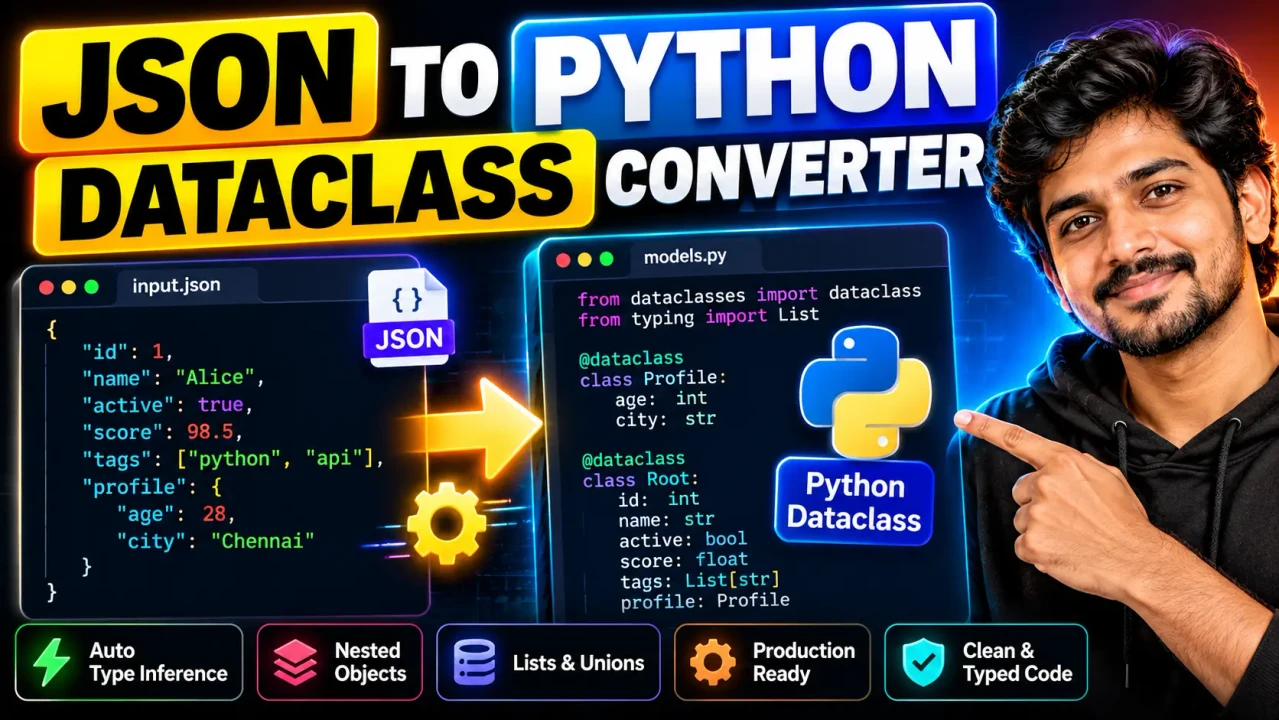
Json To Python Dataclass Generator
Quick answer: Json To Python Dataclass Generator is a developer utility concept for converting JSON objects into Python dataclass definitions. It helps Python developers create structured classes from JSON data, using Python type annotations and the @dataclass decorator. The exact supported options and processing behavior depend on the tool's implementation.
Python dataclasses provide a convenient way to represent structured data without manually writing repetitive initialization methods. When working with JSON APIs, configuration files, webhooks, or exported datasets, developers often need Python classes that describe the fields and value types in incoming JSON objects.
The Json To Python Dataclass Generator is intended to bridge that gap by turning a representative JSON object into a Python class structure. Instead of writing every field declaration manually, developers can use the generated definitions as a starting point for typed data models.
Key Takeaways
- Input: A JSON object containing representative field names and values.
- Output: Python dataclass source code, when supported by the implementation.
- Primary technology: Python's
dataclassesmodule and type annotations.- Typical use cases: API response models, configuration objects, and structured application data.
How to Use Json To Python Dataclass Generator?
- Prepare JSON: Start with a valid JSON object that includes the fields you want to model.
- Enter the input: Paste the JSON into the tool's input area, if provided.
- Generate the model: Run the conversion using the available controls.
- Review the output: Check the generated Python fields and annotations before using them in your project.
What JSON Should You Enter?
Use a representative JSON object with realistic values. JSON values provide clues about the corresponding Python types. For example, a string value suggests str, an integer suggests int, a decimal number suggests float, a Boolean suggests bool, an array suggests list, and an object suggests a nested data structure.
JSON itself does not define a separate integer and floating-point type system as Python does. A generator must interpret numeric values and choose appropriate Python annotations. If a field contains null, the intended Python annotation may need to allow None.
JSON to Python Dataclass Example
Consider this example JSON object representing a user profile.
Input JSON
{
  "id": 42,
  "name": "Avery",
  "email": "avery@example.com",
  "is_active": true,
  "score": 98.5
}
Illustrative Python Output
from dataclasses import dataclass

@dataclass
class User:
    id: int
    name: str
    email: str
    is_active: bool
    score: float
This is an illustrative mapping, not a verified capture of the tool's actual output. The class uses Python annotations to describe each field and @dataclass to generate common methods such as an initializer.
Using the Generated Dataclass
user = User(
    id=42,
    name="Avery",
    email="avery@example.com",
    is_active=True,
    score=98.5
)

print(user.name)
print(user.is_active)
One important distinction is that a dataclass declaration does not automatically parse JSON text into an instance. A JSON decoder, an explicit mapping step, or an appropriate serialization library is still needed to create an object from a JSON string.
JSON Value to Python Dataclass Type Mapping
The following table describes common type decisions when designing a JSON-to-dataclass converter. It represents conventional mappings, not a confirmed list of implementation-specific generator rules.
| JSON value or structure | Typical Python annotation | Implementation consideration |
|---|---|---|
"hello" |
str |
JSON strings map naturally to Python strings. |
42 |
int |
Preserve integer values when possible. |
98.5 |
float |
Decimal JSON numbers are commonly represented as floats. |
true or false |
bool |
Python Boolean values use capitalized names, True and False. |
null |
None or str | None, depending on context |
Python annotations should express whether a field can be absent or null. |
[1, 2, 3] |
list[int] |
Array element types should be inferred from representative values. |
{"city": "Austin"} |
A nested dataclass | Nested objects can be represented by separate classes. |
[] |
list[object] or a more specific annotation |
An empty array provides no evidence about its element type. |
{} |
A nested class cannot be meaningfully inferred from fields | An empty object contains no field names to model. |
How JSON-to-Dataclass Conversion Works
A JSON-to-dataclass conversion process generally follows these steps:
- Parse the JSON: Validate the input and obtain Python values from the JSON structure.
- Inspect field values: Identify keys, primitive values, arrays, nested objects, and nulls.
- Choose annotations: Map observed values to Python types, with additional rules for collections and nullable fields.
- Build class definitions: Produce Python source code containing imports, dataclass decorators, class names, and field annotations.
- Review the generated model: Resolve ambiguities that cannot be determined from one JSON sample.
Python's official dataclasses documentation explains the behavior of the decorator and its supported options. The Python JSON documentation describes how JSON values are decoded into Python objects.
Nested Objects, Optional Fields, and Arrays
Real API responses frequently contain nested objects and arrays. A generator must decide whether nested JSON objects become dedicated dataclasses, generic dictionaries, or another representation.
For example, consider:
{
  "id": 7,
  "name": "Morgan",
  "address": {
    "city": "Austin",
    "postal_code": "78701"
  },
  "tags": ["python", "api"]
}
A possible design uses a separate Address dataclass and a User dataclass that references it. The tags field could use list[str]. These choices improve readability but depend on the generator's actual implementation.
Optionality requires particular care. A field containing JSON null is not necessarily the same as a field that is missing from an object. Likewise, a field may be absent from one API response but present in another. A single sample cannot reliably reveal every field's required status.
Technical Edge Cases and Limitations
- Invalid JSON: Malformed syntax must be corrected before a standard JSON parser can decode it.
- Inconsistent field types: A field containing an integer in one record and a string in another may need a union annotation or data normalization.
- Empty arrays: No element type can be inferred from an empty list alone.
- Null values: A null sample does not establish the intended non-null type of a field.
- Nested structures: Deeply nested objects may require several classes and careful class naming.
- Python identifiers: JSON keys may contain spaces, hyphens, or reserved words that need special handling in generated Python code.
- Runtime validation: Dataclass annotations do not automatically enforce value types when instances are created.
- JSON decoding: Generated class definitions alone do not guarantee automatic conversion of nested dictionaries into dataclass instances.
Supported Behavior and Implementation-Dependent Features
Standard Python supports dataclass definitions, annotated fields, and generated methods. However, the supplied tool information does not establish whether this particular generator supports configurable class names, nested-class generation, optional-type inference, arrays of mixed types, custom imports, Python-version selection, or downloadable output.
Review the generated source code before incorporating it into production applications. For complicated API schemas, use representative examples from multiple responses and verify that the resulting annotations reflect the full data contract.
Frequently Asked Questions
Can JSON be converted directly into a Python dataclass?
JSON can be used to infer a dataclass structure, but a class declaration is not itself a JSON parser. Creating an instance generally requires decoding the JSON and mapping the resulting values to the dataclass fields.
How are JSON null values represented in Python dataclasses?
JSON null decodes to Python None. A field that permits null values can use an annotation such as str | None in Python 3.10 and later. The correct annotation depends on the field's intended data contract.
Can a JSON object contain nested Python dataclasses?
Yes. Nested JSON objects can be represented by separate dataclass definitions and referenced from parent classes. Converting nested dictionaries into instances requires suitable mapping or deserialization logic.
Does a Python dataclass validate field types automatically?
No. Python type annotations and dataclass declarations do not provide automatic runtime type enforcement. Additional validation logic or a validation library is needed when strict checking is required.
What happens when a JSON array is empty?
An empty array does not reveal its element type. A converter may choose a generic annotation or require additional information to determine the intended collection type.
Which Python versions support dataclasses?
The standard dataclasses module was introduced in Python 3.7. Type-annotation syntax varies by Python version, so generated code should be checked against the project's target runtime.
Author
Author Name: Jordan Mitchell
Author Description: Software Developer specializing in Python programming, data modeling, and developer utilities.
Technical Review: The technical explanation covers conventional JSON value mappings, Python dataclass declarations, and the distinction between type annotations and runtime deserialization. Tool-specific behavior should be confirmed against the deployed implementation.