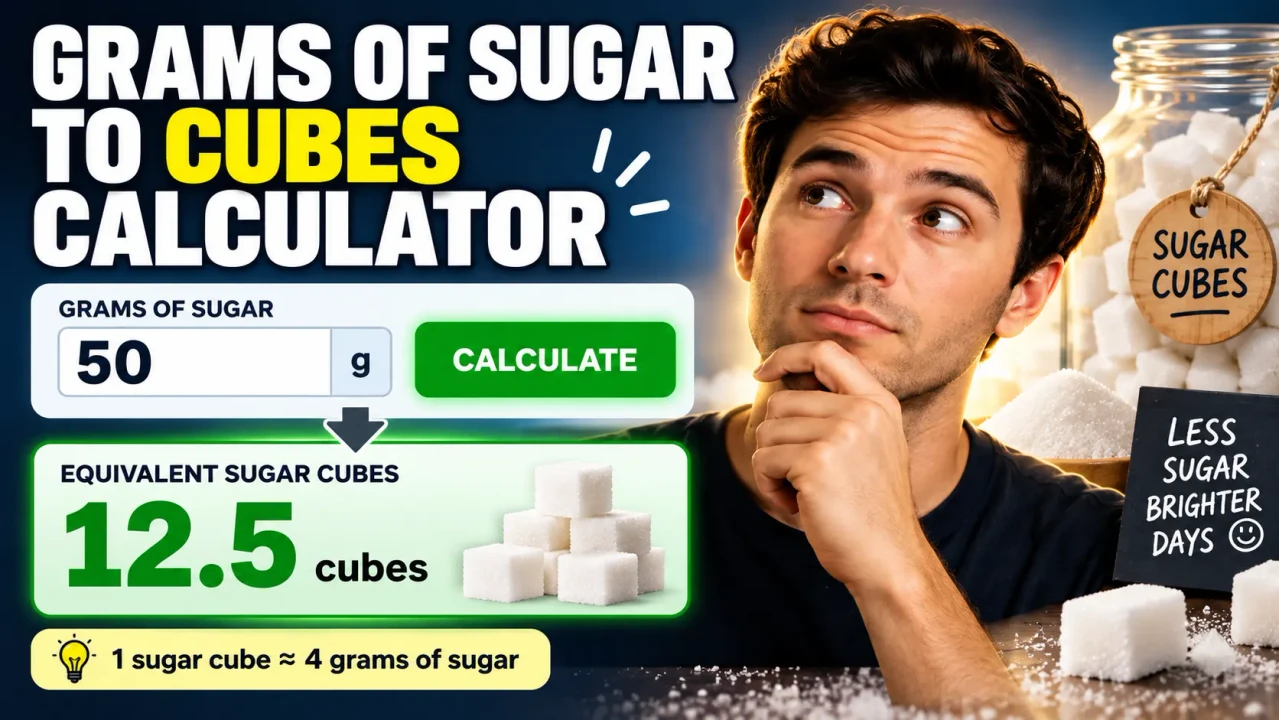
Grams Of Sugar To Cubes Calculator
Quick answer: The Grams Of Sugar To Cubes Calculator converts a quantity of sugar measured in grams into an estimated number of sugar cubes. It uses the assumed weight of one sugar cube to calculate how many cubes represent the specified amount of sugar.
Grams Of Sugar To Cubes Calculator is a unit-based food measurement calculator designed to make sugar quantities easier to visualize. Instead of interpreting a nutrition label that lists sugar in grams, users can estimate the equivalent number of individual sugar cubes. This can help when comparing food labels, understanding sugar quantities in drinks, planning recipes, or explaining nutrition information.
The result depends on the weight assigned to one sugar cube. Since sugar cubes are available in different sizes, there is no single universal conversion from grams to cubes. A calculation that assumes 4 grams per cube will produce a different result from one that assumes 3 grams or 5 grams per cube. Users should therefore treat the output as an estimate unless the cube weight is known.
Key Takeaways
- Input: Sugar quantity in grams.
- Conversion factor: Assumed weight of one sugar cube, expressed in grams.
- Output: Estimated number of sugar cubes.
- Common illustration: 4 grams of sugar per cube.
- Best suited for: Nutrition awareness, food-label interpretation, beverage comparisons, and recipe measurements.
How to Use Grams Of Sugar To Cubes Calculator?
- Enter the sugar quantity. Input the number of grams shown on a nutrition label, recipe, or food measurement.
- Set the cube weight if supported. Use the actual weight of an individual sugar cube when known. If the calculator uses a fixed conversion factor, check the stated assumption.
- Calculate the equivalent. Run the calculator to convert the gram value into a cube estimate.
- Interpret the result. Use the number to visualize the amount of sugar, keeping in mind that actual cube sizes can vary.
What does the input mean?
The gram value represents the mass of sugar being evaluated. It may come from a serving of a packaged food, a drink, a recipe, or another measured quantity. Make sure the value refers to sugar rather than the total weight of the food or beverage.
The sugar-cube weight is the conversion factor. If the calculator exposes this as an input, enter the approximate mass of one cube in grams. If the tool does not expose it, the displayed result will depend on the conversion factor built into its implementation.
What does the output mean?
The output represents the calculated number of sugar-cube equivalents, not necessarily the number of whole cubes someone would physically place in a container. Decimal results can represent a fraction of a cube. Whether the tool rounds the result or displays decimal places depends on its implementation.
Grams to Sugar Cubes: Formula and Worked Example
The mathematical conversion is straightforward when the mass of one cube is known:
Number of sugar cubes = Total sugar in grams ÷ Grams per sugar cube
- Total sugar in grams (G): The quantity being converted.
- Grams per sugar cube (C): The assumed or measured mass of one cube.
- Number of sugar cubes (N): The resulting cube equivalent.
In equation form:
N = G ÷ C
For example, suppose a drink contains 24 grams of sugar and one sugar cube is assumed to weigh 4 grams:
- Total sugar: 24 g
- Assumed cube weight: 4 g per cube
- Calculation: 24 ÷ 4 = 6
- Result: Approximately 6 sugar cubes.
This example demonstrates the conversion method, not a verified default setting of the live calculator. The actual output should be interpreted using the conversion factor configured in the tool.
Grams of Sugar to Cubes Reference Table
The following reference table uses an illustrative cube weight of 4 grams. Results are exact for that assumption before rounding; they may differ if a different cube size is used.
| Sugar quantity | Calculation | Equivalent sugar cubes |
|---|---|---|
| 4 g | 4 ÷ 4 | 1 cube |
| 8 g | 8 ÷ 4 | 2 cubes |
| 12 g | 12 ÷ 4 | 3 cubes |
| 16 g | 16 ÷ 4 | 4 cubes |
| 20 g | 20 ÷ 4 | 5 cubes |
| 24 g | 24 ÷ 4 | 6 cubes |
| 32 g | 32 ÷ 4 | 8 cubes |
| 40 g | 40 ÷ 4 | 10 cubes |
| 50 g | 50 ÷ 4 | 12.5 cubes |
How cube size changes the result
| Sugar quantity | At 3 g per cube | At 4 g per cube | At 5 g per cube |
|---|---|---|---|
| 12 g | 4 cubes | 3 cubes | 2.4 cubes |
| 20 g | 6.67 cubes | 5 cubes | 4 cubes |
| 30 g | 10 cubes | 7.5 cubes | 6 cubes |
| 40 g | 13.33 cubes | 10 cubes | 8 cubes |
These are mathematical comparisons based on three stated assumptions, not a claim that all sugar cubes have these weights. For the most useful estimate, weigh a representative cube or check the manufacturer's product information when available.
How the Grams Of Sugar To Cubes Calculator Works
The calculator applies a mass ratio. It divides the total sugar mass by the assumed mass of one cube, keeping the units consistent in grams. Because grams appear in both the numerator and denominator, the units cancel and the result is a dimensionless count of cube equivalents.
For example, dividing 18 grams by 4 grams per cube gives 4.5 cube equivalents. The result does not mean that the sugar must be packaged into exactly four and a half physical cubes. It means the total sugar mass is equivalent to four full cubes plus half the mass of another cube under the chosen assumption.
Rounding and decimal results
Rounding should be considered separately from the underlying calculation. If a calculator displays whole numbers, a result such as 4.5 may be rounded according to its configured rule. If it displays decimals, the value preserves more information about the calculated mass ratio. Do not assume a specific rounding method unless the tool indicates one.
Technical Edge Cases and Limitations
| Situation | Mathematical interpretation | What to check |
|---|---|---|
| Zero grams | Zero cube equivalents | Confirm the calculator accepts zero as a valid input. |
| Less than one cube | A fractional cube equivalent | Check whether decimal output is displayed. |
| Non-multiple of cube weight | A decimal result | Check the tool's rounding or display rules. |
| Different cube sizes | The result changes with cube weight | Use the correct mass per cube. |
| Negative grams | Not a meaningful physical sugar quantity | Use a non-negative input. |
| Missing or zero cube weight | The division is undefined when the divisor is zero | Use a positive cube weight if configurable. |
| Nutrition-label serving sizes | The conversion applies to the entered quantity | Distinguish per-serving sugar from the entire package. |
Important limitations
- Cube weight varies: Different brands and cube styles can have different masses, so the conversion factor matters.
- Nutrition labels report mass: Sugar-cube equivalents are a visualization aid and do not replace the original gram value.
- Total sugars are not always added sugar: Nutrition labels may include naturally occurring sugars as well as added sugars, depending on the product and labeling rules.
- Serving size matters: A result is only meaningful when the input matches the serving or quantity being evaluated.
- Implementation details may differ: The exact default cube weight, accepted input range, error messages, and rounding behavior must be confirmed from the live calculator.
Nutrition disclaimer: This calculator estimates physical sugar-cube equivalents from a stated mass. It does not determine whether a food is healthy, diagnose a condition, or provide an individualized dietary recommendation. For nutrition-label interpretation, consult the relevant national food-labeling authority or a qualified nutrition professional.
Author and Technical Review
Author: Daniel Brooks, Food Measurement and Nutrition Data Specialist.
Author Description: Daniel Brooks focuses on food measurement concepts, unit conversions, and clear explanations of nutrition-label data for consumer-facing calculators.
Technical Review: The conversion methodology is based on dividing the entered sugar mass by the assumed mass of one sugar cube. The live calculator's specific defaults, validation behavior, and rounding settings should be checked against its implementation before those details are documented as verified.
Reference: For authoritative context on sugar information on food labels, see the U.S. Food and Drug Administration's Added Sugars on the Nutrition Facts Label.