
Gsm To Ounces Per Square Yard
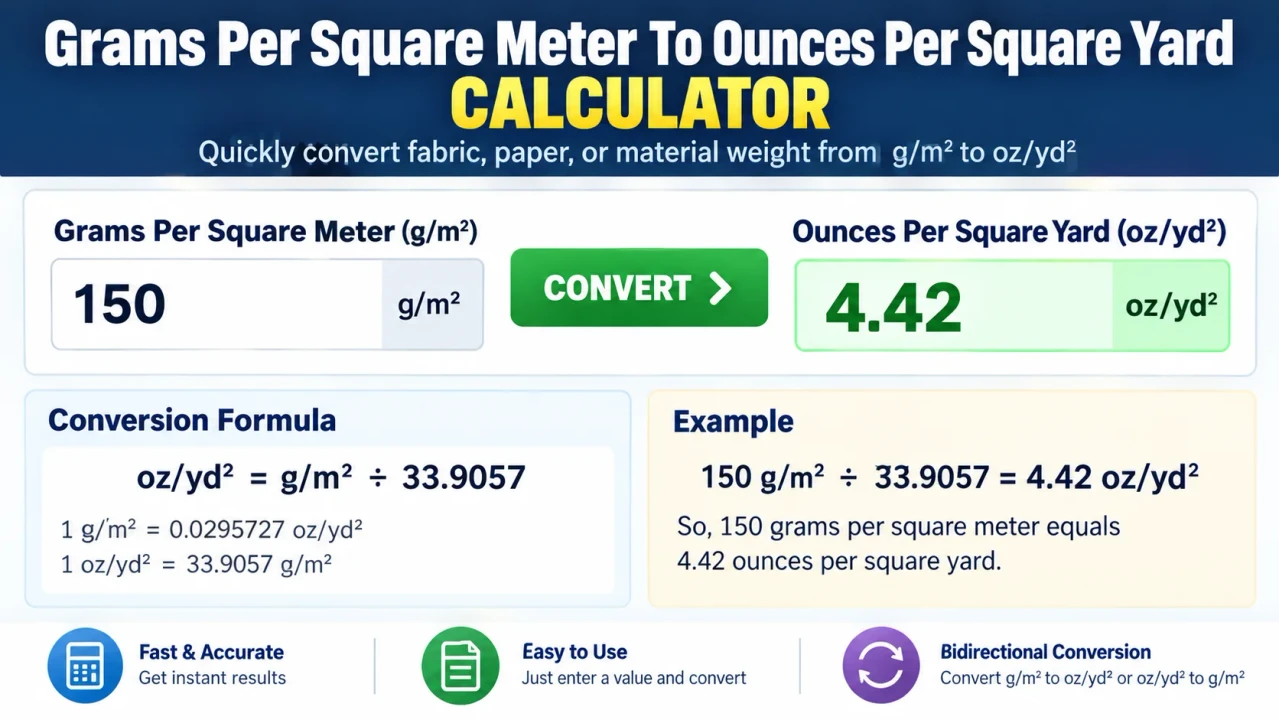
Quick answer: GSM to Ounces Per Square Yard is a unit conversion calculator that converts fabric weight from grams per square metre (GSM or g/m²) into ounces per square yard (oz/yd²). It helps textile buyers, garment manufacturers, designers, and fabric suppliers compare material specifications expressed in metric and imperial units.
Grams per square metre measures the mass of a material spread over one square metre. Ounces per square yard expresses the same areal density using square yards and avoirdupois ounces. Both measurements describe mass per unit area, making them directly convertible without knowing the fabric's roll width.
The conversion is especially useful when comparing fabric specifications from international suppliers, reviewing denim weights, selecting canvas, evaluating knitted jersey, or translating textile product descriptions for different markets. For example, a fabric rated at 200 GSM has an areal weight of approximately 5.90 oz/yd².
TL;DR / Key Takeaways
- Input: Fabric or material weight in GSM (g/m²).
- Output: Equivalent areal weight in oz/yd².
- Conversion formula: Divide GSM by approximately 33.9057.
- Reverse conversion: Multiply oz/yd² by approximately 33.9057 to obtain GSM.
- Important distinction: Ounces per square yard is not the same as ounces per linear yard.
How to Use Gsm To Ounces Per Square Yard?
- Enter the GSM value: Type the known material weight in grams per square metre, such as 180, 200, or 400.
- Calculate the conversion: Apply the conversion formula to translate the metric areal density into ounces per square yard.
- Read the result: Interpret the converted value as the number of ounces of material per square yard.
- Use the appropriate precision: Retain sufficient decimal places for specifications and round only when preparing a product listing or comparison.
The exact input controls, calculation triggers, decimal settings, and export options depend on the implemented calculator interface. The mathematical conversion below defines the expected relationship between the units.
Input and Output Example
Suppose a textile supplier lists a cotton jersey fabric with a weight of 180 GSM. A buyer who needs the equivalent value in ounces per square yard can calculate it as follows.
Input: 180 g/m²
Calculation: 180 ÷ 33.90574747 ≈ 5.309
Output: Approximately 5.31 oz/yd²
This result allows the buyer to compare areal-weight specifications across supplier catalogues. It does not, by itself, establish the fabric's softness, thickness, strength, opacity, or durability.
GSM to Ounces Per Square Yard Formula
The standard conversion is:
oz/yd² = GSM ÷ 33.90574747
The reverse formula is:
GSM = oz/yd² × 33.90574747
The factor follows from the relationship between the international yard, the square yard, and the avoirdupois ounce:
- 1 international yard = 0.9144 metres.
- 1 square yard = 0.83612736 square metres.
- 1 avoirdupois ounce = 28.349523125 grams.
- 1 oz/yd² ≈ 33.90574747 g/m².
Therefore, one gram per square metre is approximately 0.02949352468 ounces per square yard. Dividing by 33.90574747 and multiplying by 0.02949352468 are equivalent conversion methods, subject to rounding.
GSM to Ounces Per Square Yard Reference Table
The following table provides useful reference values for common fabric and material weights. Results are rounded to two decimal places for practical comparison.
| GSM (g/m²) | Ounces per Square Yard (oz/yd²) | Example Application |
|---|---|---|
| 50 | 1.47 | Very lightweight textile material |
| 80 | 2.36 | Lightweight lining or fabric |
| 100 | 2.95 | Lightweight fabric |
| 140 | 4.13 | Light to medium fabric |
| 160 | 4.72 | Lightweight jersey |
| 180 | 5.31 | T-shirt jersey |
| 200 | 5.90 | Medium-weight fabric |
| 250 | 7.37 | Heavier knit or woven fabric |
| 300 | 8.85 | Heavy jersey, fleece, or canvas |
| 400 | 11.80 | Heavy fabric or denim |
| 500 | 14.75 | Heavy denim or industrial textile |
| 600 | 17.70 | Very heavy textile material |
These application labels are illustrative, not universal textile classifications. The same GSM value can describe fabrics with very different constructions, fibres, finishes, and end uses.
Understanding GSM and oz/yd²
What does GSM mean?
GSM stands for grams per square metre. It is the mass, in grams, of a material occupying one square metre of area. The notation g/m² expresses the same unit. A higher GSM indicates more mass per unit area, but it does not necessarily mean the fabric is thicker or stronger.
What does oz/yd² mean?
Ounces per square yard is an areal mass measurement. It describes how many avoirdupois ounces of material correspond to one square yard of surface area. It is commonly encountered in fabric specifications and denim weight descriptions.
Why does the conversion factor equal approximately 33.9057?
A square yard covers 0.83612736 square metres, while an avoirdupois ounce equals 28.349523125 grams. Dividing the ounce's mass in grams by the square yard's area in square metres gives approximately 33.90574747 grams per square metre for every one ounce per square yard.
For an authoritative unit reference, see the NIST Guide for the Use of the International System of Units, which includes conversion factors for mass per area.
Technical Reference: Common Conversions
| Conversion | Formula | Example |
|---|---|---|
| GSM to oz/yd² | GSM ÷ 33.90574747 | 200 GSM ≈ 5.90 oz/yd² |
| oz/yd² to GSM | oz/yd² × 33.90574747 | 10 oz/yd² ≈ 339.06 GSM |
| GSM to oz/yd² using a multiplier | GSM × 0.02949352468 | 300 GSM ≈ 8.85 oz/yd² |
| oz/yd² to GSM using a reciprocal | oz/yd² ÷ 0.02949352468 | 12 oz/yd² ≈ 406.87 GSM |
How the Conversion Works
The conversion changes the units of both mass and area while preserving the underlying areal density. It does not measure a physical fabric sample or estimate its construction. When the GSM value is already known, no sample dimensions are required.
- Start with the material's mass per square metre.
- Divide that number by approximately 33.90574747.
- Express the resulting value in ounces per square yard.
- Round the displayed value according to the precision required by the specification.
For instance, a 400 GSM material converts to approximately 11.80 oz/yd². If the source measurement is itself rounded or uncertain, displaying additional decimal places does not increase the accuracy of the original measurement.
Edge Cases and Limitations
Zero and negative values
A zero GSM value mathematically converts to zero oz/yd². Negative values produce negative areal mass, which is not physically meaningful for ordinary fabric specifications and should be reviewed before use.
Very small or large values
The conversion factor remains the same across ordinary positive values. However, unusually small or large inputs may require additional care with display precision, input validation, and the material's actual measurement context.
Rounding differences
Different calculators may display slightly different final digits because they use different numbers of decimal places for the conversion factor or output rounding. For consistent purchasing specifications, agree on a common factor and rounding convention.
Ounces per linear yard versus ounces per square yard
These are different measurements. Ounces per linear yard describes the mass of a length of fabric, so the fabric width is needed to relate that value to areal density. Ounces per square yard already includes the area denominator and can be converted directly to GSM.
Fabric weight versus fabric performance
GSM and oz/yd² quantify areal mass, not thickness, density through the material, tear strength, drape, warmth, or durability. Fibre composition, weave or knit structure, yarn size, finishing, and moisture conditions can all affect performance.
Technical Disclaimer: This conversion provides a unit-equivalent value, not a laboratory measurement or product-quality assessment. For regulated or contractual textile specifications, use the applicable test method, documented sample conditions, and agreed rounding requirements.
Frequently Asked Questions
What is the formula for converting GSM to oz/yd²?
Divide GSM by approximately 33.90574747. For example, 200 GSM is approximately 5.90 oz/yd².
How many GSM are in one ounce per square yard?
One ounce per square yard is approximately 33.9057 GSM, or 33.9057 grams per square metre.
What is 300 GSM in ounces per square yard?
300 GSM is approximately 8.85 oz/yd², calculated by dividing 300 by 33.90574747.
Is GSM the same as ounces per square yard?
No. Both measure mass per unit area, but they use different units. GSM uses grams and square metres; oz/yd² uses avoirdupois ounces and square yards.
Can I convert ounces per linear yard directly to GSM?
No. You need the fabric width to determine the area represented by a linear yard. Ounces per square yard, by contrast, already describes mass per unit area.
Does a higher GSM always mean thicker or better-quality fabric?
No. Higher GSM means greater mass per unit area. Thickness and quality also depend on fibre, yarn, construction, finishing, and the intended application.
Author and Technical Review
Author Name: Michael Bennett
Author Description: Textile Measurement and Materials Specialist focused on fabric specifications, unit conversion, and material evaluation.
Technical Review: The conversion methodology is based on the relationship between grams per square metre and avoirdupois ounces per square yard. Numerical examples and reference values use the stated conversion factor and are rounded for practical readability.
