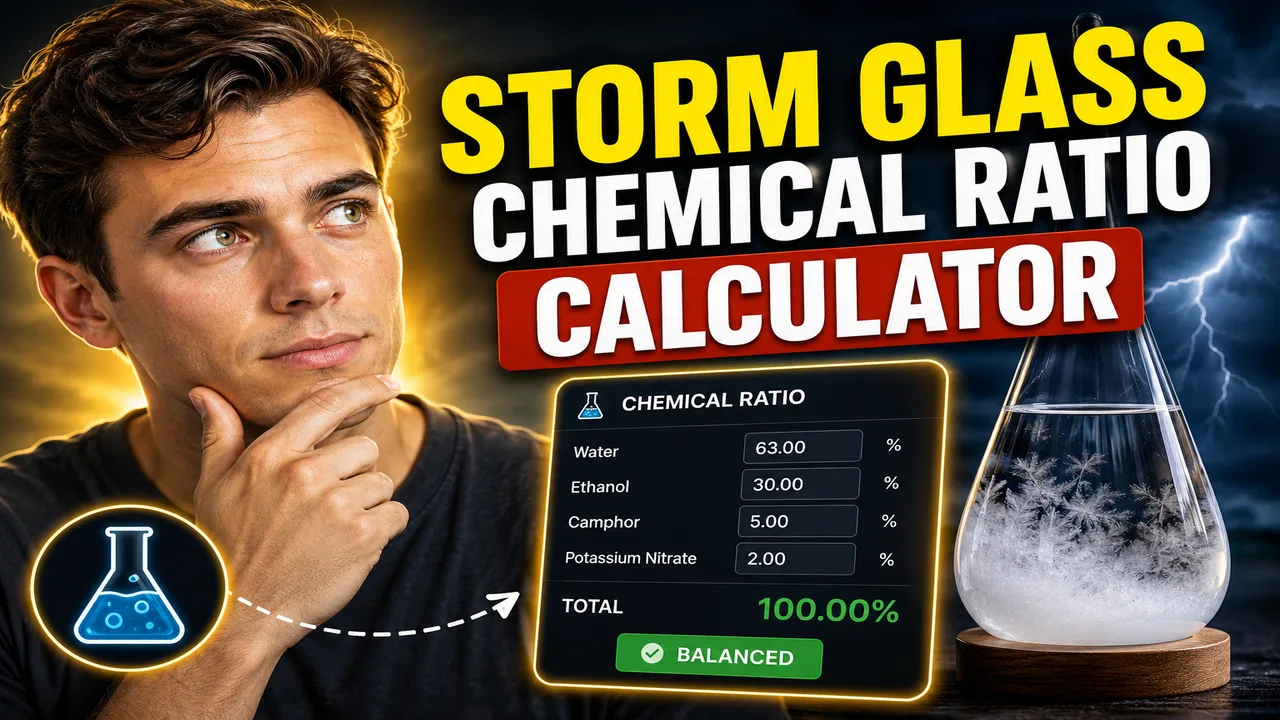
Storm Glass Chemical Ratio Calculator
Quick answer: The Storm Glass Chemical Ratio Calculator is a chemistry calculator concept for determining ingredient quantities for a storm glass mixture. A traditional formulation uses camphor, potassium nitrate, ammonium chloride, ethanol, and distilled water. The calculator can be used to plan ingredient proportions for different batch sizes when its input quantities and scaling method are defined.
A storm glass is a transparent vessel containing a chemical mixture that develops visible crystals or cloudy patterns as environmental conditions change. Historically, these changes were interpreted as signs of approaching weather. Today, storm glasses are primarily used as historical curiosities and demonstrations of crystallization and solubility.
The Storm Glass Chemical Ratio Calculator is intended to help users understand the proportions in a traditional storm glass recipe and the mathematical relationship between a reference recipe and a target batch. Its core reference is a commonly published formulation containing 2.5 g potassium nitrate, 2.5 g ammonium chloride, 10 g camphor, 33 mL distilled water, and 40 mL ethanol.
Important implementation note: The exact interface fields, calculation formula, supported units, and output behavior of the live calculator have not been provided. The examples below document a transparent proportional-scaling method that can be used for this type of calculator; they should not be interpreted as verified descriptions of the current implementation.
TL;DR / Key Takeaways
- Primary Function: Plan ingredient proportions for a storm glass mixture.
- Key Inputs: Reference quantities and a target scaling factor or batch size.
- Core Output: Proportionally scaled ingredient quantities.
- Best Suited For: Chemistry education, recipe comparisons, and crystallization demonstrations.
- Scientific Limitation: A storm glass is not a reliable standalone weather forecasting instrument.
How to Use Storm Glass Chemical Ratio Calculator?
For a ratio calculator based on proportional scaling, the general workflow is:
- Choose a reference formulation. Identify the recipe and its original quantities before changing the batch size.
- Set the target quantity. Specify the desired scale factor or the target quantity of an ingredient supported by the calculator.
- Calculate the new proportions. Apply the same multiplier to each ingredient so the original ratios remain unchanged.
- Review the results. Check the quantities, units, and rounding before using the figures in a laboratory or educational setting.
What ingredients are included in a traditional storm glass recipe?
A frequently cited formulation includes five ingredients:
- Camphor: An organic compound associated with the formation of visible crystals in the mixture.
- Potassium nitrate (KNO₃): An inorganic salt included in traditional formulations.
- Ammonium chloride (NH₄Cl): Another salt included in the reference recipe.
- Ethanol: The alcohol component used to dissolve camphor.
- Distilled water: The aqueous component used to dissolve the salts.
Published formulations vary. Ingredient quantities should therefore be treated as a specific recipe rather than a universal chemical standard. One published reference formulation lists 2.5 g each of potassium nitrate and ammonium chloride, 10 g camphor, 33 mL distilled water, and 40 mL ethanol. Read the storm glass recipe reference.
Storm Glass Chemical Ratio: Worked Example
Suppose the reference quantities are the published formulation listed above and the target is a batch scaled to 50% of the original recipe. A proportional calculator applies the same multiplier to every ingredient.
Input: Reference Formulation
| Ingredient | Reference quantity |
|---|---|
| Camphor | 10 g |
| Potassium nitrate | 2.5 g |
| Ammonium chloride | 2.5 g |
| Distilled water | 33 mL |
| Ethanol | 40 mL |
Formula
Scaled quantity = Reference quantity × Scale factor
Where:
- Reference quantity: The quantity in the selected original formulation.
- Scale factor: The target batch size divided by the reference batch size, or another explicitly selected multiplier.
- Scaled quantity: The calculated quantity for the new batch.
Calculation: 50% Batch
| Ingredient | Calculation | Scaled quantity |
|---|---|---|
| Camphor | 10 × 0.5 | 5 g |
| Potassium nitrate | 2.5 × 0.5 | 1.25 g |
| Ammonium chloride | 2.5 × 0.5 | 1.25 g |
| Distilled water | 33 × 0.5 | 16.5 mL |
| Ethanol | 40 × 0.5 | 20 mL |
These are mathematical scaling results, not a guarantee that a smaller batch will produce identical crystal patterns or performance. The physical properties of the final mixture depend on factors including ingredient purity, ethanol concentration, temperature, and preparation conditions.
Storm Glass Ingredient Ratio Reference
The following table provides the reference quantities and their proportional values at half scale. It is useful for checking a calculator's arithmetic without implying that this is the only valid storm glass formulation.
| Ingredient | Reference amount | Half-scale amount | Unit |
|---|---|---|---|
| Camphor | 10 | 5 | g |
| Potassium nitrate | 2.5 | 1.25 | g |
| Ammonium chloride | 2.5 | 1.25 | g |
| Distilled water | 33 | 16.5 | mL |
| Ethanol | 40 | 20 | mL |
How Does the Storm Glass Ratio Calculation Work?
Proportional scaling preserves the relative quantities in a reference recipe. If the batch is doubled, each ingredient quantity is multiplied by 2. If the batch is reduced to one-quarter, each ingredient quantity is multiplied by 0.25.
For a target mass of camphor, the scale factor can be expressed as:
Scale factor = Target camphor mass ÷ Reference camphor mass
For example, a target of 15 g camphor compared with a 10 g reference requires a scale factor of 15 ÷ 10 = 1.5. Applying that multiplier to the reference formulation gives 3.75 g each of potassium nitrate and ammonium chloride, 49.5 mL distilled water, and 60 mL ethanol, alongside 15 g camphor.
This approach assumes that all ingredients are scaled together. It does not calculate solubility, compensate for solvent evaporation, determine final solution volume, or guarantee that a formulation will remain clear or crystallize as expected.
Edge Cases and Calculation Limitations
- Zero or negative target: A zero scale factor produces zero quantities mathematically, while negative ingredient quantities have no practical meaning for a physical batch.
- Unit mismatch: Mass units such as grams cannot be directly substituted for volume units such as millilitres without density information and an explicit conversion method.
- Rounding: Rounding small salt quantities too aggressively can change the proportions. Preserve sufficient decimal places for the intended measurement equipment.
- Different reference recipes: Historical and modern formulations may use different proportions or solvent concentrations. Do not combine their quantities without recalculating the entire recipe.
- Solvent concentration: Ethanol and water mixtures are not interchangeable with pure ethanol on a volume-for-volume basis when solvent composition affects the formulation.
- Physical performance: Proportional scaling does not ensure equivalent crystallization, clarity, or stability in vessels of different dimensions.
Safety and Scientific Limitations
Storm glass formulations may contain flammable ethanol, camphor, potassium nitrate, and ammonium chloride. Consult the relevant safety data sheets, use suitable laboratory controls and protective equipment, keep flammable materials away from ignition sources, and avoid inhalation or ingestion. Do not heat a sealed vessel; pressure can build up and cause it to rupture. Preparation should be conducted only with appropriate chemical-safety supervision.
Storm glasses are also poor substitutes for modern weather instruments. A 2025 article in the Journal of Chemical Education describes the storm glass as a demonstration of temperature-dependent camphor crystallization and notes that its weather-prediction ability is extremely limited. Crystal formation is better understood as a response to solubility and temperature than as a dependable forecast of rain or storms. Read the Journal of Chemical Education article.
Technical Disclaimer: The displayed quantities are illustrative calculations based on a published reference formulation. They are not a validated manufacturing specification, safety certification, or weather forecast. Verify the actual calculator implementation, chemical specifications, and applicable laboratory safety requirements before using calculated values.
Frequently Asked Questions
Can the calculator scale a storm glass recipe to a different batch size?
A proportional ratio calculator can scale all reference quantities by the same multiplier. Whether the live tool supports this specific operation depends on its implemented inputs and calculation logic.
What is the standard chemical ratio for a storm glass?
There is no single universal formulation. A commonly published reference uses 10 g camphor, 2.5 g potassium nitrate, 2.5 g ammonium chloride, 33 mL distilled water, and 40 mL ethanol.
Why should every ingredient use the same scale factor?
Applying one multiplier to every ingredient preserves the reference formulation's relative proportions. Changing only one ingredient produces a different formulation rather than a simple batch-size adjustment.
Can I convert grams into millilitres directly?
No. Grams measure mass and millilitres measure volume. Converting between them requires the relevant ingredient's density and a suitable measurement model. The simple scaling formula does not perform that conversion.
Does the storm glass reliably predict storms or rain?
No. Storm glasses have not demonstrated reliable weather-prediction performance. Their crystal patterns are strongly influenced by temperature-dependent solubility and crystallization, so they should be treated as educational or decorative objects rather than forecasting instruments.
Is a mathematically correct ratio guaranteed to produce the same crystals?
No. Correct scaling preserves ingredient proportions but does not control temperature, purity, solvent concentration, nucleation, or vessel geometry. These factors can change the resulting crystal patterns.
Author: Daniel Mercer, Chemistry Education Writer specializing in practical chemistry calculations and solution preparation.
Technical Review: The ratio methodology and worked examples are based on proportional arithmetic. The live calculator's actual implementation has not been independently verified.
