
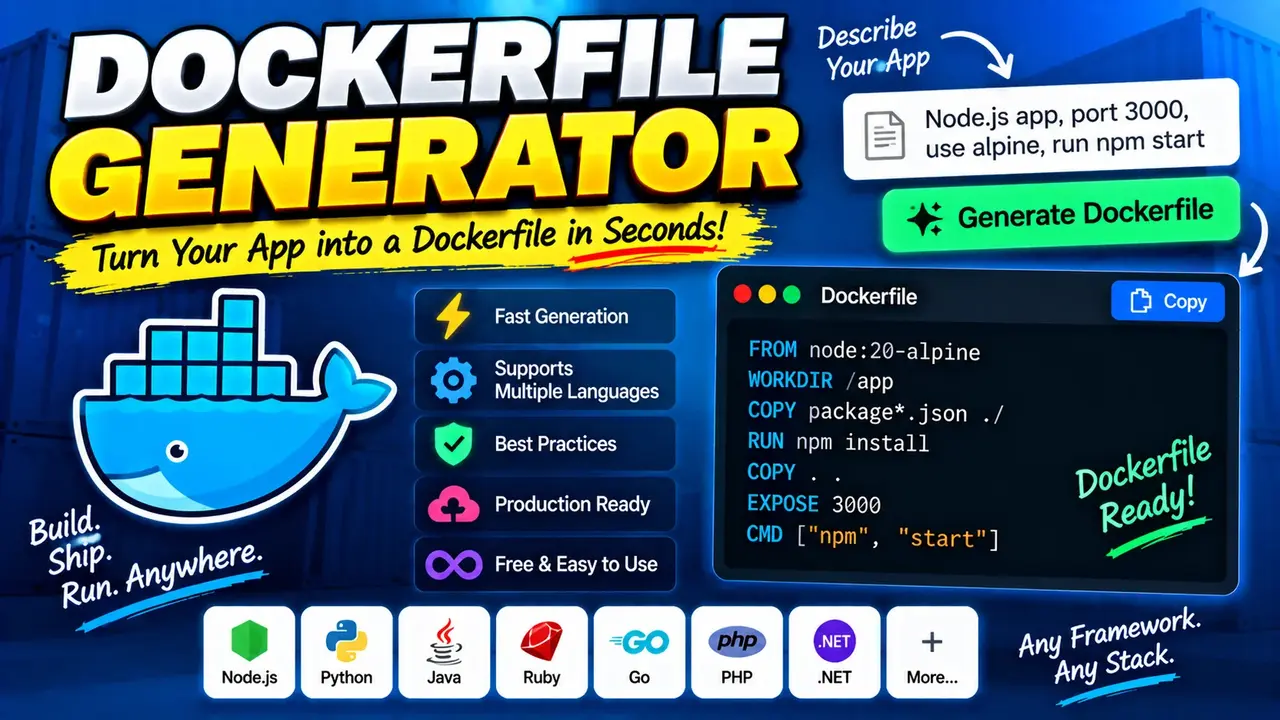
Online Dockerfile Generator - Easy Container Setup
Quick answer: The Online Dockerfile Generator - Easy Container Setup is a developer utility intended to help users create Dockerfile configuration text for packaging applications into Docker container images. A Dockerfile defines the instructions Docker uses to build an image, including the base image, application files, dependencies, configuration, and startup command. The exact input fields, supported application stacks, and generation options depend on the tool's implementation.
The Online Dockerfile Generator - Easy Container Setup is designed for developers who need a starting point for defining an application's container build process. Instead of writing every Dockerfile instruction from scratch, users can use a generator workflow to prepare a configuration and then review it before building an image.
A Dockerfile is a plain-text build specification. Docker interprets its instructions to construct an image containing an application's runtime environment and required files. The generated file is typically named Dockerfile and is used with a command such as docker build.
Key Takeaways
- Primary purpose: Prepare Dockerfile configuration text for container image builds.
- Core format: Dockerfile instructions such as
FROM,WORKDIR,COPY,RUN, andCMD.- Typical users: Application developers, DevOps engineers, students, and teams learning containerization.
- Important verification: Review the generated instructions against the application's runtime, dependency manager, build process, and deployment requirements.
How to Use Online Dockerfile Generator - Easy Container Setup?
- Open the generator: Access the tool and inspect the available fields and configuration options.
- Describe the application: Enter the requested application details, runtime, framework, dependencies, or startup configuration supported by the interface.
- Generate the Dockerfile: Use the tool's generation control to produce the configuration. The precise controls and supported inputs must be confirmed from the live implementation.
- Review the output: Check the instructions, save the result as
Dockerfileif the interface permits, and test it with Docker.
What should a Dockerfile contain?
A Dockerfile usually identifies a base image, establishes a working directory, copies application files, installs dependencies, exposes any relevant application port, and defines the default startup behavior. Not every application needs every instruction, and the correct order depends on the project's build process.
Dockerfile Input and Output Example
The following is an illustrative Dockerfile for a simple Node.js application. It demonstrates common Dockerfile syntax; it is not a verified output from this particular generator.
Example input requirements
- Application runtime: Node.js
- Dependency manifest:
package.jsonand, when applicable,package-lock.json - Application entry point:
server.js - Startup command:
npm start
Example Dockerfile output
FROM node:22-alpine

WORKDIR /app

COPY package*.json ./
RUN npm ci

COPY . .

EXPOSE 3000

CMD ["npm", "start"]
This example assumes a compatible Node.js project, a committed lockfile, and a valid start script in package.json. The port is illustrative; the application must actually listen on the corresponding port for the container to serve requests as expected.
What do the Dockerfile instructions mean?
| Instruction | Purpose | Implementation consideration |
|---|---|---|
FROM |
Selects the base image. | Choose an image compatible with the runtime and CPU architecture. |
WORKDIR |
Sets the working directory for subsequent instructions. | Use a consistent application directory, such as /app. |
COPY |
Copies files from the build context into the image. | Exclude unnecessary files with a suitable .dockerignore. |
RUN |
Executes commands while building the image. | Install dependencies using the project's actual package manager and lockfile. |
EXPOSE |
Documents the intended container listening port. | It does not publish the port to the host by itself. |
CMD |
Defines the default command used to start the container. | Use the command and arguments required by the application. |
ENTRYPOINT |
Defines the main executable for the container. | Coordinate it with CMD to avoid unexpected argument behavior. |
ENV |
Sets environment variables in the image configuration. | Do not place credentials or other secrets in image layers. |
How Does Dockerfile Generation Work?
A Dockerfile generator generally turns selected application settings into a sequence of Dockerfile instructions. The exact implementation of this tool has not been established from the supplied tool name and image URL alone, so the following describes standard Dockerfile construction principles rather than a verified description of its internal algorithm.
- Base image selection: The runtime determines which base image is appropriate, such as a Node.js, Python, Java, or operating-system image.
- Build environment setup: Instructions such as
WORKDIRestablish where subsequent commands run. - Dependency installation: A package manager installs the libraries needed by the application. Lockfiles help preserve reproducible dependency resolution.
- Application file copying: The required source files and build artifacts are added to the image.
- Runtime configuration: Instructions such as
ENV,EXPOSE,ENTRYPOINT, andCMDdescribe relevant runtime settings.
Docker processes instructions to build image layers. Instruction ordering can affect build caching: copying dependency manifests before the rest of the source code can allow the dependency-installation layer to be reused when only application files change.
Dockerfile Reference: Common Application Patterns
The correct Dockerfile structure varies by runtime and build system. This reference provides general starting points for reviewing a generated configuration; it does not establish which presets are available in this generator.
| Application pattern | Typical base image family | Build or startup consideration |
|---|---|---|
| Node.js application | node |
Use the project's package manager, lockfile, and defined start script. |
| Python application | python |
Install dependencies from the project's declared requirements or packaging configuration. |
| Java application | JDK or JRE image | Build the application artifact or copy an existing compatible JAR. |
| Compiled Go application | Go builder image and an appropriate runtime image | Compile for the target platform and copy the resulting binary into the runtime image when using a multi-stage build. |
| Static web application | Build-tool image and web-server image as appropriate | Separate asset compilation from serving when a multi-stage build suits the project. |
Edge Cases and Limitations
Missing dependency files
Instructions such as COPY package*.json ./ or RUN npm ci assume that the expected dependency files exist and that the project uses the corresponding package manager. Adjust these instructions for projects that use different manifests, workspaces, or package managers.
Incorrect ports or startup commands
A Dockerfile can build successfully but still fail at runtime if the startup command is invalid or the application listens on a different port. Verify the application's actual listening address and command before deployment.
Secrets and configuration
Do not embed API keys, passwords, tokens, or private certificates in Dockerfile instructions or copied source files. Use an appropriate runtime secret-management mechanism and review the build context to avoid including sensitive files in the image.
Build context and unnecessary files
Docker sends the selected build context to the builder. A carefully maintained .dockerignore file can exclude items such as local dependency directories, version-control metadata, temporary build outputs, and environment files that should not be included.
Architecture and version compatibility
Base image tags, native dependencies, CPU architecture, and operating-system libraries can affect whether an image builds and runs in the target environment. Test the resulting image on the intended deployment platform.
What this tool's implementation does not yet establish
- The exact application frameworks, languages, and base images supported by its interface.
- Whether it provides configurable multi-stage builds, security recommendations, or optimization options.
- Whether the output can be copied, downloaded, or exported directly.
- Whether generation runs in the browser or through a remote service.
These capabilities should be confirmed against the live tool before being described as guaranteed features.
Testing a Generated Dockerfile
After saving the configuration as Dockerfile in the intended build context, a basic verification workflow is:
docker build -t sample-app .
docker run --rm -p 3000:3000 sample-app
Replace sample-app and the port mapping with values appropriate for the project. The commands illustrate a basic build and run check; they do not guarantee that the example application or any generated configuration will work without project-specific adjustments.
For official instruction syntax and build behavior, consult the Dockerfile reference and Docker build best practices.
Author and Technical Review
Author Name: Jordan Mitchell
Author Description: Software Engineer specializing in application packaging, container-based development workflows, and developer tooling.
Technical Review: The technical explanations and examples are based on documented Dockerfile instruction semantics and general container build practices. The live generator's specific implementation and output have not been independently verified.