
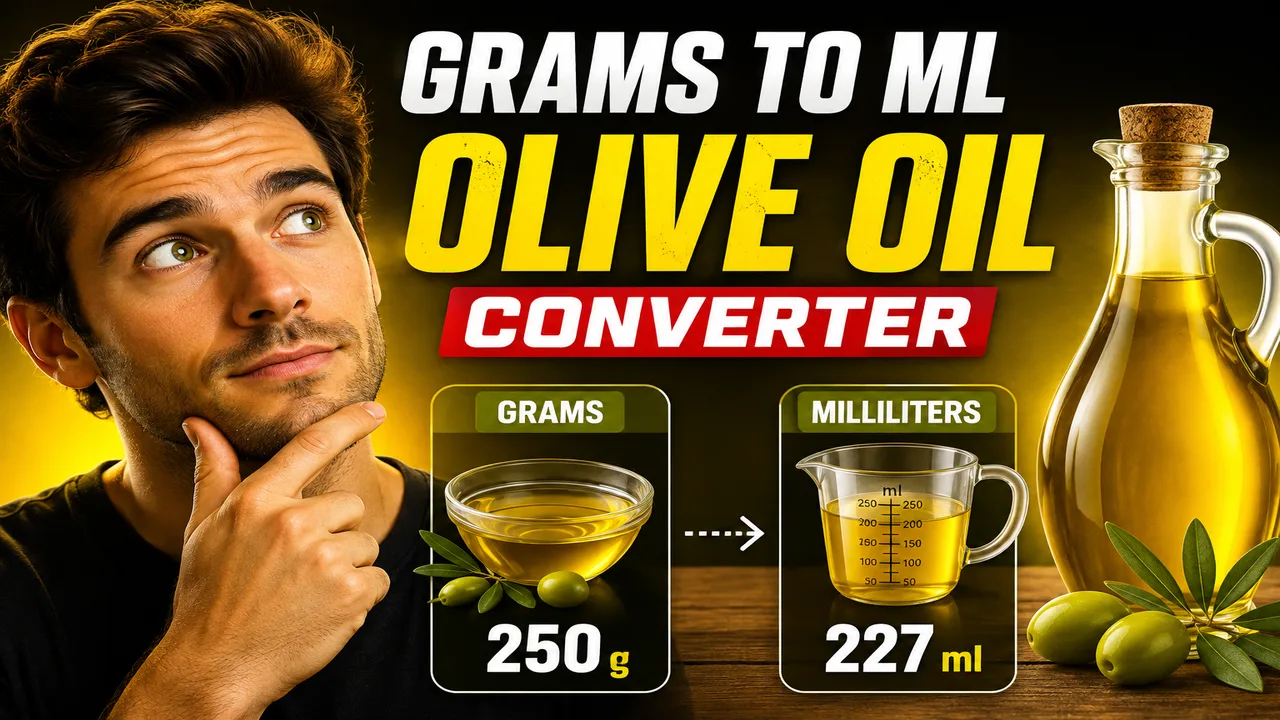
Grams To Ml Olive Oil Converter
The Grams To Ml Olive Oil Converter is a cooking measurement converter that estimates the volume of olive oil in milliliters from a weight measured in grams. It uses an assumed olive oil density of 0.91 grams per milliliter to convert weight into liquid volume, helping home cooks, bakers, and recipe developers adapt ingredient measurements.
Quick answer: To convert grams of olive oil to milliliters, divide the weight in grams by 0.91. For example, 100 grams of olive oil is approximately 109.89 ml. The result is an estimate based on the assumed density of olive oil.
Key Takeaways
- Input: Olive oil weight in grams (g).
- Output: Estimated liquid volume in milliliters (ml).
- Conversion factor: 0.91 g/ml.
- Primary use: Converting recipe weights into volume measurements.
- Important distinction: Grams measure mass, while milliliters measure volume.
How to Use Grams To Ml Olive Oil Converter?
Use the converter to translate a measured quantity of olive oil into the volume needed for a recipe. Enter the weight in grams, apply the conversion, and use the resulting milliliter value to measure the oil in a graduated measuring jug or other suitable liquid-measuring vessel.
- Enter the weight: Type the amount of olive oil in grams, such as 50 g, 100 g, or 250 g.
- Convert the measurement: Calculate the equivalent volume using the olive oil density factor.
- Read the result: The output represents the estimated milliliters of olive oil.
- Measure the oil: Use a liquid measuring container with milliliter markings to measure the converted amount.
Use a positive numeric weight for a normal cooking measurement. The actual controls, decimal precision, and error handling depend on the converter's implementation.
Grams to Milliliters Olive Oil Formula
The conversion relies on the relationship between mass, volume, and density. Density describes how much mass is contained in a given volume.
Formula:
Volume (ml) = Weight (g) ÷ Density (g/ml)
Using the assumed olive oil density of 0.91 g/ml:
Volume (ml) = Weight (g) ÷ 0.91
Where:
- Weight (g): The mass of olive oil, measured in grams.
- Density (g/ml): The assumed density of olive oil, set to 0.91 grams per milliliter.
- Volume (ml): The calculated quantity of olive oil in milliliters.
Grams to Milliliters Olive Oil Conversion Examples
For example, if a recipe requires 100 grams of olive oil, divide 100 by 0.91 to estimate the volume.
Calculation:
100 ÷ 0.91 = 109.89 ml
Result: 100 g of olive oil is approximately 109.89 ml using this conversion factor.
Likewise, 50 g corresponds to approximately 54.95 ml, while 200 g corresponds to approximately 219.78 ml. These figures are calculated estimates rather than exact measurements of every olive oil product.
Olive Oil Grams to Milliliters Reference Table
The following table provides commonly used olive oil weights and their estimated milliliter equivalents. Values are calculated using a density of 0.91 g/ml and rounded to two decimal places.
| Olive Oil Weight (g) | Estimated Volume (ml) | Calculation |
|---|---|---|
| 5 g | 5.49 ml | 5 ÷ 0.91 |
| 10 g | 10.99 ml | 10 ÷ 0.91 |
| 15 g | 16.48 ml | 15 ÷ 0.91 |
| 25 g | 27.47 ml | 25 ÷ 0.91 |
| 50 g | 54.95 ml | 50 ÷ 0.91 |
| 75 g | 82.42 ml | 75 ÷ 0.91 |
| 100 g | 109.89 ml | 100 ÷ 0.91 |
| 125 g | 137.36 ml | 125 ÷ 0.91 |
| 150 g | 164.84 ml | 150 ÷ 0.91 |
| 200 g | 219.78 ml | 200 ÷ 0.91 |
| 250 g | 274.73 ml | 250 ÷ 0.91 |
| 500 g | 549.45 ml | 500 ÷ 0.91 |
| 1000 g | 1098.90 ml | 1000 ÷ 0.91 |
How Does Olive Oil Density Affect the Conversion?
Olive oil is less dense than water under typical room-temperature conditions. This means that a given mass of olive oil occupies a larger volume than the same mass of water. For the assumed density of 0.91 g/ml, 1 gram of olive oil occupies approximately 1.0989 ml.
The relationship can also be expressed in reverse:
Weight (g) = Volume (ml) × Density (g/ml)
For example, 100 ml of olive oil at the assumed density weighs approximately 91 grams. This reverse formula is useful when a recipe specifies milliliters but a kitchen scale is available.
The density factor is an approximation. The actual density can vary with temperature and oil composition. For greater precision, use a measured density for the specific olive oil being used.
When Should You Use This Converter?
- Cooking: Convert a recipe's olive oil weight into a milliliter measurement when your measuring tools use volume.
- Baking: Translate ingredient quantities when adapting recipes that use different measurement systems.
- Meal preparation: Estimate the volume needed when portioning measured olive oil for several servings.
- Recipe scaling: Convert larger or smaller ingredient weights without manually repeating the calculation.
- Kitchen measurement: Understand the difference between the mass of olive oil and the space it occupies.
Technical Limitations and Measurement Accuracy
This converter uses a fixed density value rather than measuring the physical properties of the oil. Therefore, the result should be treated as an estimate.
- Density variation: Different oils and temperatures can produce slightly different results.
- Rounding: Displayed values rounded to two decimal places may differ slightly from unrounded calculations.
- Input validation: Empty, nonnumeric, or negative inputs are not meaningful for ordinary ingredient conversion and should be handled appropriately by the implementation.
- Ingredient specificity: This formula is intended for olive oil, not water, flour, honey, or other ingredients with different densities.
- Measurement precision: A calculated volume does not guarantee that a household measuring jug can measure that volume with equal precision.
For routine cooking, the 0.91 g/ml assumption is a practical conversion factor. When a recipe requires high measurement precision, weighing the oil directly is preferable to converting the weight into volume.
Reference Sources
For food-composition information, consult USDA FoodData Central. For technical guidance on olive oil inspection and density measurement, consult the USDA Agricultural Marketing Service.
Technical Disclaimer: The conversion provides an approximate culinary measurement based on an assumed density. It is not a laboratory measurement of a specific oil sample.
Author: Morgan Reed, Food Measurement Specialist focused on culinary unit conversions and ingredient measurement methodology.
Technical Review: The conversion methodology uses the standard mass-volume-density relationship and an assumed olive oil density of 0.91 g/ml. Individual oil density and measurement conditions may affect the actual volume.
