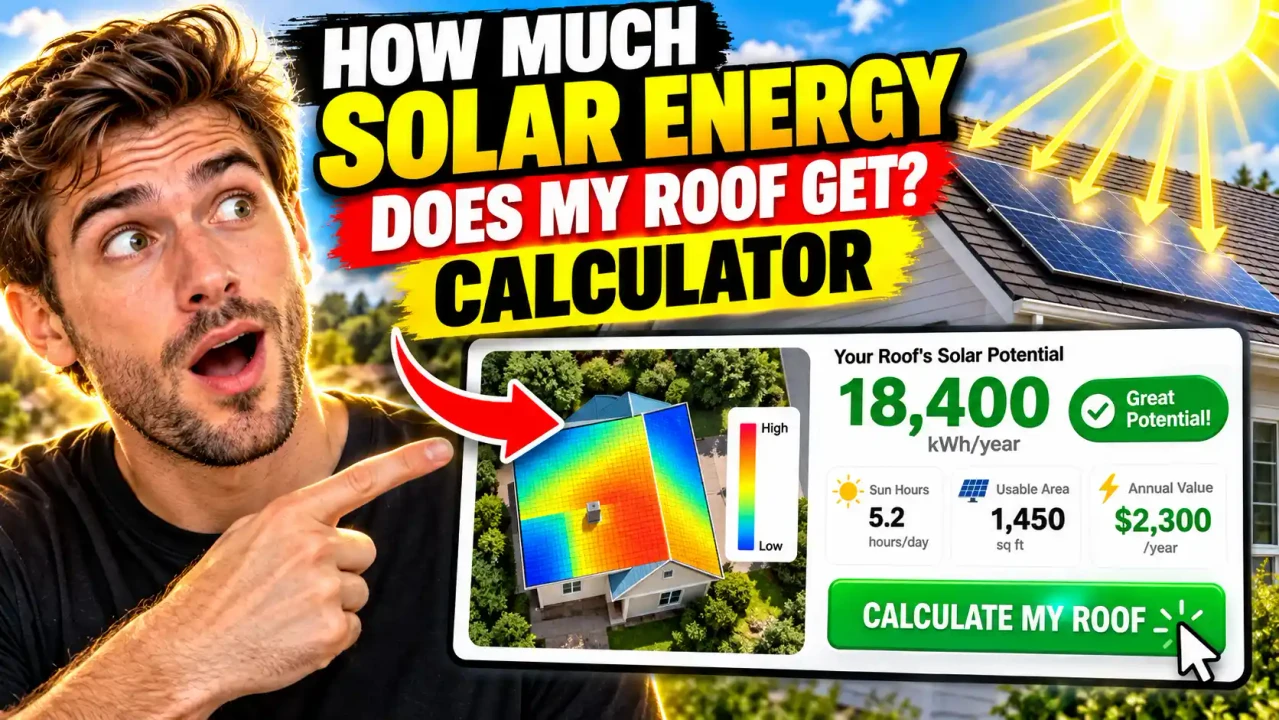
How Much Solar Energy Does My Roof Get Calculator
Quick answer: The How Much Solar Energy Does My Roof Get Calculator helps estimate the solar energy available on a roof and understand its potential for solar electricity generation. A useful estimate depends on location, roof area, orientation, tilt, shading, and solar panel system efficiency.
Wondering how much sunlight reaches your roof and whether it can support a solar power system? The How Much Solar Energy Does My Roof Get Calculator is designed to help homeowners, property owners, and solar planners evaluate rooftop solar potential before choosing an installation size.
Solar energy reaching a roof is not the same as electricity produced by solar panels. Sunlight is measured as solar irradiance or solar irradiation over time, while photovoltaic panels convert a portion of that energy into electricity. Understanding this difference helps you interpret roof solar estimates more accurately.
What Can You Learn From a Roof Solar Energy Estimate?
- Available solar energy: Approximate sunlight energy incident on a roof surface over a specified period.
- Roof suitability: How orientation, tilt, and shading may influence solar collection.
- Potential electricity generation: A preliminary estimate of how much electrical energy a suitably sized photovoltaic system might produce.
- Installation planning: Information to help determine whether a professional site assessment is worthwhile.
The exact inputs and outputs available depend on the calculator's implemented fields. No specific live calculation, satellite roof analysis, or automatic weather-data lookup is assumed here.
How to Use How Much Solar Energy Does My Roof Get Calculator?
- Identify your location. Solar availability varies with latitude, local weather, atmospheric conditions, and seasonal sun angles.
- Measure the usable roof area. Use the area of the roof section that could accommodate panels, rather than automatically counting the entire building footprint.
- Determine roof orientation and tilt. Record which direction the roof faces and its slope. These factors affect the sunlight received by a fixed panel surface.
- Account for shading. Consider trees, nearby buildings, chimneys, antennas, and other obstructions that may block sunlight during parts of the day.
- Review the estimate. Interpret the result in its stated units and time period, such as kWh per day or kWh per year.
If the calculator offers fewer inputs, use only the fields provided. Missing roof geometry, local weather, or system-efficiency data can limit the precision of the result.
Solar Energy vs. Solar Electricity
Two measurements are especially important when assessing a roof:
- Solar irradiation: Energy received per unit area over time, commonly expressed in kWh/m²/day or kWh/m²/year.
- Electrical energy generation: Electricity produced by a photovoltaic system, commonly expressed in kWh/day or kWh/year.
For example, a roof receiving 5 kWh/m²/day of solar irradiation does not automatically generate 5 kWh of electricity per square metre. Panel conversion efficiency, temperature, inverter losses, wiring, shading, and the usable panel area all affect electrical output.
Solar Roof Energy Formula and Methodology
A preliminary estimate of the solar energy incident on a roof can use the following relationship when the irradiation value represents the same roof orientation and tilt:
Incident Solar Energy = Roof Area × Solar Irradiation
Where:
- Roof Area: Usable surface area in square metres (m²).
- Solar Irradiation: Solar energy received per square metre over a stated period, in kWh/m²/day or kWh/m²/year.
- Incident Solar Energy: Solar energy reaching the selected roof surface, in kWh for that period.
To estimate electricity generated by panels, a simplified model is:
Estimated Electricity = Solar Irradiation × Panel Area × Panel Efficiency × Performance Ratio
The performance ratio represents combined real-world effects such as temperature, inverter conversion, wiring, soiling, and other system losses. Use a performance ratio consistent with the assumptions of your model; do not apply the same losses twice.
Worked Example: Estimating Daily Solar Energy
Assume a roof section has 40 m² of usable area and receives an average of 5 kWh/m²/day of solar irradiation on that surface.
| Parameter | Example value |
|---|---|
| Usable roof area | 40 m² |
| Daily solar irradiation | 5 kWh/m²/day |
| Incident solar energy | 40 × 5 = 200 kWh/day |
| Panel coverage assumption | 70% of usable area |
| Illustrative panel efficiency | 20% |
| Illustrative performance ratio | 80% |
| Estimated electricity | 200 × 0.70 × 0.20 × 0.80 = 22.4 kWh/day |
This is an illustrative calculation, not a prediction for a particular property. The assumed irradiation must match the roof surface, and actual generation can vary with weather, temperature, panel layout, and seasonal conditions.
Roof Orientation, Tilt, and Shading Reference
The table below explains how common roof conditions influence solar assessment. The effects are qualitative: their magnitude depends on the location, roof geometry, season, and time of day.
| Factor | Effect on solar potential | Assessment guidance |
|---|---|---|
| Roof orientation | Changes the timing and amount of sunlight received. | Record the direction faced by the roof or panel surface. |
| Roof tilt | Changes the angle at which sunlight reaches the surface. | Use the actual roof slope when available. |
| Partial shading | Reduces direct sunlight and may affect connected panel output. | Identify obstruction locations and the hours they cast shadows. |
| Usable area | Limits the area available for installing modules. | Exclude unsuitable sections and allow for setbacks and access. |
| Local climate | Clouds, dust, humidity, and seasonal weather affect available sunlight. | Use representative local solar-resource data when possible. |
| Panel efficiency | Determines the fraction of incident solar energy converted under specified conditions. | Use the module's rated efficiency, while allowing for operating conditions. |
| System losses | Reduce delivered electricity relative to ideal conversion. | Account for temperature, inverter, wiring, soiling, and other applicable losses. |
How Roof Solar Estimates Work
A more detailed assessment combines solar-resource information with the physical characteristics of the roof and the proposed photovoltaic system. For example, the U.S. Department of Energy's National Renewable Energy Laboratory provides the PVWatts Calculator to estimate electricity production from grid-connected photovoltaic systems using location and system-design inputs.
PVWatts also cautions that estimates contain assumptions and uncertainty. Its rooftop size-estimation method does not automatically account for roof tilt, azimuth, or shading in every calculation. A roof-area estimate alone should therefore not be treated as a detailed solar engineering assessment.
For additional information, consult the official PVWatts Calculator and the PVWatts Version 8 technical documentation.
Edge Cases and Limitations
- Missing location: Without a location or representative solar-resource value, a location-specific estimate cannot be established reliably.
- Incorrect units: Do not multiply roof area in square feet directly by irradiation in kWh/m²/day. Convert the area to square metres first.
- Unusable roof space: Roof area includes sections that may not be suitable for panels. Vents, access paths, structural restrictions, and setbacks reduce practical installation space.
- Changing shadows: A roof that receives direct sunlight at noon may still be shaded during the morning or afternoon.
- Seasonal variation: Daily solar availability is not constant throughout the year. Annual estimates should account for seasonal weather and sun angles.
- Confusing energy and power: kW measures power, while kWh measures energy produced or consumed over time.
- Unverified assumptions: An estimate based on assumed efficiency or losses may differ from measured system performance.
Technical Disclaimer
This calculator is intended for preliminary rooftop solar assessment. Estimates should not replace a professional evaluation of structural capacity, electrical design, local regulations, grid interconnection requirements, or site-specific shading. Confirm equipment specifications and expected production with a qualified solar professional before making installation or financial decisions.
Author Information
Author Name: Michael Anderson
Author Description: Renewable Energy Systems Writer focused on photovoltaic fundamentals, rooftop solar planning, energy calculations, and practical interpretation of solar-resource estimates.
Technical Review: This content explains the distinction between incident solar energy and photovoltaic electricity generation, defines the simplified estimation formulas, and identifies key assumptions and limitations. The page does not claim independent verification of the calculator's implementation.