
Solar Panel Efficiency Degradation Calculator
Estimate solar panel power loss over time using rated wattage, annual degradation, and years. Calculate retained capacity and compare long-term output.
Please complete this field to continue.
Please complete this field to continue.
Please complete this field to continue.
Results
Solar Panel Efficiency Degradation Calculator
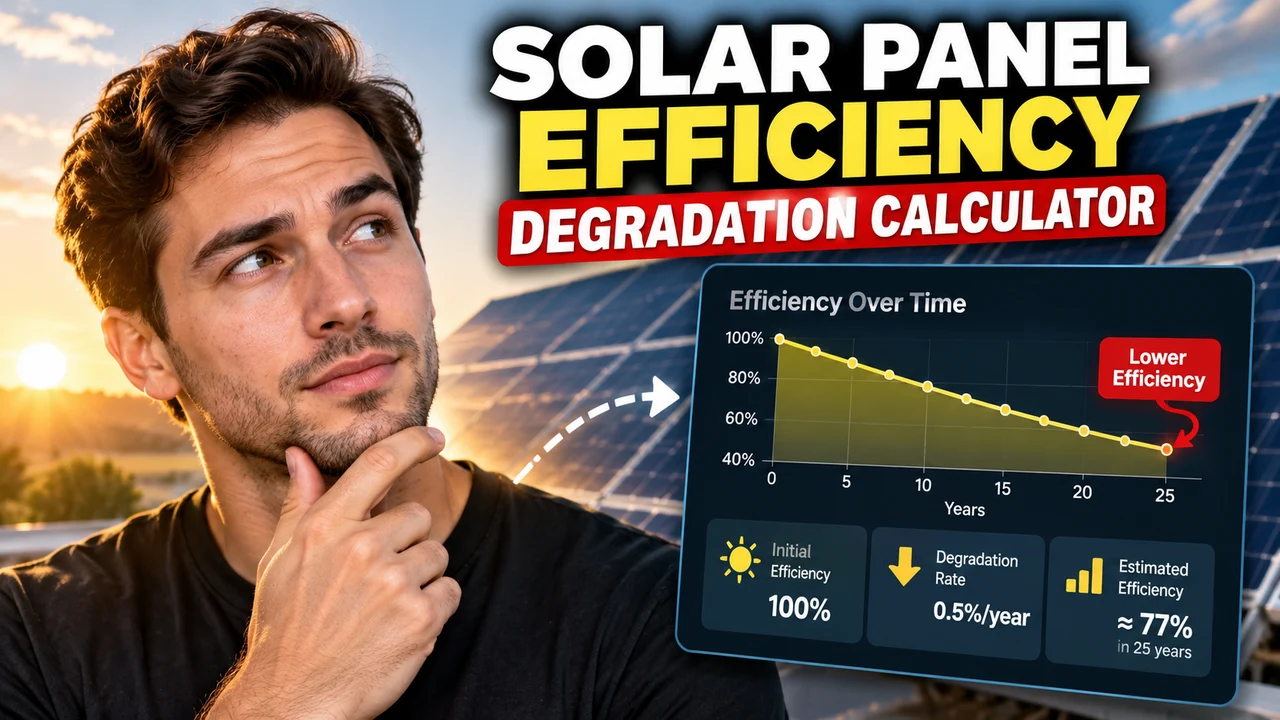
Quick answer: The Solar Panel Efficiency Degradation Calculator estimates how much a solar panel's power output and efficiency may decline over time. By entering the initial rated power, annual degradation rate, and operating years, users can estimate remaining output, cumulative performance loss, and retained capacity under a constant annual degradation assumption.
The Solar Panel Efficiency Degradation Calculator is an engineering calculator for homeowners, solar installers, renewable energy planners, and photovoltaic (PV) system owners who want to understand long-term solar panel performance. Solar modules gradually lose some of their ability to convert sunlight into electricity. Estimating this change helps users evaluate expected generation, compare degradation assumptions, and plan for the long-term operation of a solar installation.
The calculator's mathematical model uses an initial power rating and an assumed annual degradation rate to estimate remaining rated output after a selected number of years. Because the actual calculator interface and its input fields have not been independently specified, the methodology below describes a standard compound-degradation model. The published implementation should use this formula only if it matches the calculator's actual calculation logic.
TL;DR / Key Takeaways
- Primary Function: Estimate long-term photovoltaic panel performance loss.
- Key Inputs: Initial rated power, annual degradation rate, and elapsed years.
- Core Output: Estimated remaining power, percentage loss, and retained capacity.
- Best Suited For: Solar performance planning, system comparisons, and preliminary energy-yield estimates.
- Important Assumption: A constant annual degradation rate is a model input, not a guarantee of actual field performance.
How to Use Solar Panel Efficiency Degradation Calculator?
- Enter initial rated power. Use the module's nameplate power rating in watts (W) or kilowatts (kW), depending on the calculator's supported units.
- Enter annual degradation. Provide the assumed annual loss as a percentage. For example, 0.5% per year means the panel retains 99.5% of its previous year's modeled power.
- Set the operating period. Enter the number of years since installation or the future period to evaluate.
- Calculate and interpret the result. Review the estimated remaining rated power and the difference from the initial rating. Confirm the units and assumptions before using the result in a system forecast.
What does each input mean?
- Initial rated power: The panel's original direct-current (DC) power rating under its specified standard test conditions. A 400 W panel starts with a modeled rating of 400 W.
- Annual degradation rate: The assumed fractional reduction in retained power per year. A rate of 0.5% is represented mathematically as 0.005.
- Elapsed years: The number of annual degradation periods applied to the original rating. The model can estimate a future year or an existing panel's modeled retained capacity.
If the implemented calculator accepts additional inputs, such as panel count, installation year, or a target future year, those fields should be documented according to their actual behavior rather than assumed to exist.
Input and Output Example
Consider a 400 W solar module with an assumed annual degradation rate of 0.5%, evaluated after 25 years. This example uses constant compound degradation and illustrates the expected mathematical result.
Example inputs
- Initial rated power: 400 W
- Annual degradation rate: 0.5%
- Operating period: 25 years
Calculation
For a constant annual fractional loss, the remaining rated power is calculated using:
Remaining power = Initial power × (1 − degradation rate)years
Substituting the example values:
Remaining power = 400 × (1 − 0.005)25
Remaining power ≈ 352.66 W
The modeled loss is approximately 47.34 W, or 11.83% of the initial rating. The module retains approximately 88.17% of its original rated power under these assumptions.
Expected result summary
| Metric | Example result |
|---|---|
| Initial rated power | 400 W |
| Annual degradation assumption | 0.5% |
| Evaluation period | 25 years |
| Estimated remaining rated power | 352.66 W |
| Estimated power loss | 47.34 W |
| Total modeled degradation | 11.83% |
| Retained rated power | 88.17% |
These figures are illustrative mathematical estimates, not measured performance data from a particular module. If the actual calculator uses linear degradation, a different annual-rate convention, or a different rounding method, its outputs will differ.
Solar Panel Degradation Formula and Methodology
Solar panel degradation can be modeled using a compound retention formula. Each year, the remaining rated power is multiplied by the fraction retained after degradation.
Pt = P0 × (1 − r)t
- Pt: Estimated remaining rated power after t years, expressed in the same power unit as the initial rating.
- P0: Initial rated power at the starting point.
- r: Annual degradation rate expressed as a decimal. For 0.5% per year, r = 0.005.
- t: Number of annual degradation periods.
The corresponding modeled cumulative degradation percentage is:
Degradation (%) = [1 − (1 − r)t] × 100
The retained power percentage is:
Retained capacity (%) = (1 − r)t × 100
For a fixed initial rating and annual rate, increasing the evaluation period reduces the modeled remaining power. Increasing the annual degradation assumption also lowers the remaining power for the same number of years. These equations describe rated-power retention, not the complete energy yield of a photovoltaic system.
Solar Panel Degradation Reference Table
The following reference uses a 400 W module and the compound formula above. The annual rates and periods are illustrative scenarios selected for comparison, not a declaration of an industry's guaranteed or universal degradation rate.
| Annual degradation | Period | Estimated remaining power | Estimated total loss |
|---|---|---|---|
| 0.25% | 10 years | 390.09 W | 2.48% |
| 0.50% | 10 years | 380.44 W | 4.89% |
| 0.50% | 25 years | 352.66 W | 11.83% |
| 0.75% | 25 years | 331.36 W | 17.16% |
| 1.00% | 25 years | 311.13 W | 22.18% |
| 0.50% | 30 years | 343.98 W | 14.00% |
| 0.75% | 30 years | 319.19 W | 20.20% |
| 1.00% | 30 years | 296.10 W | 25.99% |
Use the row closest to the assumptions you want to evaluate, or calculate a custom scenario using the formula. Results are sensitive to the annual rate, so even modest differences in the assumed rate can produce meaningful differences over several decades.
How Does the Calculator Work?
The compound degradation model treats annual power retention as a repeated multiplication. For example, a 0.5% annual degradation rate means 99.5% of the modeled power is retained after each year. The next year's modeled power is calculated from the preceding year's value, rather than subtracting 0.5% of the original rating repeatedly.
This distinction matters when comparing compound and linear models:
- Compound model: Pt = P0 × (1 − r)t. The annual loss is applied to the remaining modeled power.
- Linear model: Pt = P0 × (1 − rt). The annual loss is calculated against the original rating.
These models are not interchangeable. A calculator should clearly identify which one it uses, especially when estimating performance over 25 or 30 years. The linear formula can also produce unrealistic negative power values if extended beyond its meaningful range, so its valid operating range needs to be considered.
Understanding Power Degradation Versus Energy Production
A solar panel's rated power and its real-world electricity generation are related but different measurements. Rated power is generally expressed in watts (W) under specified test conditions, while energy production is measured in watt-hours (Wh) or kilowatt-hours (kWh) over time.
- Rated power degradation: The modeled reduction in a module's power rating over time.
- Energy yield: The electricity generated over a day, month, or year.
- System performance: The combined effect of panel condition, sunlight, temperature, shading, inverter efficiency, wiring losses, soiling, and other operating factors.
If a 400 W panel has a modeled retained power of 352.66 W after 25 years, that does not automatically mean the system generates exactly 88.17% of its first-year electricity. Actual energy production depends on weather, installation conditions, system design, maintenance, and changes in equipment performance.
For a preliminary energy-yield estimate, a user may apply the retained-power fraction to a baseline energy estimate if other factors are assumed unchanged. This is a simplifying assumption, not a substitute for a detailed photovoltaic system model.
Technical Edge Cases and Limitations
| Input or condition | Mathematical consideration | Recommended interpretation |
|---|---|---|
| Zero years | (1 − r)0 = 1 | Remaining power equals the initial rating. |
| Zero degradation | (1 − 0)t = 1 | No modeled degradation occurs. |
| Negative degradation rate | Produces a growth factor in the formula | Reject unless the calculator explicitly supports a gain scenario. |
| Rate of 100% | r = 1 produces zero retained power for positive whole-year periods. | Check whether the input range is intentionally permitted. |
| Rate above 100% | The retention factor becomes negative. | Reject as physically inappropriate for this model. |
| Fractional years | The formula can calculate fractional periods for a valid positive retention factor. | Interpret the result according to the calculator's time convention. |
| Very long periods | Repeated compound loss approaches zero for a positive rate below 100%. | Check numeric precision and rounding. |
| Mixed power units | Watts and kilowatts differ by a factor of 1,000. | Convert units before comparing results. |
Because the live implementation's validation rules have not been supplied, these are mathematical considerations and recommended input checks, not verified descriptions of the current interface's error handling.
What the estimate does not account for
- Individual module defects, damage, hot spots, or manufacturing variation.
- Temperature-related changes in instantaneous power output.
- Soiling, shading, snow, or changes in site conditions.
- Inverter replacement, wiring losses, or system downtime.
- Nonlinear degradation, early-life stabilization, or changing degradation rates.
- Measured field performance, unless such measurements are separately provided and incorporated.
The calculator should therefore be treated as a planning aid rather than a prediction of exact future electricity generation. For investment decisions, warranty assessments, or performance guarantees, use the module manufacturer's technical documentation and applicable test reports, along with site-specific production data.
Technical References
- National Renewable Energy Laboratory (NREL) — Photovoltaic Research: Research and resources on photovoltaic performance, reliability, and system behavior.
- NREL — Solar Resource Data: Resources for understanding the solar conditions that influence energy production.
These references provide background for photovoltaic performance assessment. They do not establish the exact degradation rate of an individual module or verify the implementation of this particular calculator.
Frequently Asked Questions
What is solar panel efficiency degradation?
Solar panel degradation is the gradual reduction in a module's ability to produce electrical power under comparable conditions. It is commonly represented as an annual percentage and may be used to estimate retained rated power over time.
How is remaining solar panel power calculated?
Under a constant compound degradation assumption, remaining power equals the initial rated power multiplied by (1 − annual degradation rate)years. The percentage rate must be converted to a decimal before calculation.
Does a 0.5% annual degradation rate mean a 12.5% loss after 25 years?
Not under a compound model. At 0.5% annual degradation, the modeled 25-year cumulative loss is approximately 11.83%, because each year's loss applies to the remaining power. A simple linear model would instead estimate a 12.5% loss over 25 years.
Can this calculator estimate annual electricity production?
A rated-power degradation estimate alone cannot determine exact annual electricity production. An energy forecast also needs a baseline yield and assumptions about sunlight, temperature, shading, soiling, system losses, and operating conditions.
Does solar panel degradation happen at the same rate every year?
Not necessarily. A constant annual rate is a simplifying modeling assumption. Actual degradation can vary with module technology, climate, installation conditions, operating history, and individual panel characteristics.
What degradation rate should I enter?
Use a rate supported by the module manufacturer's technical documentation, warranty terms, or relevant reliability data. If no product-specific value is available, compare multiple clearly labeled assumptions instead of treating a single illustrative rate as a guaranteed outcome.
Author and Technical Review
Author: Daniel Mercer, Electrical Engineering Content Specialist.
Author Description: Technical content specialist focused on photovoltaic system calculations, electrical power fundamentals, and renewable energy performance estimation.
Technical Review: The mathematical explanation uses a constant compound-degradation model and distinguishes rated-power retention from energy production. The calculation methodology should be matched against the deployed calculator before publication.
Technical Disclaimer: Results are estimates based on the selected inputs and mathematical assumptions. They are not a guarantee of future module performance, warranty compliance, or electricity generation. Validate consequential engineering and financial decisions against manufacturer documentation, site conditions, and qualified professional judgment.