
Solar Battery Storage Sizing Calculator For Home
Estimate home solar battery capacity from daily energy use, backup duration, usable depth of discharge, and system efficiency to plan residential storage.
Please complete this field to continue.
Please complete this field to continue.
Please complete this field to continue.
Please complete this field to continue.
Please complete this field to continue.
Results
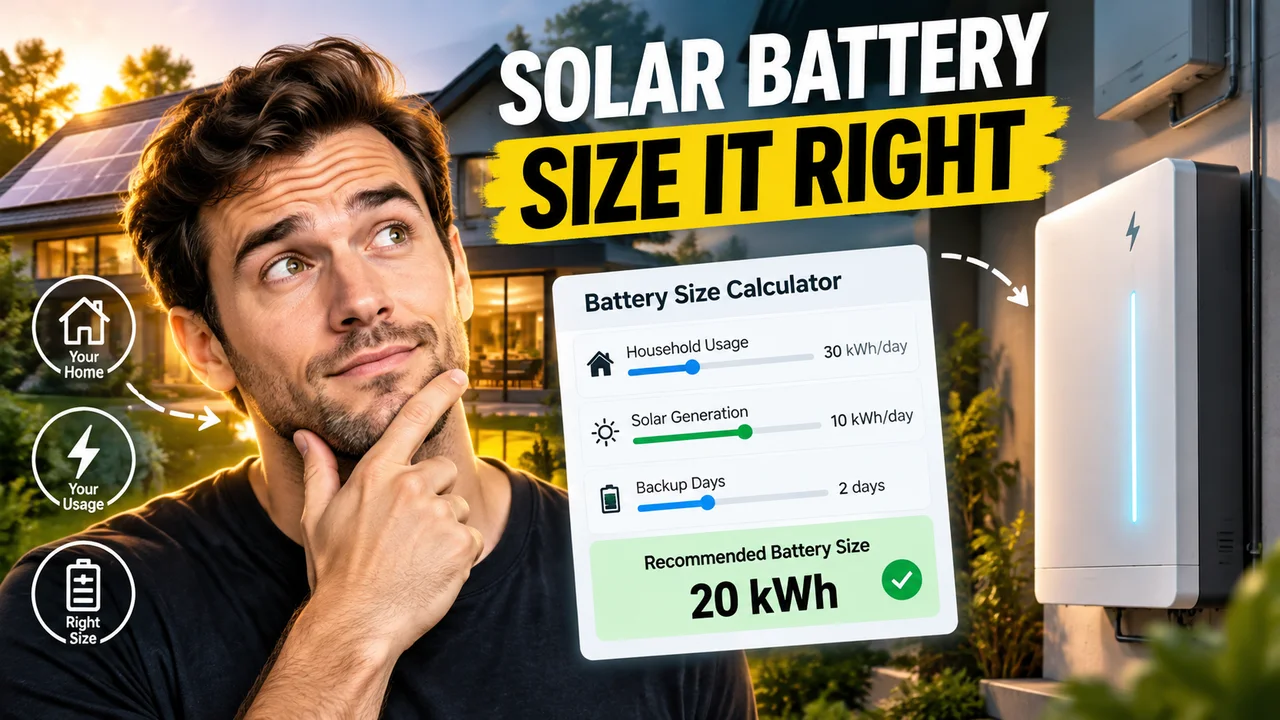
Solar Battery Storage Sizing Calculator For Home
Quick answer: The Solar Battery Storage Sizing Calculator For Home is a residential energy-planning calculator intended to help homeowners estimate the battery storage capacity needed to support household electricity consumption. A practical estimate depends on daily energy usage, the number of hours or days of backup required, battery depth of discharge, and system efficiency. The resulting capacity estimate can help compare home solar battery options and prepare for a more detailed system design.
Choosing a home solar battery involves more than matching a battery to the wattage of a solar panel system. The battery must store enough usable energy for the appliances a household intends to run, while its inverter must supply sufficient power to operate those appliances simultaneously. The Solar Battery Storage Sizing Calculator For Home is designed around this residential storage-sizing problem.
Key Takeaways
- Primary function: Estimate residential battery storage requirements.
- Important inputs: Household electricity consumption, backup duration, usable battery capacity, and system losses, where supported by the calculator.
- Core output: An estimated battery capacity requirement, expressed in an appropriate energy unit such as kilowatt-hours (kWh).
- Best suited for: Homeowners comparing backup options, planning solar-plus-storage installations, and preparing preliminary energy requirements.
Why Does Home Solar Battery Sizing Matter?
A correctly sized battery balances backup expectations, energy consumption, usable capacity, and system performance. A battery that is too small may run out of stored energy before the required backup period ends. An unnecessarily large battery can increase installation costs without providing a corresponding benefit for the household's actual loads.
Residential battery sizing involves two separate questions:
- Energy capacity: How many kilowatt-hours must the battery deliver over the backup period?
- Power output: How many watts or kilowatts must the battery inverter deliver at one time?
These measurements are not interchangeable. Kilowatt-hours measure energy stored or consumed over time, while kilowatts measure the rate at which electrical power is supplied. A battery may contain sufficient energy for several hours of use but still be unable to start an appliance with a high instantaneous power demand.
How to Use Solar Battery Storage Sizing Calculator For Home?
- Determine the energy requirement. Establish the household's daily electricity consumption or the energy consumption of the appliances that need backup. Use actual meter readings or appliance energy estimates whenever possible.
- Choose the backup period. Decide how long the battery should supply electricity when solar generation or grid power is unavailable. A few hours of essential-load backup can require substantially less capacity than a full day of household operation.
- Account for usable capacity and losses. If the calculator supports depth of discharge or efficiency inputs, use the battery manufacturer's specifications rather than assuming all nominal capacity is available to the loads.
- Review the estimate. Compare the resulting capacity with available battery sizes and check whether the inverter can handle the expected simultaneous and startup loads.
The exact fields and output behavior of the live calculator have not been established by the supplied tool information. The workflow above describes the engineering method for estimating residential battery storage and should be aligned with the calculator's actual controls before publication.
Input and Output Example
The following worked example illustrates a standard battery-sizing calculation. It is an explanatory example, not a verified output from the live calculator.
| Parameter | Example value | Meaning |
|---|---|---|
| Daily energy requirement | 8 kWh | Energy required by the selected household loads per day |
| Backup duration | 1 day | Target operating period without replenishment |
| Depth of discharge | 80% | Assumed fraction of nominal battery capacity that is usable |
| Battery-to-load efficiency | 90% | Assumed fraction of usable battery energy delivered to the loads |
| Estimated nominal capacity | 11.11 kWh | Approximate battery nameplate capacity required |
For these assumptions, the calculation is:
Nominal battery capacity = Required load energy ÷ (Depth of discharge × Battery-to-load efficiency)
Substituting the example values:
Nominal capacity = 8 kWh ÷ (0.80 × 0.90)
Nominal capacity = 8 ÷ 0.72 = 11.11 kWh
A nominal battery capacity of approximately 11.1 kWh would therefore be the mathematical estimate under these assumptions. The final selection must also account for the battery manufacturer's permitted operating limits, inverter conversion losses if not already included, temperature, aging, reserve requirements, and the power rating of the system.
Battery Sizing Formula and Variables
For a household whose backup requirement is expressed as daily energy consumption, a useful preliminary formula is:
Required nominal capacity (kWh) = Daily load energy (kWh/day) × Backup days ÷ (Usable depth of discharge × Delivery efficiency)
Where:
- Daily load energy: Electricity needed by the selected loads over 24 hours, in kWh/day.
- Backup days: Number of days of autonomy required without charging from solar generation or another source.
- Usable depth of discharge: The permitted fraction of rated capacity available for discharge, expressed as a decimal.
- Delivery efficiency: The assumed fraction of battery energy that reaches the intended loads, expressed as a decimal.
For backup periods measured in hours, first calculate the energy needed during those hours. If the loads consume an average of 500 watts for 6 hours, their energy requirement is 0.5 kW × 6 hours = 3 kWh. This value can then be adjusted for usable battery capacity and applicable system losses.
Residential Solar Battery Reference Table
| Backup energy required | Usable fraction | Delivery efficiency | Calculated nominal capacity |
|---|---|---|---|
| 3 kWh | 80% | 90% | 4.17 kWh |
| 5 kWh | 80% | 90% | 6.94 kWh |
| 8 kWh | 80% | 90% | 11.11 kWh |
| 10 kWh | 80% | 90% | 13.89 kWh |
| 15 kWh | 80% | 90% | 20.83 kWh |
These values are illustrative mathematical estimates using consistent assumptions. They are not prescribed battery sizes, manufacturer recommendations, or guaranteed calculator outputs. A different battery chemistry, permitted discharge limit, efficiency, or reserve policy will change the result.
How Does Battery Capacity Differ From Inverter Power?
Battery capacity and inverter power must be evaluated separately. For example, a 10 kWh battery supplying a steady 2 kW load could theoretically provide five hours of operation before accounting for usable-capacity limits and conversion losses. Actual runtime depends on the battery's available energy and the connected equipment.
| Design factor | Unit | Why it matters |
|---|---|---|
| Battery energy capacity | kWh | Determines the amount of stored energy |
| Inverter power rating | kW | Limits the power supplied at a given moment |
| Peak or surge power | kW | Helps accommodate brief startup loads |
| Charging power | kW | Affects how quickly the battery can recharge |
| Solar generation | kWh/day | Influences how much energy can be replenished |
Technical Edge Cases and Limitations
- Essential loads versus whole-home backup: Sizing for lighting, fans, refrigeration, and communication equipment can produce a different result from sizing for every household circuit.
- High-power appliances: Air conditioners, pumps, electric ovens, and other substantial loads can exceed an inverter's power rating even when sufficient battery energy remains.
- Solar charging during an outage: Solar generation can extend backup runtime, but actual production varies with sunlight, weather, shading, panel orientation, and system configuration.
- Depth of discharge: Nominal battery capacity should not automatically be treated as fully usable energy. Follow the battery manufacturer's operating specifications.
- Conversion losses: AC-coupled and DC-coupled configurations can have different losses. Avoid counting the same losses twice when using an efficiency-adjusted formula.
- Extended outages: Multi-day backup requires consideration of changing household demand and the ability to recharge the battery between periods of use.
- Incomplete inputs: If daily consumption, backup duration, or efficiency assumptions are unknown, the calculated capacity may be unreliable. Use documented estimates rather than treating missing values as zero.
How to Validate a Preliminary Battery Estimate
Before selecting equipment, compare the estimate with the household's actual load profile and the battery manufacturer's usable-energy specification. Confirm that the inverter can handle both continuous demand and appliance startup surges. For solar-assisted backup, evaluate expected generation and recharge opportunities rather than assuming the panels will always replenish the battery.
The U.S. Department of Energy explains the distinction between energy storage capacity and power capacity in its Solar Integration: Solar Energy and Storage Basics resource. The National Renewable Energy Laboratory's System Advisor Model battery-storage documentation provides further context on battery performance, operating conditions, and solar-plus-storage modeling.
Technical Disclaimer: This methodology provides a preliminary energy-capacity estimate, not a certified electrical design. Final equipment selection should account for applicable electrical codes, battery safety requirements, manufacturer specifications, installation conditions, and professional system design.
Author: Alex Morgan, Residential Energy Systems Technical Writer focused on household electricity demand, battery storage, and inverter sizing.
Technical Review: The sizing methodology should be checked against the stated energy assumptions, usable battery capacity, efficiency factors, and inverter power requirements before being used for an installation decision.