
Daily Fiber Intake Calculator - Daily Nutrition Guide
Use the Daily Fiber Intake Calculator to estimate a daily fiber target from age-based nutrition guidance and plan balanced meals with practical gram-per-day references.
Please complete this field to continue.
Please complete this field to continue.
Results
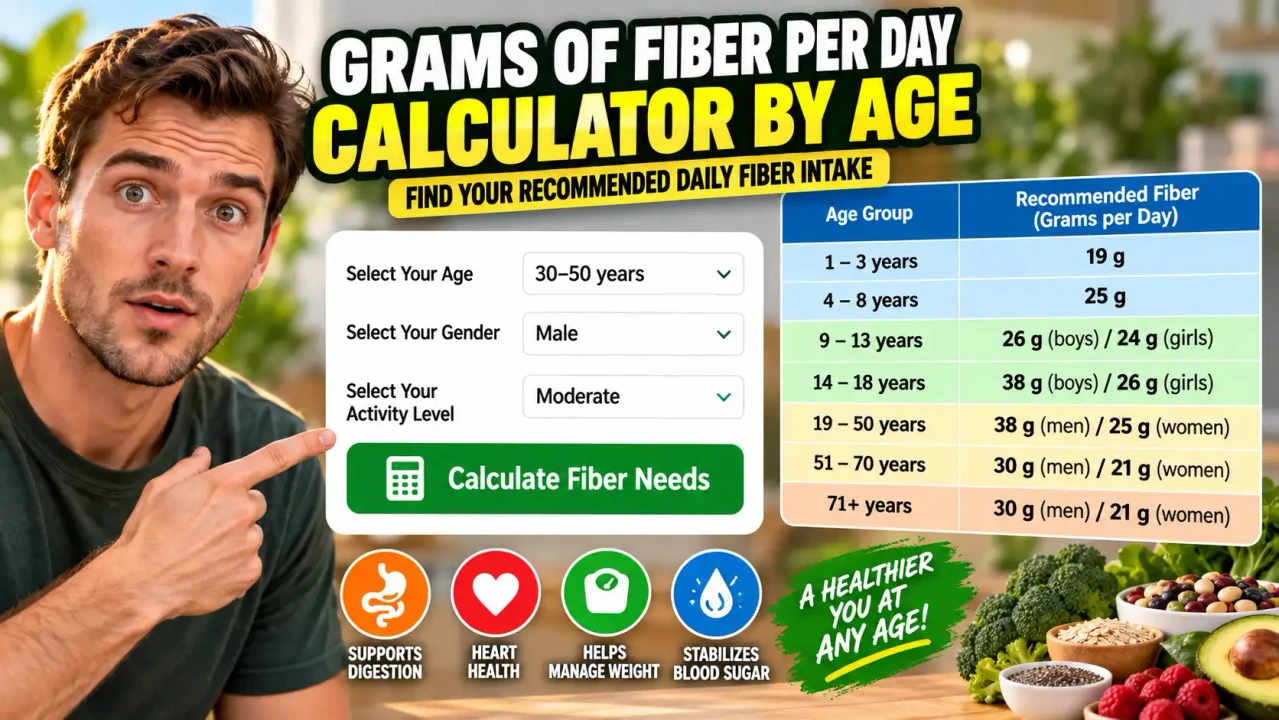
Daily Fiber Intake Calculator
Quick answer: The Daily Fiber Intake Calculator is a nutrition calculator designed to help users estimate how many grams of dietary fiber they should consume each day. Age, sex, and applicable dietary reference values can help determine an appropriate daily target. The result is intended as general nutrition guidance, not an individualized medical prescription.
Dietary fiber is the part of plant-based foods that the human digestive system does not fully break down. It is found in foods such as beans, lentils, whole grains, vegetables, fruits, nuts, and seeds. Getting enough fiber supports normal bowel function and can contribute to a balanced eating pattern.
The Daily Fiber Intake Calculator is intended for people who want to understand their daily fiber needs and compare their eating habits with an age-appropriate nutrition recommendation. It can help users turn a general dietary guideline into a practical target measured in grams per day.
TL;DR / Key Takeaways
- Primary Function: Estimate a daily dietary fiber target.
- Main Reference Factors: Age, sex, and the selected dietary guideline.
- Core Output: A recommended or estimated quantity of fiber in grams per day.
- Best Suited For: Meal planning, nutrition education, and reviewing daily food choices.
- Important Limitation: The calculator's exact input fields and calculation method must match the implemented version of the tool.
How to Use Daily Fiber Intake Calculator?
- Enter your age. Use your age in years, or the age category requested by the calculator. Age matters because recommended fiber intake can vary during childhood, adolescence, and adulthood.
- Select the requested personal details. If the tool asks for sex or another reference category, select the applicable option. Different nutrition guidelines may use different reference values.
- Calculate the daily target. Submit the inputs to obtain the calculator's estimated fiber recommendation.
- Apply the result to meals. Use the result as a planning reference when choosing fiber-containing foods throughout the day.
The actual controls available on the published calculator should determine which inputs are required. Do not assume that body weight, calorie intake, pregnancy status, or other personal information is used unless the implementation explicitly requests it.
What Does the Daily Fiber Intake Calculator Measure?
The primary output is a daily fiber target, typically expressed in grams per day (g/day). This is a dietary quantity rather than a blood test result, a measure of digestive health, or a diagnosis of fiber deficiency.
There is no single number that applies to every person. Fiber recommendations can vary according to age, sex, life stage, energy requirements, and the nutrition authority used as the reference. A calculator should therefore identify its underlying guideline and avoid presenting one value as universally correct.
Daily Fiber Intake Reference Table
The following reference values are based on the U.S. National Academies' Dietary Reference Intakes for fiber. They are general Adequate Intake (AI) values, not a claim about the calculator's internal algorithm. They can serve as a transparent reference when implementing or checking an age-based fiber calculator.
| Age or life stage | Male reference | Female reference | Unit |
|---|---|---|---|
| 1–3 years | 19 | 19 | g/day |
| 4–8 years | 25 | 25 | g/day |
| 9–13 years | 31 | 26 | g/day |
| 14–18 years | 38 | 26 | g/day |
| 19–50 years | 38 | 25 | g/day |
| 51 years and older | 30 | 21 | g/day |
| Pregnancy, ages 14–50 | 28 | g/day | |
| Lactation, ages 14–50 | 29 | g/day | |
Reference note: These values represent the U.S. Dietary Reference Intakes for total fiber. They are provided for context and should not be assumed to be the calculator's exact output until its formula and reference source are verified. Recommendations may differ in other countries.
Authoritative reference: National Academies of Sciences, Engineering, and Medicine. For practical dietary guidance, consult the Dietary Guidelines for Americans.
How Is Daily Fiber Intake Estimated?
The calculator's exact algorithm has not been supplied. A valid age-based implementation can use a lookup table that associates each age range and applicable reference category with a daily Adequate Intake value. In that model, the result is selected from a reference table rather than calculated from an arbitrary multiplier.
Some dietary guidance also expresses fiber intake relative to energy intake. A commonly cited reference for adults is approximately 14 grams of fiber per 1,000 kilocalories. Where that approach is used, the estimated target is calculated as follows:
Estimated fiber target (g/day) = Daily energy intake (kcal/day) × 14 g / 1,000 kcal
Variable definitions:
- Daily energy intake: The energy intake used for the estimate, measured in kilocalories per day.
- 14 g per 1,000 kcal: The reference fiber density used in this example.
- Estimated fiber target: The resulting quantity of dietary fiber in grams per day.
Worked example: If a person uses a daily energy reference of 2,000 kcal, the calculation is 2,000 × 14 ÷ 1,000 = 28 grams of fiber per day. This demonstrates the energy-based method only; it does not establish that the published Daily Fiber Intake Calculator uses this formula.
Understanding the Result
A daily fiber recommendation is a target for total fiber consumed across meals and snacks. It is not necessary to obtain the entire amount from one food. A varied diet containing vegetables, fruit, legumes, whole grains, nuts, and seeds can contribute different amounts toward the daily total.
For example, oats at breakfast, beans or lentils at lunch, vegetables with dinner, and whole fruit as a snack can all contribute fiber. The actual fiber content depends on the food, portion size, preparation method, and product formulation. Food labels and reliable nutrient databases can help estimate intake.
Technical Edge Cases and Limitations
- Age boundaries: Age ranges should be defined without gaps or overlaps. A person at a category boundary must be assigned to exactly one applicable range.
- Young children: Adult reference values should not be applied to children without an appropriate pediatric guideline.
- Pregnancy and lactation: If the tool does not ask about these life stages, it may not account for their distinct reference values.
- Missing or invalid age: An implementation should request a valid age or supported age category instead of silently choosing a reference value.
- Different national guidelines: A U.S. reference table may not match recommendations published by health authorities in other countries.
- Medical needs: Some digestive conditions, medical treatments, or clinician-directed diets may require individualized fiber guidance.
Nutrition Guidance and Disclaimer
Nutrition Disclaimer: Daily fiber estimates are intended for general educational and meal-planning purposes. They do not diagnose a medical condition or replace advice from a qualified healthcare professional or registered dietitian. People with gastrointestinal conditions or specific medical dietary restrictions should seek individualized guidance before making substantial dietary changes.
When increasing fiber intake, a gradual change and adequate fluid intake are commonly advised. Individual fluid needs and any fluid restrictions should be considered, especially when a healthcare professional has prescribed a specific diet.
Frequently Asked Questions
How many grams of fiber should I eat per day?
The target depends on age, sex, life stage, and the guideline used. For example, U.S. reference values for adults ages 19–50 are 38 g/day for males and 25 g/day for females. These are reference values, not personalized prescriptions.
Does the calculator use age to determine fiber needs?
An age-based calculator can match the user's age to an appropriate reference category. The exact inputs and calculation method of this implementation should be confirmed against the published tool.
Can children use a daily fiber calculator?
Children need age-appropriate nutrition references. Use pediatric guidance rather than applying an adult target to a child.
What does g/day mean?
Grams per day is the total quantity of fiber consumed over a day. It includes fiber from all foods and beverages that contribute dietary fiber.
Is the 14 grams per 1,000 calories method the same as an age-based recommendation?
No. The energy-based method estimates fiber in proportion to calorie intake, while an age-based method can select a reference value from an age and sex table. They are related approaches but are not interchangeable in every situation.
Can I use the result to treat constipation or another digestive condition?
No. The result is general nutrition information, not treatment advice. Digestive symptoms that persist or require medical care should be discussed with a qualified healthcare professional.
Author Information
Author Name: Emily Carter, Nutrition Science Writer
Author Description: Emily Carter writes about dietary reference values, nutrition literacy, and practical food-planning methods.
Technical Review: The article explains general dietary fiber reference values and distinguishes an energy-based estimate from an age-based lookup method. The calculator's actual implementation should be checked before attributing a specific formula to it.