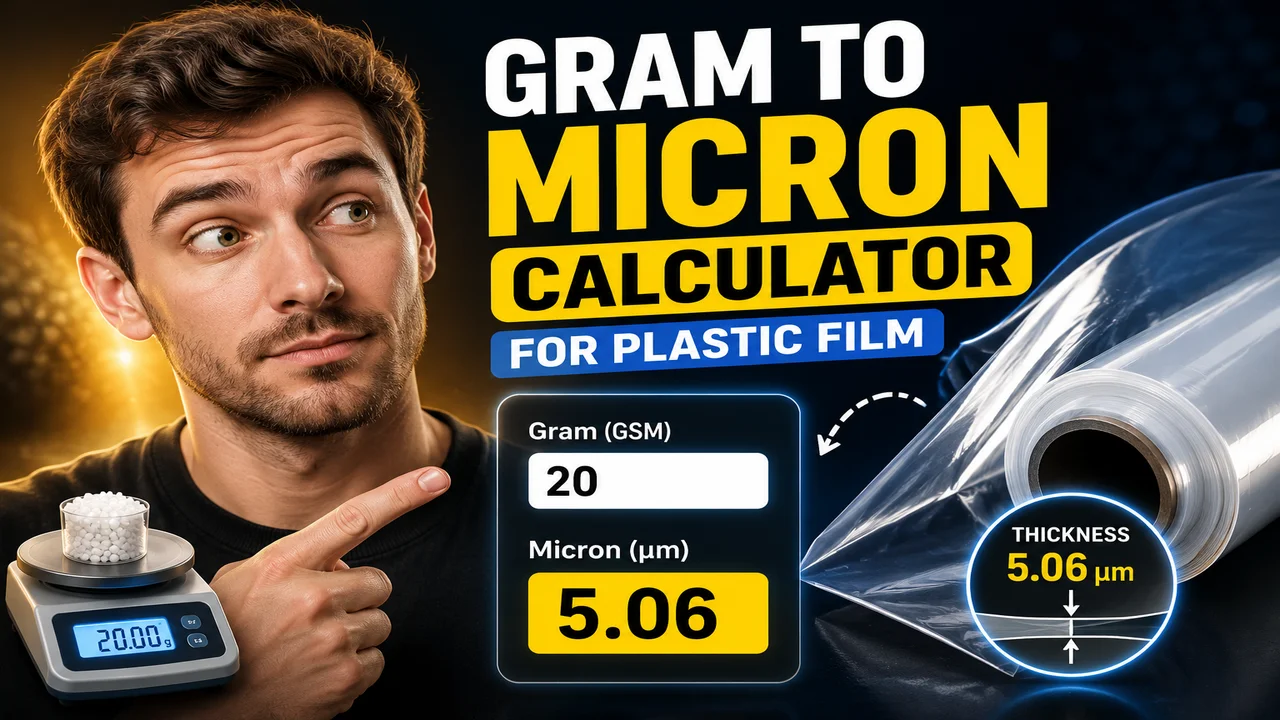
Gram To Micron Calculator For Plastic Film
Quick answer: The Gram To Micron Calculator For Plastic Film helps estimate plastic film thickness in microns from a film's weight in grams per square metre (GSM), using the material density and the appropriate measurement units. The result is useful for comparing film thickness specifications in plastic packaging, bag manufacturing, lamination, and flexible packaging.
Plastic film weight and thickness are closely related, but grams and microns measure different properties. Grams measure mass, while microns measure thickness. To convert a film's grammage into thickness, the calculation must account for the film material's density and the area represented by the weight measurement.
This distinction matters when evaluating polyethylene (PE), polypropylene (PP), and other plastic films. Two films with the same GSM can have different thicknesses if their material densities differ. Similarly, two films with the same thickness can have different weights per square metre because of differences in density or material composition.
The Gram To Micron Calculator For Plastic Film is intended to support preliminary film specification calculations. Before using any result for purchasing, extrusion settings, quality control, or product acceptance, confirm that the input represents GSM rather than the total weight of a roll, bag, or sample.
TL;DR / Key Takeaways
- Primary function: Estimate plastic film thickness from grammage.
- Key input: Film weight per unit area, normally expressed in g/m², together with the material density.
- Core output: Estimated thickness in microns (µm).
- Best suited for: Packaging professionals, plastic film buyers, converters, manufacturers, and quality-control teams.
- Important limitation: A reliable result requires the correct density and consistent units.
How to Use Gram To Micron Calculator For Plastic Film?
- Enter the film grammage: Provide the weight per unit area in grams per square metre (GSM or g/m²). Do not enter the total roll weight unless the film area is also known and the tool explicitly supports that calculation.
- Identify the material density: Use the density corresponding to the actual resin or film formulation. Different polymer grades, blends, fillers, and multilayer constructions may have different effective densities.
- Calculate the thickness: Run the calculator and review the thickness result in microns.
- Check the assumptions: Compare the result with the material specification or a suitable thickness measurement when the value will be used for manufacturing or quality decisions.
Input guidance: GSM means grams per square metre. Micron, commonly written as µm, is a unit of length equal to one-millionth of a metre. Density is commonly expressed in g/cm³ for this conversion. These quantities must be interpreted consistently for the formula to produce a meaningful result.
Output guidance: The calculated micron value represents an estimated thickness based on the stated grammage and density. It is not necessarily a direct measurement of the finished film, especially when the film contains multiple layers, additives, coatings, or uneven thickness distributions.
Input and Output Example
Consider a hypothetical single-layer plastic film with a grammage of 18 g/m² and an assumed density of 0.90 g/cm³. This example illustrates the physical relationship between grammage, density, and thickness; it does not assert that the calculator uses these exact defaults.
Input
- Film grammage: 18 g/m²
- Assumed material density: 0.90 g/cm³
Calculation
For a uniform film, thickness can be estimated by dividing mass per unit area by material density. With GSM expressed in g/m² and density expressed in g/cm³, the unit conversion simplifies to:
Thickness (µm) = GSM ÷ Density (g/cm³)
Substituting the example values:
Thickness = 18 ÷ 0.90 = 20 µm
Expected result
Estimated film thickness: 20 microns.
The calculation assumes that the specified grammage represents the plastic film itself and that the assumed density accurately represents its material. If the weight includes printing ink, adhesive, a coating, moisture, or multiple materials, the simple single-density calculation may not describe the actual layer thickness.
Gram To Micron Formula and Methodology
The relationship follows the mass-density equation:
Density = Mass ÷ Volume
For a uniform film, volume equals area multiplied by thickness. Therefore:
Thickness = Mass per unit area ÷ Density
When grammage is given in g/m² and density in g/cm³, the converted formula is:
Thickness (µm) = Grammage (g/m²) ÷ Density (g/cm³)
Where:
- Thickness (µm): Estimated film thickness in microns.
- Grammage (g/m²): Mass of the film per square metre.
- Density (g/cm³): Mass per unit volume of the material.
The formula is dimensionally consistent because 1 g/m² divided by 1 g/cm³ corresponds to approximately 1 µm of thickness. For example, a material with a density of 1.0 g/cm³ has an estimated thickness numerically equal to its GSM value in microns.
Reverse calculation: If thickness and density are known, the corresponding theoretical grammage can be estimated with:
GSM = Thickness (µm) × Density (g/cm³)
For a film measuring 25 µm at an assumed density of 0.92 g/cm³, the estimated grammage is 25 × 0.92 = 23 g/m².
Plastic Film GSM to Micron Reference Table
The following table shows theoretical thickness values for selected grammages and illustrative densities. The densities are calculation examples, not verified values for every commercial resin grade. Select a density appropriate to the actual material before using these results as specifications.
| Film grammage (GSM) | At 0.90 g/cm³ | At 0.92 g/cm³ | At 1.00 g/cm³ |
|---|---|---|---|
| 10 g/m² | 11.11 µm | 10.87 µm | 10.00 µm |
| 15 g/m² | 16.67 µm | 16.30 µm | 15.00 µm |
| 20 g/m² | 22.22 µm | 21.74 µm | 20.00 µm |
| 25 g/m² | 27.78 µm | 27.17 µm | 25.00 µm |
| 30 g/m² | 33.33 µm | 32.61 µm | 30.00 µm |
| 40 g/m² | 44.44 µm | 43.48 µm | 40.00 µm |
| 50 g/m² | 55.56 µm | 54.35 µm | 50.00 µm |
How Material Density Affects Film Thickness
For a fixed grammage, thickness is inversely proportional to density. A lower-density material produces a greater theoretical thickness at the same mass per square metre, while a higher-density material produces a smaller thickness.
- Same GSM, different density: The calculated micron value changes when the assumed density changes.
- Same micron, different density: The theoretical GSM changes with density.
- Multilayer films: A single-density formula may be unsuitable when layers have different densities. Calculate each layer separately when its grammage and density are known, then add the layer thicknesses.
- Filled or coated films: Mineral fillers, coatings, inks, adhesives, and other components can change the relationship between total grammage and polymer thickness.
For a multilayer structure with individually known layer grammages and densities, the total theoretical thickness can be estimated as the sum of the individual layer thicknesses. If only total GSM and an effective density are available, the result depends on whether that effective density accurately represents the complete construction.
Technical Edge Cases and Limitations
| Condition | Effect on the calculation | Recommended action |
|---|---|---|
| Zero GSM | Produces zero theoretical thickness in the formula. | Confirm that the input is intentional and not a missing measurement. |
| Zero density | The calculation requires division by density and is undefined. | Use a valid positive density. |
| Negative GSM or density | Not physically meaningful for an ordinary film specification. | Check the input values and units. |
| Total roll weight entered as GSM | Mixes total mass with mass per unit area. | Determine the net film mass and film area first. |
| Multilayer film | Total GSM alone may not identify each layer's thickness. | Use layer-specific grammage and density or a suitable effective density. |
| Coated or printed film | Total mass may include non-polymer materials. | Account for the additional layers when their contributions are known. |
Rounding also matters. Calculations may produce repeating decimals, such as 11.111… µm. Retain adequate precision during calculation and round the final value according to the applicable product specification or measurement procedure. Do not assume that a rounded theoretical value guarantees the same measured thickness at every point across a film roll.
The calculator's exact input fields, built-in density presets, validation behavior, rounding rules, and supported output units have not been independently established from the supplied tool name and image URL. Confirm those implementation details against the live calculator before documenting them as actual interface features.
Authoritative Technical References
- National Institute of Standards and Technology (NIST): SI Units — background on the International System of Units and unit relationships.
- IUPAC Gold Book: Density — terminology for the mass-to-volume relationship used in the calculation.
Technical Disclaimer
This calculator's result should be treated as a theoretical estimate based on grammage, density, and the assumed film construction. Actual film thickness can vary with resin formulation, fillers, coatings, layer distribution, and manufacturing conditions. For purchasing tolerances, production control, or formal quality acceptance, use the applicable product specification and an appropriate thickness measurement method.
Author and Technical Review
Author Name: Daniel Mercer
Author Description: Materials and Manufacturing Engineer specializing in polymer processing, flexible packaging materials, and engineering calculations.
Technical Review: The calculation methodology is based on the mass-per-area and density relationship. Verify the live tool's implementation, supported inputs, and rounding behavior before relying on interface-specific claims.