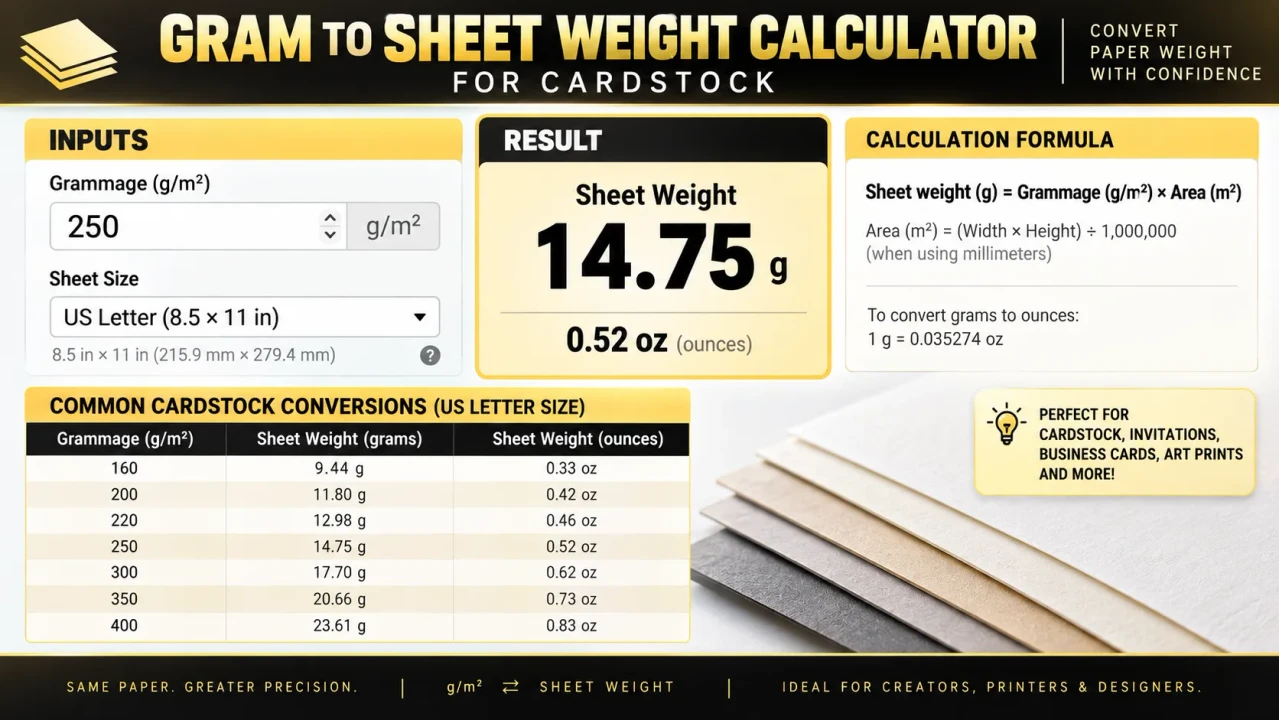
Gram To Sheet Weight Calculator For Cardstock
Quick answer: The Gram To Sheet Weight Calculator For Cardstock estimates the weight of a single cardstock sheet or a stack of sheets using GSM (grams per square meter), sheet dimensions, and quantity. It provides estimated weight in grams, ounces, and kilograms for paper crafting, printing, stationery, and packaging calculations.
Cardstock GSM describes the mass of one square meter of material, not the weight of an individual finished sheet. To calculate sheet weight, you must account for both the cardstock's grammage and its surface area. This calculator applies that relationship to standard paper sizes and custom dimensions, helping users estimate material requirements before purchasing, printing, cutting, or assembling cardstock products.
The calculator supports common sizes including US Letter, US Legal, US Tabloid, A4, A3, and A5, along with a custom-size option. Users provide the cardstock GSM and number of sheets to estimate individual sheet weight and total paper weight.
TL;DR / Key Takeaways
- Primary Function: Calculate cardstock sheet and stack weight from GSM.
- Key Inputs: Sheet size, width and height for custom sizes, GSM, and sheet quantity.
- Core Output: Estimated weight in grams, ounces, and kilograms.
- Best Suited For: Printing, invitations, greeting cards, paper crafts, stationery, and packaging estimates.
How to Use Gram To Sheet Weight Calculator For Cardstock?
- Select the cardstock size: Choose a predefined paper size or select Custom Size for nonstandard dimensions.
- Enter custom dimensions: If using a custom size, enter the sheet width and height in millimeters.
- Enter the GSM value: Use the grammage listed on the cardstock packaging, supplier specification, or product information.
- Enter the quantity: Specify the number of sheets to estimate. Enter 1 to calculate the weight of a single sheet.
- Calculate and review: Select Calculate to view the estimated sheet weight and total weight in the available units.
Input and Output Example
Consider 250 GSM cardstock in US Letter size, measuring 8.5 × 11 inches. The dimensions are equivalent to 215.9 × 279.4 millimeters.
Example Input
- Cardstock size: US Letter
- Width: 215.9 mm
- Height: 279.4 mm
- Cardstock weight: 250 GSM
- Number of sheets: 100
Calculation
First, calculate the sheet area:
Area = 215.9 × 279.4 ÷ 1,000,000
Area = 0.06032246 m²
Next, multiply the area by the GSM:
Sheet weight = 0.06032246 × 250
Sheet weight = 15.080615 g
Calculate the weight of 100 sheets:
Total weight = 15.080615 × 100
Total weight = 1,508.0615 g
Expected Results
- Weight per sheet: approximately 15.08 g
- Weight per sheet: approximately 0.532 oz
- Total weight for 100 sheets: approximately 1.508 kg
These are theoretical paper weights calculated from the nominal GSM and dimensions. Actual material weight may vary.
Formula Used to Calculate Cardstock Sheet Weight
The calculator uses the relationship between grammage and sheet area to estimate the mass of a rectangular cardstock sheet.
Sheet Weight Formula
Sheet Weight (g) = Width (mm) × Height (mm) × GSM ÷ 1,000,000
For multiple sheets, the formula becomes:
Total Weight (g) = Sheet Weight (g) × Number of Sheets
The result can also be expressed in other weight units:
- Ounces: Weight in grams ÷ 28.349523125.
- Kilograms: Weight in grams ÷ 1,000.
Formula Variables
- Width: Horizontal sheet dimension in millimeters.
- Height: Vertical sheet dimension in millimeters.
- GSM: Grammage in grams per square meter.
- Number of Sheets: Quantity of individual cardstock sheets.
- 1,000,000: Conversion factor from square millimeters to square meters.
The calculation retains intermediate precision before displaying rounded results. This avoids introducing unnecessary rounding errors when calculating the weight of individual sheets and larger quantities.
Common Cardstock Size Reference
The following reference table provides the standard dimensions used to estimate cardstock weight. The same GSM produces different sheet weights because each size has a different area.
| Paper Size | Dimensions in Inches | Dimensions in Millimeters | Area in Square Meters |
|---|---|---|---|
| US Letter | 8.5 × 11 | 215.9 × 279.4 | 0.06032246 |
| US Legal | 8.5 × 14 | 215.9 × 355.6 | 0.07677404 |
| US Tabloid | 11 × 17 | 279.4 × 431.8 | 0.12064492 |
| A4 | Approximately 8.27 × 11.69 | 210 × 297 | 0.06237 |
| A3 | Approximately 11.69 × 16.54 | 297 × 420 | 0.12474 |
| A5 | Approximately 5.83 × 8.27 | 148 × 210 | 0.03108 |
For example, a 250 GSM A3 sheet weighs approximately twice as much as a 250 GSM A4 sheet because the A3 area is twice the A4 area. For custom sizes, calculate weight using the actual width and height rather than assuming a standard paper format.
How GSM Affects Cardstock Weight
GSM stands for grams per square meter. It is a measure of grammage that allows paper and board materials to be compared by mass per unit area.
For sheets of identical dimensions, increasing the GSM increases the calculated weight proportionally. A 300 GSM sheet has 20% more mass than a 250 GSM sheet of the same size, assuming both values describe the nominal grammage of the material.
However, GSM is not a direct measurement of thickness, stiffness, or bending strength. Two cardstock products with the same grammage may have different calipers or handling characteristics because of their fiber composition, density, coatings, and manufacturing methods.
Technical Edge Cases and Limitations
- Custom dimensions: Enter the actual width and height in millimeters to avoid errors caused by selecting an incorrect preset size.
- Zero or negative values: Zero dimensions or zero GSM produce a mathematical result of zero, but negative dimensions, negative GSM, and negative sheet quantities do not describe valid physical cardstock measurements.
- Very small or large quantities: Total paper weight scales linearly with sheet quantity. Large orders may require additional calculations for packaging and handling materials.
- Manufacturing variation: Nominal GSM does not guarantee that every sheet has precisely the calculated mass. Moisture, production tolerances, coatings, and printing can change actual weight.
- Packaging and shipping: The calculated total represents the cardstock itself, not the complete packed shipment. Envelopes, cartons, wrappers, inserts, and protective materials must be accounted for separately.
- Thickness and stiffness: The calculator does not determine caliper, density, stiffness, or bending performance.
Technical Disclaimer: Results are estimates based on the entered dimensions, nominal grammage, and sheet quantity. For production orders with strict weight tolerances, verify the supplier's technical specification or weigh a representative sample.
Author and Technical Review
Author Name: Daniel Mercer
Author Description: Paper and Print Production Specialist focused on paper grammage, sheet dimensions, and print-material calculations.
Technical Review: The calculation methodology uses sheet area multiplied by grammage, with standard metric conversions for square meters, grams, ounces, and kilograms. The underlying concept of paper grammage is described by ISO 536:2019, Paper and board — Determination of grammage.
