
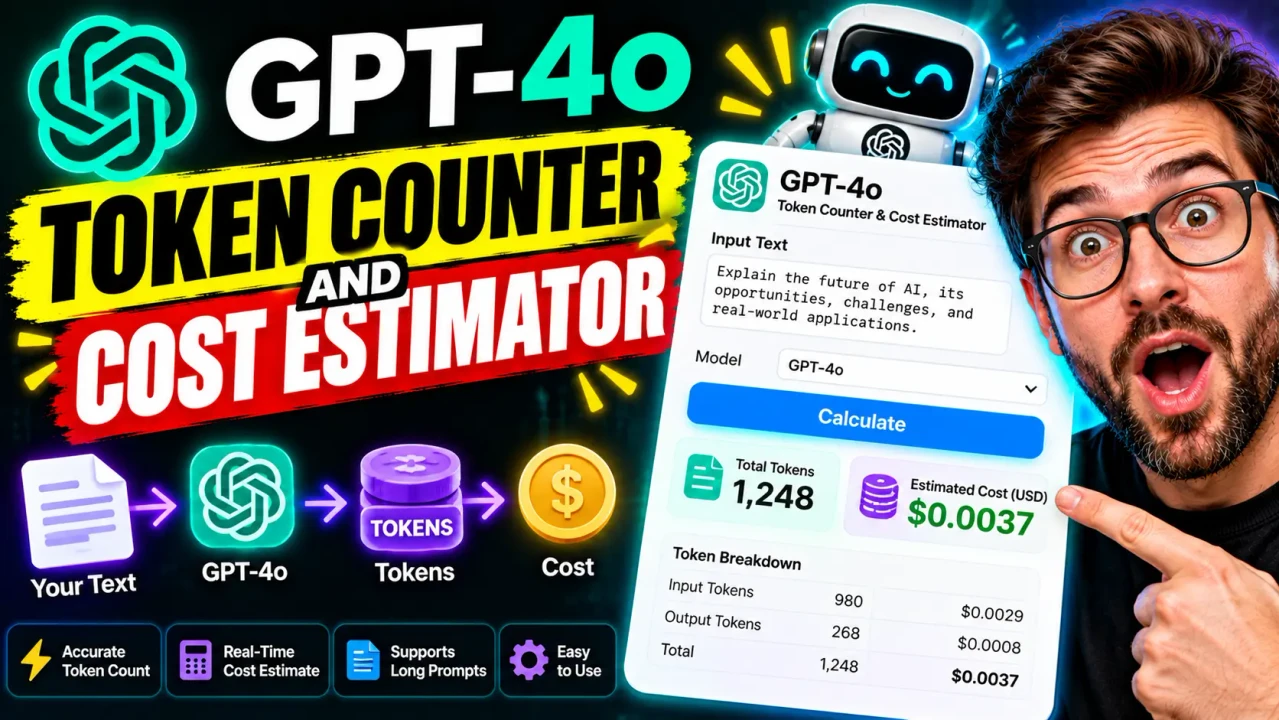
Gpt-4o Token Counter And Cost Estimator
Quick answer: The Gpt-4o Token Counter And Cost Estimator helps developers estimate token usage and API expenses for GPT-4o requests. Token counts and estimated costs help users plan prompts, compare input and output usage, and forecast API spending using the selected pricing assumptions.
The Gpt-4o Token Counter And Cost Estimator is a developer utility designed for estimating the token requirements and potential API costs of working with GPT-4o. It addresses two practical questions: how many tokens a request may consume and how much those tokens may cost at the applicable API rates.
Tokens are the units language models process. A token can represent a complete word, part of a word, punctuation, or other text elements. Consequently, word count and character count alone cannot determine the exact number of tokens in a request. Tokenization depends on the text, its encoding, and the model.
For cost estimation, input tokens and output tokens must be considered separately. Reused prompt content that qualifies for prompt caching may have a different rate from uncached input. The resulting estimate depends on the token counts, applicable pricing, and any additional billable services used by the application.
How to Use Gpt-4o Token Counter And Cost Estimator?
- Provide the text: Enter representative prompt content when the tool provides a text input for token estimation.
- Review token usage: Examine the estimated number of tokens associated with the supplied content. Treat text-based estimates as approximate unless the implementation uses the appropriate tokenizer.
- Set usage assumptions: Enter or select the relevant input and output token quantities and pricing options available in the tool.
- Calculate the cost: Review the estimated API expense and use the result to evaluate prompt size, expected response length, and projected usage.
The exact input fields and available configuration options depend on the deployed tool interface. Confirm the displayed settings before using an estimate for budgeting.
Input and Output Example
Consider an illustrative GPT-4o API request with 10,000 input tokens and 2,000 output tokens. Using the standard text-token rates listed in OpenAI's GPT-4o model documentation, the estimated token cost can be calculated as follows.
Input tokens: 10,000
Output tokens: 2,000

GPT-4o input rate: $2.50 per 1 million tokens
GPT-4o output rate: $10.00 per 1 million tokens

Input cost:
10,000 / 1,000,000 × $2.50 = $0.025

Output cost:
2,000 / 1,000,000 × $10.00 = $0.020

Estimated total: $0.045
This example represents an illustrative text-only API request using those pricing rates. It excludes cached-input discounts, image or audio processing charges, additional tool charges, taxes, and other applicable fees. Check the current official GPT-4o model documentation before relying on a cost estimate.
GPT-4o Token Cost Reference
The following reference illustrates how token categories affect estimated text-token costs. The prices shown are the standard rates documented for GPT-4o and should be checked against current pricing before use.
| Token category | Rate per million tokens | Cost for 10,000 tokens |
|---|---|---|
| Uncached input | $2.50 | $0.025 |
| Cached input | $1.25 | $0.0125 |
| Output | $10.00 | $0.10 |
Important: These are reference rates, not a guarantee of the rates currently configured in the tool. Consult the official OpenAI API pricing documentation for applicable prices, model variants, and billing conditions.
How GPT-4o Token Cost Is Calculated
For standard text-token billing, the basic calculation separates input and output usage:
Input cost = Input tokens × Input rate / 1,000,000

Output cost = Output tokens × Output rate / 1,000,000

Estimated total = Input cost + Output cost
When cached input applies, calculate that portion separately using the applicable cached-input rate:
Estimated total =
(Uncached input tokens × Input rate / 1,000,000)
+ (Cached input tokens × Cached input rate / 1,000,000)
+ (Output tokens × Output rate / 1,000,000)
Each rate is expressed in currency per million tokens. Token quantities must use the same unit as the pricing calculation, and the rates must correspond to the model and billing conditions being evaluated.
Token Estimation: Important Technical Details
- Text length: Longer prompts generally require more tokens, but character count is not a reliable substitute for tokenization.
- Language and formatting: Code, punctuation, unusual strings, whitespace, and non-English text can tokenize differently from ordinary English prose.
- Input versus output: Prompt tokens and generated tokens may have different billing rates.
- Conversation history: API requests that include previous messages can consume tokens beyond those in the latest user message.
- Multimodal content: Images, audio, and other supported input types may have additional token-accounting rules that a text-only estimate does not capture.
- Prompt caching: Only qualifying cached input should be priced at the cached-input rate.
Limitations and Accuracy
A token counter based on text-length heuristics provides an estimate rather than an exact model-token count. Exact counting requires a tokenizer compatible with the relevant model and consideration of the actual API request structure. Even an exact count of visible text may differ from total API usage when message framing, image inputs, tools, or other request components contribute to billing.
Cost estimates also depend on current pricing and actual usage. The final amount may differ if the request generates more or fewer tokens than expected, uses cached input, includes other billable features, or targets a different model version. Verify usage against the API response's reported token-usage fields and your billing records when reconciling actual expenses.
The estimator should be used for planning and comparison, not as a substitute for measured API usage or the official pricing schedule. The exact token-counting algorithm, supported inputs, processing location, and privacy characteristics should be confirmed from the deployed implementation.
Frequently Asked Questions
What does a GPT-4o token counter do?
It estimates or counts the tokens associated with text supplied to a GPT-4o workflow. A compatible tokenizer is needed for exact model-specific text counts.
How much does GPT-4o cost per million tokens?
The standard rates in the cited model documentation are $2.50 per million uncached input tokens, $1.25 per million cached input tokens, and $10 per million output tokens. Verify the current rates before calculating expenses.
How do I calculate GPT-4o API cost?
Multiply each token category by its corresponding price per million, divide by one million, and add the resulting costs. Calculate cached and uncached input separately when applicable.
Is a text-based token estimate exact?
Not necessarily. Character-based or word-based estimates are approximate. Exact counting requires compatible tokenization and may still exclude other components of the complete API request.
Does the estimate include cached input and other API charges?
Only if the tool explicitly accounts for them. Check whether cached tokens, image or audio processing, tool calls, and other billable services are included in the displayed result.
Why can the actual API cost differ from the estimate?
Actual usage can differ because of generated response length, conversation history, model selection, cached input, multimodal content, additional services, or changes to applicable pricing.
Author
Author Name: Jordan Miller
Author Description: Software engineering content specialist focused on API integration, token accounting, and developer cost estimation.
Technical Review: The calculation methodology distinguishes input, cached-input, and output token costs and identifies important limitations of text-based estimates. Pricing should be verified against the official OpenAI documentation before production budgeting.
