
Morse Code Translator | Free Encoder & Decoder Tool
Morse Code Translator converts text into dot-and-dash sequences and decodes Morse code into readable text. Translate messages and check letter patterns easily.
Loading tool… if this message stays, JavaScript is blocked or failed to load — check your connection and console, then reload.
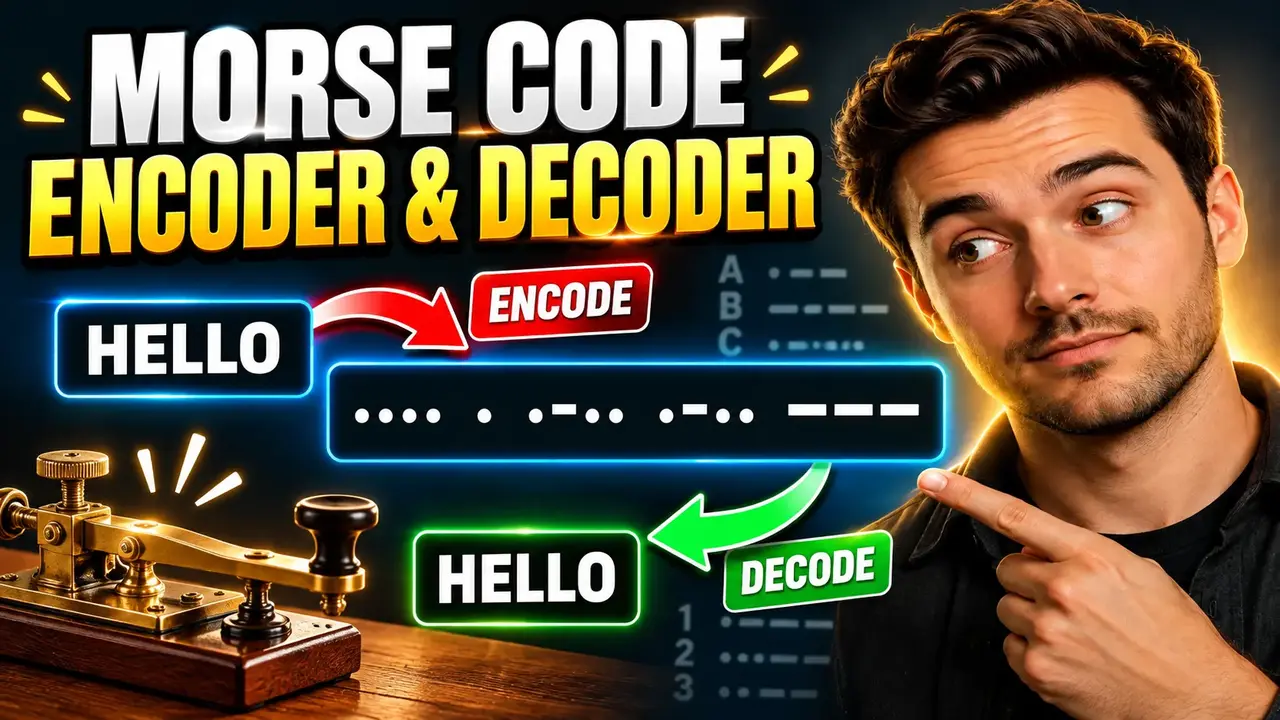
Morse Code Translator | Free Encoder & Decoder
Quick answer: The Morse Code Translator is an encoding and decoding utility that converts readable text into Morse code and Morse code into readable text. It is useful for learning Morse code, interpreting dot-and-dash sequences, practicing communication, and exploring how letters, numbers, and punctuation are represented in Morse code.
Morse code represents characters using sequences of dots (.) and dashes (-). Each letter and digit has a defined sequence, while spaces separate letters and word gaps distinguish one word from another. The Morse Code Translator helps users move between ordinary text and these symbolic sequences without manually looking up every character.
Use the translator to encode a message for a Morse code exercise or decode a sequence into readable text. For example, the English word "SOS" becomes ... --- .... Conversely, entering ... --- ... into a compatible decoder produces SOS.
What Can You Do With a Morse Code Translator?
- Text to Morse code: Convert words, sentences, numbers, and supported punctuation into dot-and-dash sequences.
- Morse code to text: Interpret recognized Morse sequences as letters, digits, and supported punctuation.
- Learn character patterns: Compare Morse representations and memorize common sequences.
- Check practice messages: Compare an encoded message with its expected Morse representation.
- Explore communication history: Understand the symbolic encoding used in traditional telegraphy and other Morse code applications.
Exact punctuation support, accepted spacing conventions, and handling of invalid sequences depend on the translator's implementation. Review the output before using a converted message in a communication exercise.
How to Use Morse Code Translator | Free Encoder & Decoder?
- Choose the conversion direction. Select text-to-Morse encoding or Morse-to-text decoding, depending on the message you have.
- Enter your input. For encoding, type a word or sentence. For decoding, enter dot-and-dash sequences with clear separators between characters.
- Run the conversion. Use the translator's available conversion control to process the input.
- Review the result. Check the encoded symbols or decoded text, paying particular attention to character and word boundaries.
The precise control labels and available options depend on the implemented interface. This guide describes the standard translation workflow without assuming unverified interface features.
Morse Code Input and Output Example
Consider the message "HELLO WORLD". Under the International Morse code alphabet, each letter is represented by its corresponding dot-and-dash sequence. A slash is commonly used in written examples to make word boundaries visible.
Example: Text to Morse Code
Input:
HELLO WORLD

Output:
.... . .-.. .-.. --- / .-- --- .-. .-.. -..
Example: Morse Code to Text
Input:
.... . .-.. .-.. --- / .-- --- .-. .-.. -..

Output:
HELLO WORLD
These examples use conventional International Morse code representations and slash-separated words. A particular translator may use a different word separator or require a specific spacing format. Match the input convention expected by the tool when decoding a message.
International Morse Code Reference Table
The following reference lists the standard International Morse code patterns for English letters and digits. It is useful for checking individual characters when verifying encoded output or diagnosing a decoding mistake.
| Character | Morse Code | Character | Morse Code |
|---|---|---|---|
| A | .- | N | -. |
| B | -... | O | --- |
| C | -.-. | P | .--. |
| D | -.. | Q | --.- |
| E | . | R | .-. |
| F | ..-. | S | ... |
| G | --. | T | - |
| H | .... | U | ..- |
| I | .. | V | ...- |
| J | .--- | W | .-- |
| K | -.- | X | -..- |
| L | .-.. | Y | -.-- |
| M | -- | Z | --.. |
| 0 | ----- | 5 | ..... |
| 1 | .---- | 6 | -.... |
| 2 | ..--- | 7 | --... |
| 3 | ...-- | 8 | ---.. |
| 4 | ....- | 9 | ----. |
Letter patterns are separated by spaces in common written Morse notation. A slash between groups is a readable convention for indicating a word boundary; it is not itself a Morse character for a space. Morse code also defines punctuation and certain procedural signals, but their availability in a text translator depends on the implementation.
How Morse Code Translation Works
A Morse code translator generally uses a character-to-sequence mapping for encoding and a sequence-to-character mapping for decoding.
- Encoding: The translator reads the input text character by character, looks up each supported character's Morse pattern, and joins the patterns using a separator.
- Decoding: The translator splits the Morse input into individual code groups, matches each group to a known pattern, and reconstructs the corresponding text.
- Word boundaries: Spaces or another agreed delimiter separate words so the decoded output can preserve the message structure.
For example, the letter E maps to a single dot (.), while the letter T maps to a single dash (-). The letter A maps to dot-dash (.-), and N maps to dash-dot (-.). These short patterns demonstrate why preserving symbol order matters.
Spacing, Invalid Sequences, and Limitations
Why Morse Code Spacing Matters
Morse code uses timing in actual signaling and separators in written representations. A text-based decoder needs a reliable way to distinguish one character from the next. For example, ... --- ... represents three character groups: S, O, and S. If the separators are removed, the intended character boundaries may become ambiguous.
- Dots and dashes: Use periods and hyphens consistently unless the interface documents alternative symbols.
- Letter separators: Separate each Morse character according to the format expected by the decoder.
- Word separators: Use the tool's documented convention, such as a slash or a defined spacing pattern.
- Unknown patterns: A sequence that does not match a recognized character may be rejected, skipped, or displayed as an unknown symbol, depending on implementation.
Important Limitations
A text translator operates on symbolic representations. It does not automatically establish the meaning of a message, determine the sender's intent, or guarantee that a manually copied sequence matches the original transmission. Audio decoding, automatic sound recognition, flashing-light interpretation, and radio signal reception are separate capabilities and should not be assumed to exist in a text encoder and decoder.
International Morse code is also distinct from other Morse code variants and specialized signaling conventions. When translating historical material, non-English text, or procedural signals, verify that the source uses the same character set and conventions as the translator.
Technical Reference
| Input condition | Expected interpretation | Practical guidance |
|---|---|---|
| Recognized text letter | Corresponding Morse pattern | Check the standard character mapping. |
| Recognized Morse group | Corresponding text character | Keep each code group separate. |
| Multiple words | Text with word boundaries | Use the decoder's supported word separator. |
| Unsupported punctuation | Implementation-dependent | Verify punctuation support before conversion. |
| Malformed Morse sequence | Implementation-dependent | Review dots, dashes, and separators. |
| Unseparated Morse symbols | Potentially ambiguous decoding | Restore the intended character boundaries. |
Author and Technical Review
Author Name: Michael Bennett
Author Description: Technical content specialist focused on digital utilities, character encoding, and practical software documentation.
Technical Review: The examples and reference mappings in this guide describe standard International Morse code for English letters and digits. Interface-specific options, punctuation coverage, invalid-input handling, and processing behavior should be confirmed against the deployed translator.
Authoritative Reference
For the underlying signaling conventions, consult the International Telecommunication Union's International Morse Code recommendation (ITU-R M.1677). This primary reference is useful when checking character patterns and distinguishing standardized Morse code from tool-specific formatting.