
RAG Chunk Estimator
Estimate RAG document tokens, chunk counts, overlap, and top-K context usage with the Rag Context Chunk Token Estimator. Plan retrieval budgets before deployment.
Result
No estimate yetLocal math: heuristic token estimate via LLMTokenCore; utilization assumes a 128k context window. How was this calculated? Chunks = ceil((tokens − overlap) / (size − overlap)).
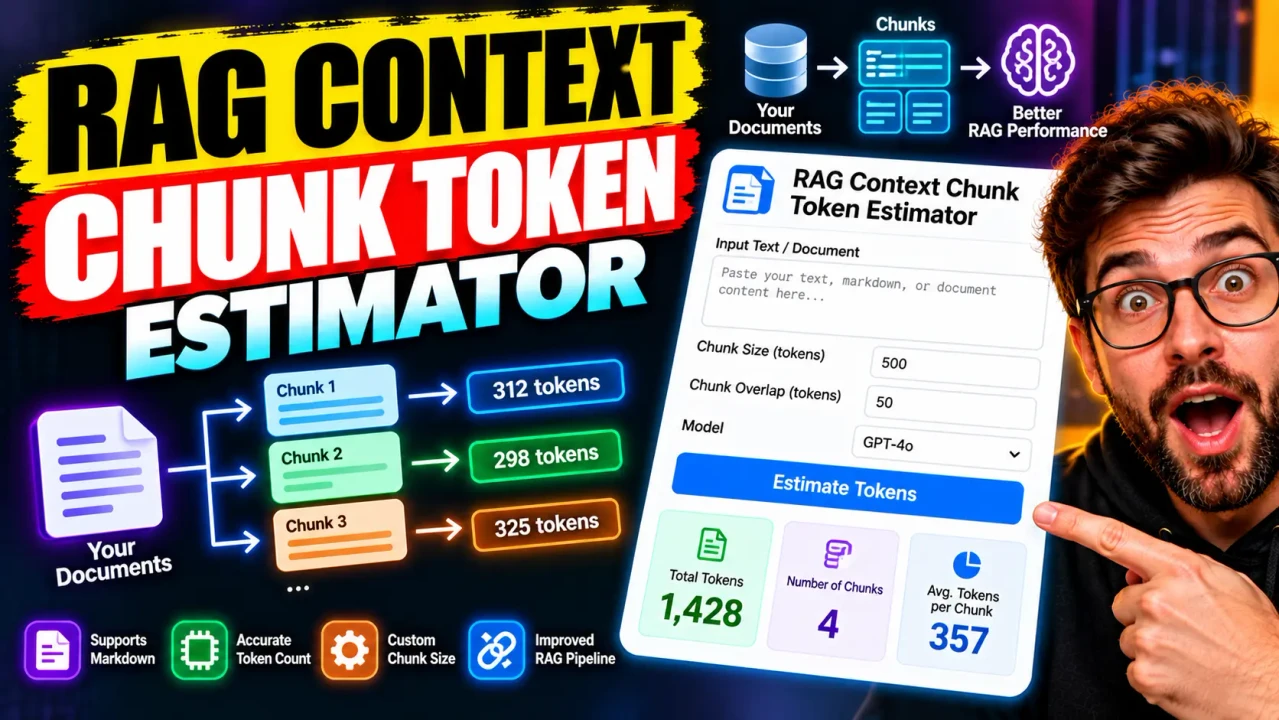
Rag Context Chunk Token Estimator
Quick answer: The Rag Context Chunk Token Estimator is a RAG planning utility that estimates document token volume, chunk count, overlapping chunk capacity, and retrieved-context usage. It accepts document text, chunk size, overlap, and top-K retrieval settings to help developers plan how retrieved content fits into an LLM context window.
TL;DR / Key Takeaways
- Primary function: Estimate token usage and document chunking requirements for retrieval-augmented generation (RAG).
- Inputs: Document text, chunk size in tokens, overlap in tokens, and top-K retrieved chunks.
- Outputs: Estimated document tokens, chunk count, retrieval-related token usage, and context utilization.
- Planning assumption: The displayed estimator uses a 128,000-token context window for utilization calculations.
- Best suited for: AI application developers, RAG engineers, data engineers, and prompt engineers tuning retrieval settings.
What Does the Rag Context Chunk Token Estimator Do?
The Rag Context Chunk Token Estimator helps developers understand how document segmentation and retrieval settings affect the amount of text supplied to a large language model (LLM). In a RAG pipeline, documents are divided into smaller passages, indexed for retrieval, and selected as context when a user submits a question. The estimator provides a practical way to compare chunking configurations before implementing them in a production pipeline. Instead of considering document length alone, developers can examine how chunk size, overlap, and the number of retrieved chunks interact. For example, a system configured to retrieve five chunks of approximately 512 tokens each has a nominal retrieved-chunk allowance of: 5 × 512 = 2,560 tokens That estimate covers the selected chunks, not necessarily the complete model request. System instructions, the user's question, conversation history, document metadata, and the generated answer can consume additional context capacity. The tool is therefore useful for preliminary capacity planning. Its results should not be interpreted as an exact token count for every model or tokenizer.
How to Use Rag Context Chunk Token Estimator?
- Enter the document: Paste the text you want to evaluate into the document input.
- Set the chunk size: Specify the target number of tokens per chunk.
- Configure overlap: Enter the number of tokens shared between adjacent chunks. Overlap should be smaller than the chunk size.
- Choose top-K retrieval: Specify how many chunks the retrieval stage is expected to return.
- Estimate: Select the Estimate Chunks button to calculate the displayed planning metrics.
- Compare configurations: Change the chunk size, overlap, or top-K value and compare the estimates.
What does each input control?
- Document: The source text whose approximate token volume and chunking requirements are being evaluated.
- Chunk size (tokens): The target size of each chunk. Smaller chunks can provide more focused passages, while larger chunks retain more surrounding context.
- Overlap (tokens): The shared token region between neighboring chunks. Overlap can preserve information near chunk boundaries but increases repeated content.
- Top-K retrieved: The number of chunks assumed to be returned by the retrieval stage. This value influences the estimated context assembled from retrieved passages.
Input and Output Example
Consider a document with an estimated length of 5,000 tokens and the following configuration:
Estimated document tokens: 5000
Chunk size: 500 tokens
Overlap: 100 tokens
Top-K retrieved: 5
Using the estimator's documented chunk-count calculation:
Chunks = ceil((tokens - overlap) / (chunk size - overlap))

Chunks = ceil((5000 - 100) / (500 - 100))
Chunks = ceil(4900 / 400)
Chunks = 13
The resulting planning figures are:
| Metric | Illustrative result | Interpretation |
|---|---|---|
| Estimated document tokens | 5,000 | Approximate token volume of the input document. |
| Chunk size | 500 tokens | Target token capacity of each chunk. |
| Overlap | 100 tokens | Shared content between adjacent chunks. |
| Effective stride | 400 tokens | New token positions covered by each subsequent chunk. |
| Estimated chunks | 13 | Approximate number of chunks required by the formula. |
| Nominal top-K token allowance | 2,500 tokens | Five chunks multiplied by 500 tokens each. |
The example demonstrates the planning mathematics; the actual document input and heuristic token estimate may produce different results. The nominal top-K allowance is not a guarantee that five retrieved chunks contain exactly 2,500 unique tokens, because adjacent chunks can repeat overlapping content.
Technical Reference: Chunk Size, Overlap, and Retrieval
Chunk size and overlap are separate configuration variables. Chunk size determines the intended size of a passage, while overlap controls how much text is repeated across neighboring passages.
| Configuration | Example | Practical effect |
|---|---|---|
| Small chunks | 256 tokens | Creates more focused passages but may separate facts that depend on surrounding context. |
| Medium chunks | 512 tokens | Provides a useful starting point for testing general-purpose RAG retrieval. |
| Large chunks | 1,024 tokens | Retains more local context but consumes more tokens per retrieved passage. |
| No overlap | 0 tokens | Avoids deliberate duplication between adjacent chunks. |
| Moderate overlap | 50–100 tokens | Repeats some boundary content to reduce fragmentation across chunk edges. |
| High overlap | 200 tokens on 500-token chunks | Increases redundancy and can reduce the number of distinct source tokens represented within a retrieval budget. |
These are illustrative configurations, not mandatory defaults. The best values depend on document structure, retrieval quality, embedding model constraints, and the questions the system needs to answer.
How the Chunk Estimate Works
The estimator's displayed chunk-count formula is:
Chunks = ceil((T - O) / (C - O))
Where:
- T: Estimated document token count.
- O: Overlap in tokens.
- C: Target chunk size in tokens.
- ceil: Rounds a fractional result up to the next whole number.
The denominator, C − O, represents the effective stride: the number of new token positions covered as the chunking window advances. For example, a 500-token chunk with 100 tokens of overlap advances by 400 tokens. This explains why overlap increases the number of chunks required to cover a document. This formula is a planning approximation. Exact chunk counts can differ when a real chunker respects paragraph boundaries, sentence boundaries, document structure, or special tokenization rules. The supplied formula also requires a valid configuration with positive chunk size and overlap smaller than the chunk size.
Understanding Context Utilization
The displayed estimator describes context utilization using a 128,000-token context window. Conceptually, utilization can be understood as:
Context utilization (%) =
(estimated context tokens / context window) × 100
For an illustrative request containing 2,500 tokens of retrieved chunks:
(2500 / 128000) × 100 ≈ 1.95%
This is a retrieved-context-only illustration. It does not include additional prompt instructions, conversation history, metadata, or generated output unless those components are explicitly included in the underlying calculation. The 128,000-token figure is an estimator assumption, not a guarantee that every target model supports that context length. Before deployment, verify the context-window limit and tokenization behavior for the model actually used by the application.
Technical Edge Cases and Limitations
- Empty documents: An empty input has no meaningful source content to divide into chunks. Review the resulting estimate before relying on it.
- Overlap equals or exceeds chunk size: This is an invalid sliding-window configuration because the effective stride becomes zero or negative.
- Very short documents: A document shorter than the target chunk size may require only one chunk in a typical chunking implementation. Exact behavior depends on the chunk-count implementation.
- Overlapping content: Summing retrieved chunk sizes counts repeated overlap more than once. It is not the same as measuring unique source tokens.
- Tokenizer differences: Different models and tokenizers can split identical text into different numbers of tokens. The tool uses a heuristic token estimate via LLMTokenCore, so treat its token count as approximate.
- Context overhead: Retrieval tokens are only one part of the complete prompt. System messages, user input, conversation history, formatting, and output reservations can consume additional capacity.
- Structure-aware chunking: Semantic, sentence-aware, and recursive splitters may create different chunk counts from a fixed-size formula.
Recommended Validation Before Deployment
Use the estimator to compare plausible chunking configurations, then validate the chosen settings against the target model and real retrieval workload.
- Measure token counts with the tokenizer associated with the target model or embedding pipeline.
- Check that the configured overlap is smaller than the chunk size.
- Include prompt instructions, user input, retrieved metadata, conversation history, and output allowance in the application's complete context budget.
- Evaluate retrieval relevance and answer quality using representative questions rather than selecting chunk sizes from token arithmetic alone.
For tokenizer-specific behavior, consult the OpenAI Tokenizer. For additional context-window and API guidance, consult the OpenAI API documentation.
Frequently Asked Questions
Does the Rag Context Chunk Token Estimator return exact token counts?
No. Its displayed token estimate is heuristic. Token counts can vary with the tokenizer, model, text content, and formatting, so use the target model's tokenizer for final validation.
How does overlap affect the estimated number of chunks?
Overlap reduces the effective stride between chunks. For example, a 500-token chunk with 100 tokens of overlap advances by 400 tokens, causing more chunks to be needed to cover the same document.
What does top-K mean in RAG?
Top-K is the number of retrieved passages selected for a query. If five chunks of approximately 500 tokens are selected, their nominal combined size is 2,500 tokens before considering repeated overlap and other prompt components.
Why does the estimator use a 128,000-token context window?
The displayed tool uses 128,000 tokens as its context-utilization assumption. The appropriate limit for a real application depends on the selected model and its supported context length.
Can overlapping chunks cause token-budget estimates to overstate unique information?
Yes. Adjacent chunks may contain repeated text. Adding each chunk's full size counts this repeated content multiple times, so the total retrieved token volume is not equivalent to the number of unique source tokens.
Does the estimator guarantee good RAG retrieval quality?
No. It estimates chunking and token-budget metrics rather than retrieval accuracy. Retrieval quality also depends on document structure, embeddings, indexing, ranking, query formulation, and evaluation against representative questions.
Is document processing entirely local and private?
The available tool description does not establish its complete processing or data-retention behavior. Avoid entering confidential or sensitive documents unless the site's privacy and processing details have been verified.
Author Information
Author Name: Jordan Mitchell
Author Description: Software and Data Engineering Content Specialist focused on retrieval-augmented generation, token budgeting, and AI application architecture.
Technical Review: The explanation covers the displayed chunk-count formula, overlap and stride relationships, approximate token estimation, and context-budget assumptions. Validate the estimator's output against the target model and actual retrieval pipeline before production use.