
Free Random Topic Generator - Get Fresh Writing Ideas
Find writing ideas with the Free Random Topic Generator. Explore topic suggestions for essays, blogs, stories, and brainstorming, then develop your next idea.
Choose Your Randomness
Full topics, ice-breaker questions, single words, or a mix.
If this field is highlighted, pick an option to continue.
How many fresh picks per click.
If this field is highlighted, pick an option to continue.
📌 Using this tool's default topics, questions & words. The category dropdown is disabled.
Your Topics
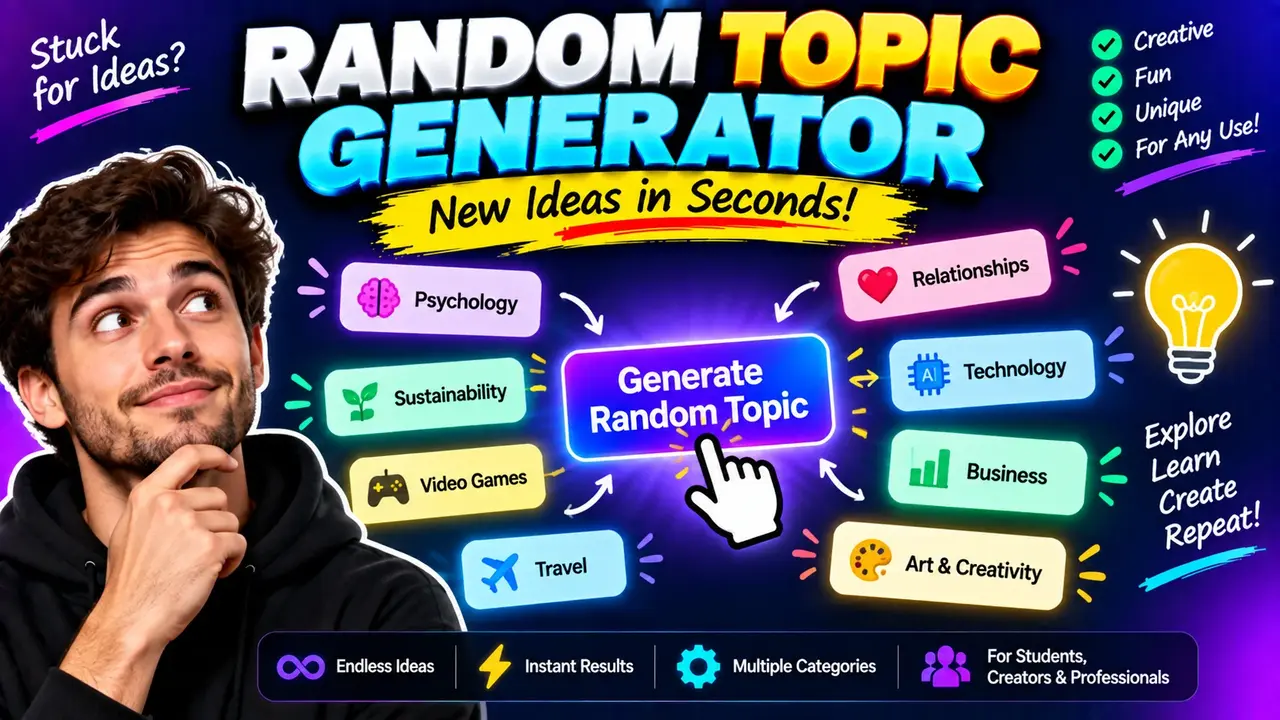
Free Random Topic Generator - Get Fresh Writing Ideas
Quick answer: The Free Random Topic Generator is a writing idea generator intended to help users discover fresh topics for writing, brainstorming, content planning, and creative exploration. It helps overcome the blank-page problem by providing a starting point for developing an article, essay, story, blog post, or other written project. The exact generation algorithm, available settings, and output format depend on the implemented tool.
Choosing what to write about can be harder than writing the first draft. Writers may have the skills and time to create content but struggle to find a useful, interesting, or original subject. The Free Random Topic Generator is designed for this early stage of the writing process: finding a topic that can be explored, researched, developed, or transformed into a complete piece of content.
Random topic generation is useful when a writer wants to explore ideas outside their usual interests, create a brainstorming prompt, or generate several possible directions before committing to one. Instead of waiting for inspiration, users can use a generated topic as a starting point and apply their own knowledge, research, creativity, and judgment.
Who Can Use a Random Topic Generator?
- Bloggers: Discover potential article subjects and expand a content calendar.
- Students: Find starting points for essays, assignments, presentations, and writing exercises.
- Creative writers: Explore story themes, imaginative prompts, and unexpected narrative directions.
- Content marketers: Brainstorm possible editorial subjects for audiences, campaigns, and publications.
- Teachers: Prepare discussion topics and writing exercises for classroom activities.
- Journal writers: Find reflection prompts when they do not know what to write about.
- Researchers: Explore preliminary subject areas before narrowing a question for further investigation.
How to Use Free Random Topic Generator - Get Fresh Writing Ideas?
The generator is intended to make topic discovery straightforward. Use the controls available in the actual tool interface and review the generated suggestions before choosing a subject.
- Open the generator: Navigate to the tool and inspect its available input fields or controls.
- Set your preferences: If the interface offers categories, keywords, or other options, choose settings that fit your writing goal.
- Generate a topic: Use the generation control to request a writing idea.
- Review the suggestion: Decide whether the result suits your purpose. If not, generate another suggestion if the interface supports repeated generation.
- Develop the idea: Turn the selected topic into a research question, outline, thesis, story premise, or article plan.
The available information does not establish which input fields, topic categories, generation controls, or export options the implementation supports. The steps above therefore describe the general workflow without assuming that unverified interface features are present.
Input and Output Example
The following examples illustrate how a randomly suggested topic can be developed into a practical writing assignment. They are illustrative examples, not verified outputs from the live generator.
Example 1: Blog Writing
Writing goal: Find a subject for a general-interest blog article.
Illustrative topic: How Urban Gardens Can Improve Community Life
Possible article outline:
- Explain what an urban garden is.
- Explore its potential social and environmental benefits.
- Discuss common challenges, including space and maintenance.
- Present practical examples of community gardening.
- Conclude with considerations for starting a local project.
Example 2: Creative Writing
Writing goal: Find a premise for a short story.
Illustrative topic: A Librarian Discovers a Book That Records Tomorrow's Events
Possible development: Establish the discovery, introduce a consequence of reading the book, create a conflict between knowledge and responsibility, and build toward a decision that changes the protagonist's future.
Example 3: Student Essay
Writing goal: Find a subject for an argumentative essay.
Illustrative topic: Should Schools Introduce More Outdoor Learning?
Possible research direction: Investigate educational outcomes, implementation costs, accessibility, curriculum requirements, and evidence from relevant studies. The final essay should use credible sources rather than treating the generated topic as proof of a claim.
Topic Types and Their Best Uses
A topic is more useful when it matches the format, audience, and purpose of the intended writing project. The following reference table can help users decide how to develop a suggestion.
| Topic Direction | Suitable Writing Format | Next Step |
|---|---|---|
| Informational | Blog posts, explainers, educational articles | Identify the audience and the main question to answer. |
| Argumentative | Essays, opinion pieces, debate preparation | Frame a debatable claim and identify evidence on both sides. |
| Creative | Short stories, fiction, poetry exercises | Introduce a character, conflict, setting, or unexpected constraint. |
| Reflective | Journals, personal essays, memoir writing | Connect the subject to an experience, observation, or question. |
| Research-oriented | Academic projects, reports, presentations | Check source availability and narrow the subject into a researchable question. |
| Practical | How-to articles, tutorials, guides | Identify a specific problem and define actionable steps for solving it. |
| Comparative | Reviews, analytical essays, comparison articles | Select two or more subjects and establish fair comparison criteria. |
This table is a writing-development reference, not a claim that the generator has seven built-in categories. The tool's actual category options, if any, should be documented only after they are verified.
How Random Topic Generation Works
A random topic generator produces or selects a writing subject for a user. The precise method varies by implementation. Some generators select from a predefined collection, while others combine words, prompts, categories, or other data to construct suggestions. Without implementation details, it is not possible to establish which method this particular tool uses.
Regardless of the underlying method, a generated topic should be treated as a starting point rather than a finished writing plan. A useful topic generally has enough focus to suggest a direction while leaving room for the writer to choose a perspective, audience, structure, and level of detail.
From Topic to Research Question
Broad topics often need refinement before they are ready for an essay or research project. For example, the subject renewable energy can be narrowed to How do residential solar panels affect household electricity costs? The more specific question identifies a context, a subject of investigation, and a potential way to organize research.
For creative writing, refinement works differently. A topic such as time travel can become a premise involving a character, a limitation, and a consequence. Adding those elements makes the idea easier to develop into a plot.
A Simple Topic Evaluation Method
- Relevance: Does the subject match the assignment, audience, or intended publication?
- Scope: Is it narrow enough to address within the available word count or project duration?
- Researchability: For factual writing, can reliable evidence be found?
- Original perspective: Can the writer contribute a useful interpretation, example, argument, or creative angle?
- Practical value: Does the topic give the intended reader a reason to continue reading?
Edge Cases and Limitations
Broad or Vague Suggestions
A suggestion such as technology identifies a large subject area but does not define a clear article or research question. Narrow it by audience, application, location, time period, or problem.
Repeated or Similar Topics
Random selection does not necessarily guarantee uniqueness. If a suggestion resembles an earlier result, change the angle or add a specific constraint. The implementation's duplicate-handling behavior has not been verified.
Topics Requiring Current Information
Subjects involving current events, scientific developments, laws, market conditions, or public policy require independent research. A generated suggestion does not establish that its underlying assumptions are current or correct.
Unsuitable or Sensitive Subjects
Some suggestions may be inappropriate for a classroom, workplace, audience, or publication. Review each result before using it and choose a different direction when necessary.
Missing Preferences or Unavailable Options
If the interface does not provide category or keyword controls, users may need to refine the generated suggestion manually. Supported inputs, generation limits, and error-handling behavior should be confirmed from the actual implementation rather than assumed.
Tips for Getting Better Writing Ideas
- Use constraints: When possible, limit a subject by audience, format, length, setting, or point of view.
- Generate alternatives: Compare several suggestions before selecting a topic if repeated generation is available.
- Combine related ideas: A subject from one area can inspire a fresh angle in another.
- Ask a question: Convert a broad topic into a question that the finished piece can answer.
- Check originality: Search for existing articles or work on the same subject and identify a meaningful new angle.
- Verify factual claims: Use reliable references for academic, technical, or evidence-based writing.
Frequently Asked Questions
What is a random topic generator used for?
A random topic generator helps writers discover subjects for articles, essays, stories, journal entries, classroom activities, and brainstorming sessions.
Does a generated topic provide a complete article?
A topic is a starting point, not necessarily a finished article, outline, or research plan. Writers should develop the idea into an appropriate structure and add original work and evidence where needed.
Can students use a random topic generator for essays?
Students can use topic suggestions to explore possible essay subjects. They should ensure that the chosen topic meets the assignment requirements, can be researched with credible sources, and supports their own analysis.
Are the generated topics guaranteed to be unique?
Uniqueness is not established for this implementation. Even a randomly selected topic may resemble existing writing or a previous suggestion, so users should evaluate originality and develop a distinctive angle.
Can the generator create creative writing prompts?
The tool is intended to help discover writing ideas, including potential creative subjects. Whether it generates full prompts or only topic suggestions depends on its actual output format.
Does the generator support categories or custom keywords?
The available tool information does not confirm specific category filters or custom keyword inputs. Check the actual interface to determine which options are supported.
Should generated topics be fact-checked?
Yes. For factual or research-based writing, independently verify claims, dates, statistics, and assumptions with reliable sources. A topic suggestion is not evidence that a claim is true.
Related Writing Resources
Writers can complement topic discovery with resources that help turn an idea into a well-structured piece of work:
- Purdue Online Writing Lab for writing, outlining, and academic writing guidance.
- Library of Congress for exploring research collections and source material.
These are external reference resources, not ToolHox utilities. No related internal ToolHox URLs were supplied for this tool.
Author and Technical Review
Author Name: ToolHox Editorial Team
Author Description: Editorial team focused on practical online utilities, writing workflows, and accessible tool documentation.
Technical Review: The documentation describes general topic-discovery workflows and writing-development practices. The live generator's algorithm, input controls, output structure, and processing behavior require verification against the implemented tool.