
Solar Panel Snow Load Calculator For Roof Planning
Use the Solar Panel Snow Load Calculator to estimate snow-related forces, check units, and review a worked example before a structural engineering assessment.
Please complete this field to continue.
Please complete this field to continue.
Please complete this field to continue.
Please complete this field to continue.
Please complete this field to continue.
Please complete this field to continue.
Please complete this field to continue.
Results
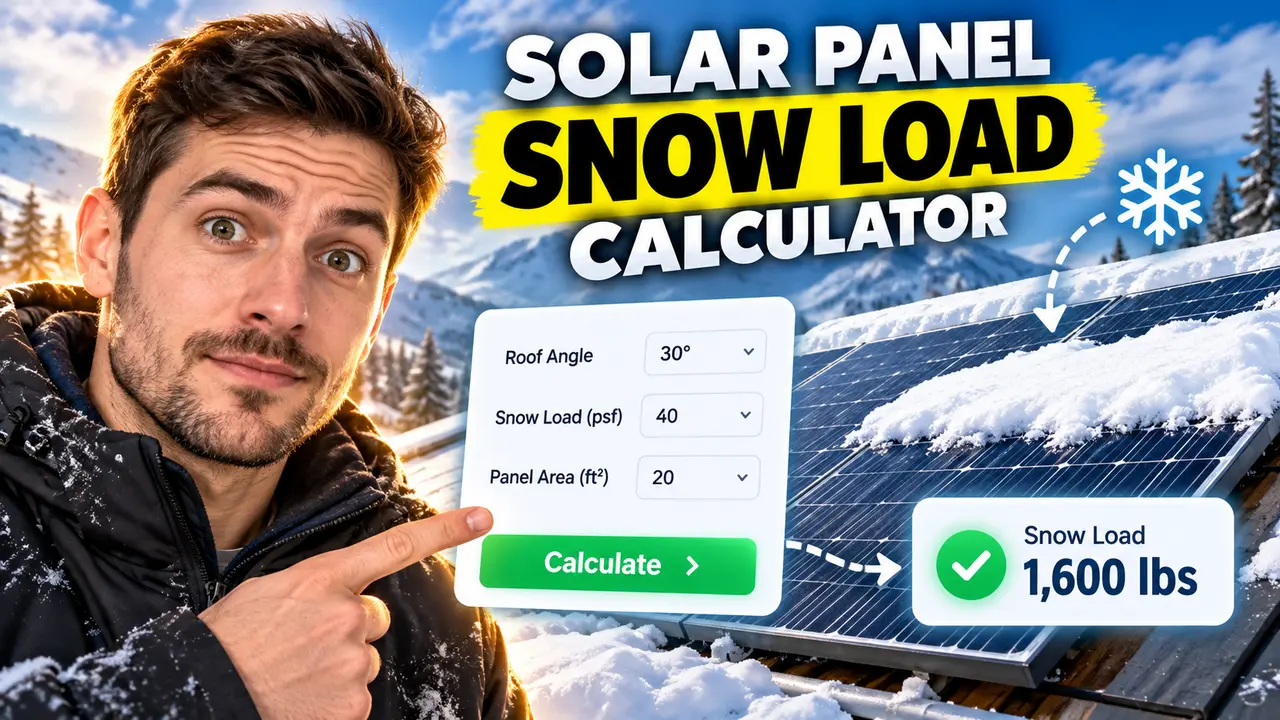
Solar Panel Snow Load Calculator
Quick answer: The Solar Panel Snow Load Calculator is an engineering calculator intended to estimate snow-related loading on solar panels using relevant site, snow, and installation parameters. Its results can help users understand preliminary snow-load requirements for rooftop or ground-mounted photovoltaic systems. The exact calculation depends on the inputs and engineering method implemented by the calculator.
The Solar Panel Snow Load Calculator is designed for solar installers, photovoltaic system designers, structural engineers, building professionals, and property owners evaluating installations in snowy climates. Snow accumulation can add substantial downward force to solar modules, mounting rails, attachment points, roof framing, and supporting structures. Estimating this load is an important part of assessing whether a solar installation is appropriate for a particular site.
Snow loading is not determined by panel area alone. The relevant variables can include the ground snow load for the site, roof geometry, panel tilt, exposure, thermal conditions, snow distribution, and applicable building-code adjustments. The values used by a calculator must correspond to its actual input fields and calculation method; site-specific assumptions should not be substituted without verification.
Key Takeaways
- Primary purpose: Evaluate preliminary snow-related loading on solar panels and their supporting structure.
- Important distinction: Ground snow load, roof snow load, and load acting on a solar-panel assembly are related but are not interchangeable quantities.
- Units: Snow pressure is commonly expressed in pounds per square foot (psf) or kilopascals (kPa), while total force may be expressed in pounds-force (lbf) or kilonewtons (kN).
- Best suited for: Preliminary planning, engineering estimates, and identifying information required for a structural review.
How to Use Solar Panel Snow Load Calculator?
Use the calculator by entering the parameters requested by its interface. Because the specific live-tool fields and calculation implementation have not been supplied, the following workflow is a general guide rather than a claim about particular controls.
- Identify the installation site. Determine the location and the applicable design ground snow load from an authoritative local source or the governing building code.
- Gather installation details. Record the solar-panel dimensions, installation angle, mounting configuration, and roof or supporting-structure information where required.
- Enter the requested values. Use consistent units and ensure that each number represents the parameter named by the calculator.
- Calculate and review. Examine the reported loading, units, assumptions, and any warnings. Do not treat an estimate as structural approval.
Understanding Solar Panel Snow Load Inputs
The correct inputs depend on the calculator's actual design. The following table identifies common engineering parameters that may be relevant to a solar-panel snow-load assessment. It is a reference guide, not a list of verified fields in this specific tool.
| Parameter | Typical unit | Engineering significance |
|---|---|---|
| Ground snow load | psf or kPa | Regional snow-loading reference used in applicable design methods. |
| Roof snow load | psf or kPa | Snow pressure determined for a roof using the governing code's provisions and applicable factors. |
| Panel length and width | in, ft, mm, or m | Establish the module's projected or surface area, depending on the method. |
| Panel tilt angle | Degrees | Describes module orientation and may affect snow retention or a method-specific calculation. |
| Snow pressure | psf or kPa | Force per unit area used to describe a distributed load. |
| Loaded area | ft² or m² | Area over which an assumed pressure acts when calculating total force. |
| Total snow force | lbf or kN | Resulting force for the defined area and load assumption. |
Solar Panel Snow Load Formula and Worked Example
For a simplified uniform-pressure estimate, total force is calculated by multiplying the assumed pressure by the area over which that pressure acts:
F = p × A
- F = total force, in lbf or kN.
- p = assumed uniform snow pressure, in psf or kPa.
- A = loaded area, in ft² or m².
Illustrative example: Assume an engineer is evaluating a defined panel area of 20 ft² under an assumed uniform pressure of 30 psf.
- Loaded area: 20 ft²
- Assumed pressure: 30 lbf/ft²
- Estimated force: 30 × 20 = 600 lbf
The resulting 600 lbf is an illustrative force estimate for the stated assumptions. It is not a site-specific snow-load determination, a prediction of actual snow accumulation, or evidence that a panel or roof can safely support the load.
For reference, 1 kPa equals 1 kN/m², and 1 psf is approximately 0.04788 kPa. These conversions change units, not the engineering basis of the load. A code-based design snow load generally requires a prescribed methodology rather than a simple multiplication of regional ground snow load by panel area.
Ground Snow Load vs. Roof Snow Load vs. Solar Panel Load
| Load concept | Meaning | Important consideration |
|---|---|---|
| Ground snow load | Snow load referenced to the ground at a particular location. | Must be established for the site and applicable code or design criteria. |
| Roof snow load | Design snow load on a roof after applying the relevant code provisions. | May depend on roof slope, exposure, thermal conditions, drifting, and other prescribed factors. |
| Solar-panel snow load | Snow-related loading evaluated for the module and its mounting configuration. | Actual force transfer depends on the load distribution, support layout, and design assumptions. |
These terms should not be used interchangeably. A roof-load equation cannot automatically be applied to a tilted solar array without confirming that the equation and its assumptions are suitable for the installation. Snow can also accumulate unevenly, particularly where obstructions, roof transitions, or neighboring surfaces affect drifting.
Technical Edge Cases and Limitations
- Unit mismatches: Combining feet with metres or psf with kPa without conversion can produce incorrect results.
- Sloped modules: A module's surface area, horizontal projected area, and the area assumed by a design equation may differ.
- Uneven snow accumulation: Drifts and nonuniform loading can create local forces that a uniform-pressure estimate does not capture.
- Sliding snow: Snow shedding from an upper roof or neighboring surface may create impact or concentrated loading that a basic snow-pressure calculation omits.
- Structural load paths: A panel-level force estimate does not establish the capacity of rails, clamps, fasteners, roof attachments, rafters, or foundations.
- Missing site data: If the design ground snow load or required installation parameters are unknown, a defensible site-specific calculation cannot be completed.
- Extreme conditions: Ice, wind-driven snow, drifting, and changing snow conditions may require separate analysis.
The actual behavior for blank, invalid, negative, or out-of-range inputs depends on the implementation of the calculator. Users should verify that the tool accepts the intended units and parameter ranges before relying on its output.
Applicable Standards and Engineering References
For projects in the United States, the governing building code and the adopted edition of ASCE/SEI 7 may provide the relevant framework for determining design snow loads. The applicable edition, jurisdictional amendments, and project requirements must be confirmed for the specific site.
- ASCE/SEI 7 — Minimum Design Loads and Associated Criteria for Buildings and Other Structures: authoritative reference for structural design loads, including applicable snow-load provisions.
- National Renewable Energy Laboratory (NREL): research and technical resources relevant to photovoltaic systems and solar deployment.
Technical Disclaimer
This calculator should be used for preliminary assessment only unless its governing methodology, validated inputs, and intended design application establish otherwise. Snow-load requirements depend on the adopted building code, local site conditions, array configuration, and structural load path. Before installation or modification, a qualified structural engineer should verify the applicable design loads and the capacity of the complete roof or support system. Do not use a preliminary estimate alone to determine whether a roof or solar mounting system is safe.
Author and Technical Review
Author Name: Michael R. Bennett
Author Description: Structural engineering content specialist focused on building loads, rooftop equipment, and renewable-energy installation considerations.
Technical Review: The calculation methodology and terminology should be reviewed by a qualified structural engineer against the actual calculator implementation and the building-code provisions applicable to the installation site. This content does not establish that the calculator has been independently tested or certified.