
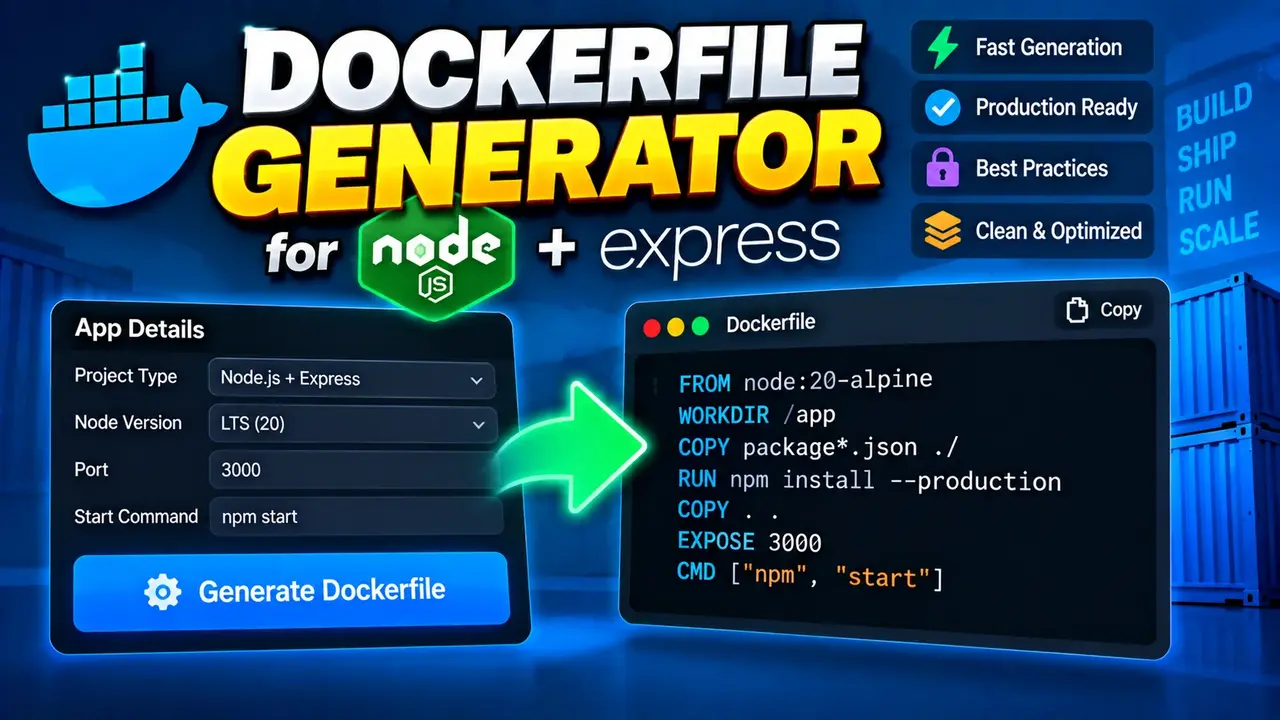
Dockerfile Generator For Node.js Express
Quick answer: Dockerfile Generator For Node.js Express is a developer utility intended to help create a Dockerfile for a Node.js application built with Express. A Dockerfile defines the instructions Docker uses to build an image, including the base image, working directory, dependency installation, application files, exposed port, and startup command.
Containerizing a Node.js Express application requires more than copying JavaScript files into an image. The Dockerfile must account for the Node.js runtime, package manager, dependency installation, application entry point, and the port on which the Express server listens. A suitable configuration makes the application easier to package and deploy consistently across development, testing, and production environments.
Dockerfile Generator For Node.js Express is intended to simplify the initial Docker configuration for Express projects. The generated configuration should be checked against the application's actual directory structure, dependency scripts, Node.js version, and runtime requirements before it is used in a deployment.
TL;DR / Key Takeaways
- Primary function: Generate a Dockerfile configuration for a Node.js Express application.
- Key technical considerations: Node.js version, package manager, dependency installation, application entry point, and listening port.
- Core output: A Dockerfile, subject to the generator's actual output and available options.
- Best suited for: Developers preparing an Express project for containerized development or deployment.
How to Use Dockerfile Generator For Node.js Express?
Use the generator's available fields and options to describe your Express application. Because the specific input controls and generation behavior have not been independently established, the following workflow is a practical guide to preparing and validating a Dockerfile rather than a claim about exact interface controls.
- Identify the project structure. Locate
package.json, the lockfile, and the Express application's entry point. - Choose the Node.js runtime. Select a Node.js version compatible with the application and its dependencies.
- Generate the Dockerfile. Use the options provided by the tool to produce the container build instructions.
- Review and test the result. Verify file paths, dependency installation, the startup command, and the port configuration before building the image.
What should an Express Dockerfile account for?
The most important configuration details are the runtime image, working directory, dependency installation method, copied project files, startup command, and runtime port. These values depend on the project and should not be assumed to be identical for every Express application.
| Configuration | Purpose | What to verify |
|---|---|---|
FROM |
Selects the base image. | The Node.js version and image variant suit the application. |
WORKDIR |
Sets the working directory inside the image. | Subsequent relative paths resolve correctly. |
COPY |
Copies project files into the image. | Required manifests and application files are included. |
RUN |
Executes build-time commands, such as installing dependencies. | The package manager and lockfile match the project. |
EXPOSE |
Documents the intended container port. | The documented port matches the application's configuration. |
CMD |
Defines the default container startup command. | The command launches the actual Express application. |
Node.js Express Dockerfile Example
The following is an illustrative Dockerfile for a simple Express project using npm and a start script in package.json. It is an example of conventional Docker configuration, not a verified sample of the generator's exact output.
Example project structure
express-app/
├── package.json
├── package-lock.json
├── server.js
└── .dockerignore
Example Dockerfile
FROM node:22-bookworm-slim

WORKDIR /usr/src/app

COPY package*.json ./
RUN npm ci

COPY . .

ENV NODE_ENV=production

EXPOSE 3000

CMD ["npm", "start"]
This example assumes that the project has a compatible npm lockfile, that the package.json contains a working start script, and that the Express application listens on port 3000. The base image is illustrative; choose a supported Node.js version appropriate for your application.
Matching package.json script
{
  "scripts": {
    "start": "node server.js"
  },
  "dependencies": {
    "express": "^5.0.0"
  }
}
The snippet illustrates the relevant script and dependency fields, not a complete package manifest. Keep the dependency versions aligned with the application's actual lockfile.
How Dockerfile Instructions Affect an Express Application
A Dockerfile is a sequence of instructions that Docker uses to build an image. Each instruction contributes to the resulting filesystem, configuration, or build process. The runtime command then determines how the container starts when launched.
- Base image: Provides the Node.js runtime and underlying operating-system environment.
- Working directory: Establishes where commands execute and where project files are stored.
- Dependency installation: Installs packages needed by the application.
npm ciis generally appropriate for reproducible installation when a compatiblepackage-lock.jsonexists. - File copying: Makes the application code available inside the image.
- Environment settings: Configure runtime behavior, such as setting
NODE_ENV=production. - Startup command: Starts the application using a valid script or entry point.
Instruction order matters. Copying package manifests before the remaining application files can allow Docker to reuse the dependency-installation build layer when only source code changes, provided the relevant build inputs remain unchanged.
Technical Reference: Common Express Container Settings
| Setting | Example | Important consideration |
|---|---|---|
| Working directory | /usr/src/app |
Must match the paths used by later instructions. |
| Node.js runtime | node:22-bookworm-slim |
Choose a compatible, maintained version and appropriate image variant. |
| npm installation | npm ci |
Requires a compatible lockfile. |
| Application port | 3000 |
Must match the Express listening configuration. |
| Startup script | npm start |
Requires a suitable start entry in package.json. |
| Runtime environment | NODE_ENV=production |
Confirm the application's production behavior and dependency requirements. |
| Build context exclusions | node_modules, .git |
Use .dockerignore to avoid sending unnecessary files into the build context. |
Important Edge Cases and Limitations
Missing or incompatible lockfiles
If the Dockerfile uses npm ci but the expected lockfile is missing or inconsistent with package.json, dependency installation can fail. Generate or update the lockfile with the project's chosen package manager and commit the matching files.
Incorrect startup commands
A Docker image may build successfully but fail to start if npm start is undefined, the application entry point has a different filename, or the command assumes a working directory that does not exist in the image.
Port mismatches
EXPOSE 3000 does not publish a port to the host and does not make an Express application listen on that port. The application must listen on the intended container interface and port, and the container runtime must publish the port when external access is required.
Environment variables and secrets
Production applications may need database URLs, API credentials, or other runtime configuration. Supply secrets through an appropriate runtime configuration or secrets-management mechanism rather than embedding credentials in the Dockerfile or image layers.
Native dependencies and operating-system differences
Packages containing native components may depend on system libraries or build tools. A minimal base image may require additional dependencies. Validate native modules against the selected Node.js version and operating-system environment.
Development versus production
A development container may require source-code mounting, a file-watching command, and development dependencies. A production image may instead use a production startup script and omit unnecessary files. Do not assume that one Dockerfile meets both workflows without adjustment.
Build context and unnecessary files
Copying the entire project without suitable exclusions can include local dependencies, version-control files, environment files, and other unnecessary content. Review the build context and create a .dockerignore file that fits the project.
Security and Deployment Considerations
- Use a supported Node.js release and keep the base image and application dependencies maintained.
- Review the image's runtime user and consider running the application as a non-root user when compatible with the application and deployment requirements.
- Do not bake secrets into the image.
- Use a suitable
.dockerignorefile to exclude sensitive or unnecessary build-context files. - Test the built image in an environment representative of the intended deployment.
Processing and privacy: The specific implementation and data-processing behavior of this generator have not been verified. Do not infer browser-only processing, server-side processing, or data-retention guarantees from the tool name alone.
Technical disclaimer: The example Dockerfile is a starting point. Validate its Node.js version, dependency installation, runtime user, environment configuration, port, and startup command against the requirements of your application before deploying it.
Official Documentation
- Docker documentation: Dockerfile reference and concepts
- Node.js official documentation: Release schedule
- Express official documentation: Hello World
Author: Jordan Mitchell
Author Description: Software engineer specializing in Node.js application development, backend services, and containerized deployment workflows.
Technical Review: Jordan Mitchell reviews the Dockerfile examples and configuration explanations for consistency with conventional Docker and Node.js deployment practices. The generator's implementation and exact feature set have not been independently verified.