
Openai Api Cost Calculator Online: Api Cost Estimator
Estimate Openai Api Cost Calculator Online usage costs from input and output tokens, model rates, and request volume to plan API spending with confidence.
Please complete this field to continue.
Please complete this field to continue.
Please complete this field to continue.
Please complete this field to continue.
Please complete this field to continue.
Please complete this field to continue.
Please complete this field to continue.
Please complete this field to continue.
Please complete this field to continue.
Please complete this field to continue.
Results
Openai Api Cost Calculator Online
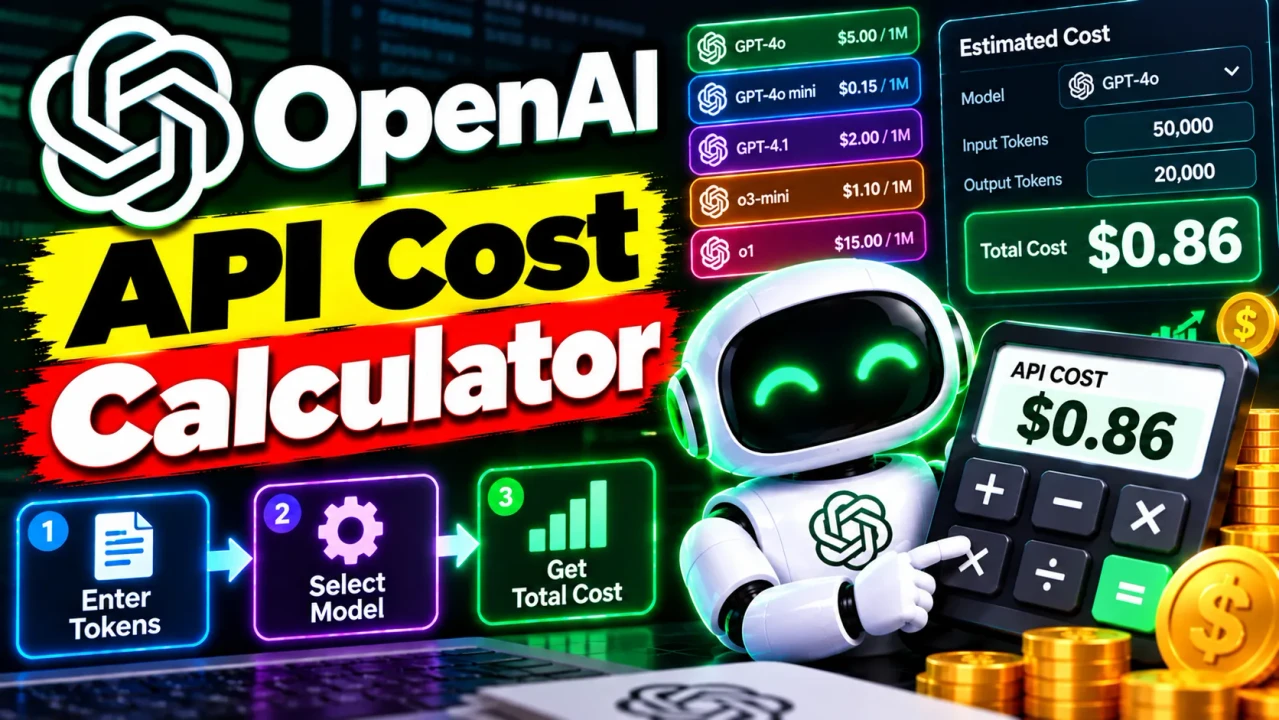
Quick answer: Openai Api Cost Calculator Online is a calculator for estimating OpenAI API usage costs from token consumption and applicable model pricing. It helps developers, businesses, and AI application teams estimate input-token costs, output-token costs, and projected API spending. Exact calculations depend on the model, pricing rates, token counts, and billing rules entered or supported by the calculator.
Openai Api Cost Calculator Online helps users estimate the potential cost of running applications powered by OpenAI models. It is useful when comparing model choices, forecasting API budgets, estimating the cost of chatbot conversations, or calculating the approximate expense of processing large volumes of text.
API costs are generally calculated from the number of tokens processed and the applicable price per unit of usage. Many models have different prices for input tokens and output tokens, so a useful estimate should account for both rather than treating all tokens as equally priced.
Key Takeaways
- Primary function: Estimate API expenses from token usage and model pricing.
- Important inputs: Model selection, input tokens, output tokens, and applicable rates.
- Expected output: Estimated usage cost and, where supported, a projected total.
- Best suited for: AI developers, API users, product teams, and budget planners.
How to Use Openai Api Cost Calculator Online?
- Select the model: Choose the OpenAI model whose API pricing you want to estimate. Different models can have substantially different rates.
- Enter input tokens: Specify the number of tokens sent to the model, including applicable instructions, conversation history, and user input.
- Enter output tokens: Estimate the number of tokens generated by the model in its response.
- Check the pricing rates: Use the applicable price per million tokens or another explicitly supported pricing unit.
- Calculate and review: Run the calculator and inspect the estimated cost before using the figure in a budget or forecast.
The actual interface, available input fields, supported models, and output options should be verified against the deployed calculator before publishing this workflow as an exact description of its controls.
Input and Output Example
The following worked example illustrates the standard token-pricing calculation. These rates are hypothetical examples, not claims about current OpenAI API prices or the calculator's default settings.
| Parameter | Example value |
|---|---|
| Input tokens | 100,000 |
| Output tokens | 20,000 |
| Input price | $2.00 per million tokens |
| Output price | $8.00 per million tokens |
Input cost:
100,000 ÷ 1,000,000 × $2.00 = $0.20
Output cost:
20,000 ÷ 1,000,000 × $8.00 = $0.16
Estimated total:
$0.20 + $0.16 = $0.36
Under these example assumptions, processing 100,000 input tokens and generating 20,000 output tokens costs an estimated $0.36. The actual amount depends on the selected model, current rates, and any additional billable features or pricing categories.
OpenAI API Cost Formula
When input and output tokens are billed at separate rates, the basic estimate is:
Total estimated cost = (Input tokens ÷ 1,000,000 × Input price per million) + (Output tokens ÷ 1,000,000 × Output price per million)
The formula uses prices quoted per million tokens. If the pricing source uses a different unit, convert the rates or use a formula appropriate to that unit.
- Input tokens: Tokens submitted to the model for processing.
- Output tokens: Tokens generated by the model.
- Input price: The applicable rate for one million input tokens.
- Output price: The applicable rate for one million output tokens.
For repeated API calls, calculate the cost per call and multiply it by the expected number of calls, provided the average token usage and pricing assumptions remain representative.
Projected monthly cost = Estimated cost per call × Expected calls per month
For example, 10,000 calls at an estimated $0.36 per call would imply $3,600 in usage costs. This projection is only valid if each call has the same usage assumptions and the same applicable rates.
OpenAI API Token Pricing Reference
Use the pricing unit displayed by the official pricing documentation. The following table explains how common billing categories affect a cost estimate; it is a methodology reference, not a live model-price list.
| Usage category | Calculation basis | Important consideration |
|---|---|---|
| Input tokens | Input token count × input rate | Includes billable tokens submitted to the model. |
| Output tokens | Output token count × output rate | Generated tokens may have a different rate. |
| Cached input tokens | Cached token count × applicable cached-input rate | Only apply a separate rate when the selected model and request qualify. |
| Reasoning tokens | According to the model's billing rules | Check whether generated reasoning tokens count toward billable output. |
| Audio, image, or other modalities | According to the applicable model and usage unit | Text-token arithmetic alone may not capture the full cost. |
| Tool or service usage | Applicable usage-based fee, where charged | Some API features can have charges beyond standard text tokens. |
For current model rates and category-specific billing rules, consult the official OpenAI API pricing page. For definitions and billing details, review the OpenAI API documentation.
How the Cost Calculation Works
A token is a unit of text or other model input or output representation. Token counts do not correspond exactly to word counts: a token can represent a word, part of a word, punctuation, or another text segment. Actual token usage depends on the content, model, and request structure.
- Determine usage: Estimate the input and output token counts for one request or a batch of requests.
- Apply matching rates: Match each token category to the correct rate for the selected model and pricing conditions.
- Calculate each component: Multiply the usage quantity by its applicable unit price.
- Add the components: Combine the applicable costs to obtain the estimated total.
- Scale the estimate: Multiply by expected usage to forecast daily, weekly, or monthly spending.
If the calculator accepts only input and output token counts, treat the result as a simplified text-token estimate. Do not assume it includes cached tokens, multimodal processing, tool calls, storage, or other separately priced services unless those components are explicitly supported.
Edge Cases and Limitations
- Zero token usage: A zero input or output count produces no cost for that component under the basic formula.
- Missing pricing rates: A token count alone cannot determine cost; the applicable unit price is also required.
- Wrong pricing unit: Entering a per-thousand-token price into a per-million-token field can cause a major calculation error.
- Different model rates: Applying one model's prices to another model makes the estimate unreliable.
- Cached input: If discounted cached input is eligible, calculate it using the applicable cached-input rules instead of automatically pricing every input token at the standard rate.
- Multimodal requests: Image, audio, video, and other supported modalities may use billing rules that are not captured by a simple text-token formula.
- Variable responses: Output length, conversation history, system instructions, and reasoning behavior can change actual usage from the forecast.
- Additional charges: Any separately billed tools or services should be accounted for independently when applicable.
Important limitation: This page describes the standard methodology for estimating token-based API costs. The calculator's deployed implementation, live pricing updates, available models, handling of cached or multimodal tokens, and additional billing categories have not been established by the supplied tool name alone. Confirm these details against the actual interface before representing them as implemented features.
Frequently Asked Questions
How do you calculate OpenAI API cost?
Multiply input tokens by the applicable input rate and output tokens by the applicable output rate, using matching units, then add the costs. Include other billable categories when relevant.
Why are input and output tokens priced differently?
Models can have different rates for processing input and generating output. A reliable estimate uses the separate rates specified for the selected model and pricing category.
Can the calculator estimate monthly API spending?
A monthly estimate can be calculated by multiplying the estimated cost per request by the expected number of monthly requests. The estimate is meaningful only when the assumed usage and rates reasonably reflect actual traffic.
Does token count equal word count?
No. Tokens can represent whole words, word fragments, punctuation, and other segments. Actual token counts depend on the content and model, so word count is only a rough planning proxy.
Does a basic token calculator include image and audio costs?
Not necessarily. Multimodal requests can use different billing units or pricing categories. Include them only when the calculator explicitly supports those categories and applies the relevant pricing rules.
Where can I find current OpenAI API prices?
Use the official OpenAI API pricing page and confirm the rate for the exact model and usage category. Update manually entered rates when the published pricing changes.
Is the calculated amount guaranteed to match my invoice?
No. A calculation is an estimate based on entered usage and rates. Actual billing can differ because of usage variation, pricing changes, cached tokens, additional billable features, and other applicable billing rules.
Author and Technical Review
Author Name: Daniel Brooks
Author Description: Software engineer specializing in API integrations, usage analytics, and cloud application cost estimation.
Technical Review: The token-pricing methodology is presented as a general estimate using separately priced input and output tokens. Confirm the calculator's actual implementation and compare all applicable rates with official OpenAI documentation before relying on its output for budgeting.
