
Voltage Sensitivity Of A Galvanometer Calculator Calculate
Calculate galvanometer voltage sensitivity from deflection, applied voltage, current sensitivity, and coil resistance. Apply the correct formula and check units.
Please complete this field to continue.
Please complete this field to continue.
Please complete this field to continue.
Results
Voltage Sensitivity Of A Galvanometer Calculator Calculate
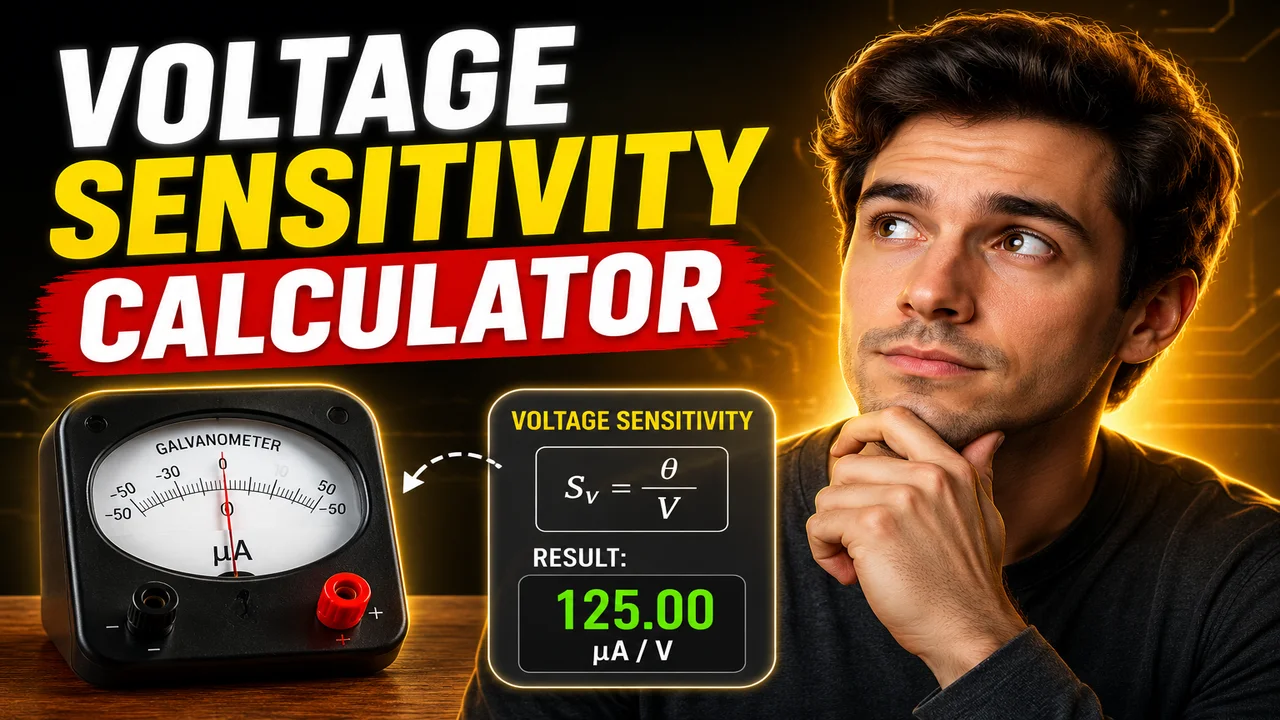
Quick answer: The Voltage Sensitivity Of A Galvanometer Calculator calculates how much a galvanometer's pointer deflects for each unit of applied voltage. It uses the relationship between current sensitivity and galvanometer resistance, or the ratio of deflection to applied voltage when those values are known.
The Voltage Sensitivity Of A Galvanometer Calculator is an electrical physics calculator for students, teachers, and learners studying moving-coil galvanometers. Voltage sensitivity measures the deflection produced per unit voltage applied across the galvanometer. It helps compare the response of measuring instruments and understand how coil resistance affects their sensitivity.
For a moving-coil galvanometer, the voltage sensitivity depends on the coil's magnetic and mechanical properties as well as its resistance. A galvanometer can have high current sensitivity without having equally high voltage sensitivity, because increasing the number of coil turns can also increase the coil resistance.
What Is Voltage Sensitivity?
Voltage sensitivity is defined as the angular deflection produced per unit voltage applied across a galvanometer. It indicates how much the pointer moves when the applied voltage changes.
The basic formula is:
SV = θ / V
Where:
- SV = voltage sensitivity, measured in radians per volt (rad/V) or scale divisions per volt (div/V).
- θ = pointer's angular deflection in radians, or deflection in scale divisions when using a calibrated scale.
- V = voltage applied across the galvanometer, measured in volts (V).
When current sensitivity and galvanometer resistance are known, voltage sensitivity can also be calculated using:
SV = SI / RG
Here, SI is current sensitivity and RG is the resistance of the galvanometer coil in ohms. This equation follows from Ohm's law, I = V/RG, for the galvanometer's resistive coil.
How to Use Voltage Sensitivity Of A Galvanometer Calculator Calculate?
- Identify the values available in your physics problem, such as current sensitivity and galvanometer resistance, or deflection and applied voltage.
- Enter the relevant values in the calculator's corresponding input fields, using consistent units.
- Calculate the voltage sensitivity using the applicable formula.
- Read the result and check whether it is expressed in rad/V or div/V, according to the input measurements.
The exact input fields and output presentation depend on the calculator implementation. Use the variables and units shown by the actual interface.
Voltage Sensitivity Formula and Methodology
For a moving-coil galvanometer, the deflecting torque balances the restoring torque at equilibrium:
NABI = kθ
Rearranging gives the angular deflection:
θ = (NAB/k)I
Since the current through a galvanometer coil of resistance RG is I = V/RG, substituting into the deflection equation gives:
θ = (NAB/kRG)V
Therefore, voltage sensitivity is:
SV = θ/V = NAB/(kRG) = SI/RG
Where:
- N = number of turns in the galvanometer coil.
- A = effective area of the coil in square metres (m²).
- B = magnetic flux density in tesla (T).
- k = torsional constant of the suspension, expressed consistently with the angular unit used.
- RG = galvanometer coil resistance in ohms (Ω).
- SI = current sensitivity, or deflection per unit current.
The formula assumes a linear deflection response, a consistent system of units, and the standard moving-coil galvanometer model. If deflection is measured in scale divisions instead of radians, use a calibrated current sensitivity in div/A and report voltage sensitivity in div/V.
Worked Example: Calculating Voltage Sensitivity
Suppose a galvanometer has a current sensitivity of 200 divisions per ampere and a coil resistance of 100 Ω.
Given:
- Current sensitivity, SI = 200 div/A
- Galvanometer resistance, RG = 100 Ω
Calculation:
SV = SI/RG
SV = 200/100 = 2 div/V
Result: The voltage sensitivity is 2 divisions per volt. Under the linear-response assumption, an applied voltage of 0.5 V would produce a deflection of 1 division.
Voltage Sensitivity Reference Table
| Known quantities | Formula | Resulting unit |
|---|---|---|
| Deflection and applied voltage | SV = θ/V | rad/V or div/V |
| Current sensitivity and coil resistance | SV = SI/RG | rad/V or div/V |
| Number of turns, coil area, magnetic field, torsional constant and resistance | SV = NAB/(kRG) | rad/V when units are consistent |
| Voltage sensitivity and current sensitivity | RG = SI/SV | Ω |
| Voltage sensitivity and applied voltage | θ = SVV | rad or divisions, matching sensitivity |
Voltage Sensitivity vs. Current Sensitivity
Current sensitivity measures deflection per unit current, whereas voltage sensitivity measures deflection per unit voltage. The two quantities are related, but they are not interchangeable.
- Current sensitivity: SI = θ/I.
- Voltage sensitivity: SV = θ/V = SI/RG.
For the same current sensitivity, a galvanometer with lower coil resistance has greater voltage sensitivity. Increasing the number of turns may increase current sensitivity, but it can also increase coil resistance. Consequently, increasing the number of turns does not necessarily increase voltage sensitivity.
Important Edge Cases and Limitations
- Zero voltage: The ratio θ/V cannot be evaluated directly when V = 0. Use a defined sensitivity value or another valid set of measurements.
- Zero resistance: The expression SI/RG is undefined for RG = 0. A real galvanometer coil has resistance.
- Unit mismatch: Do not combine degrees with radians, millivolts with volts, or microamperes with amperes without conversion.
- Zero deflection: A zero reading at a nonzero voltage gives a calculated ratio of zero for that measurement, but instrument offsets, calibration and measurement limits may need investigation.
- Large deflection: The standard formula assumes a proportional response. Mechanical limits, nonlinear response or instrument saturation can make the simple relationship unsuitable.
- Input availability: The formulas describe the physics, but the precise fields, validation rules, rounding and error messages must be confirmed from the live calculator interface.
Authoritative Physics References
The voltage-sensitivity relationship is explained in the NCERT Class 12 Physics chapter on moving charges and magnetism. See the NCERT Physics textbook and the CIET educational material on galvanometer sensitivity.
Technical Disclaimer: This calculator supports educational calculations using the stated galvanometer model. For laboratory measurements, verify the instrument's calibration, resistance, operating range and applicable experimental conditions before relying on calculated values.
Author Name: Daniel Mercer
Author Description: Electrical engineering educator specializing in circuit measurement, instrumentation and introductory electromagnetism.
Technical Review: The formulas and worked example should be checked against the stated variable definitions, consistent SI units and the linear-response assumption for a moving-coil galvanometer.