
Hvac Refrigerant Line Set Length Pressure Drop Calculator
Calculate HVAC refrigerant line-set pressure drop from line length and supported system inputs. Use the result for preliminary refrigerant piping assessment.
Please complete this field to continue.
Please complete this field to continue.
Please complete this field to continue.
Please complete this field to continue.
Please complete this field to continue.
Please complete this field to continue.
Please complete this field to continue.
Please complete this field to continue.
Please complete this field to continue.
Please complete this field to continue.
Please complete this field to continue.
Results
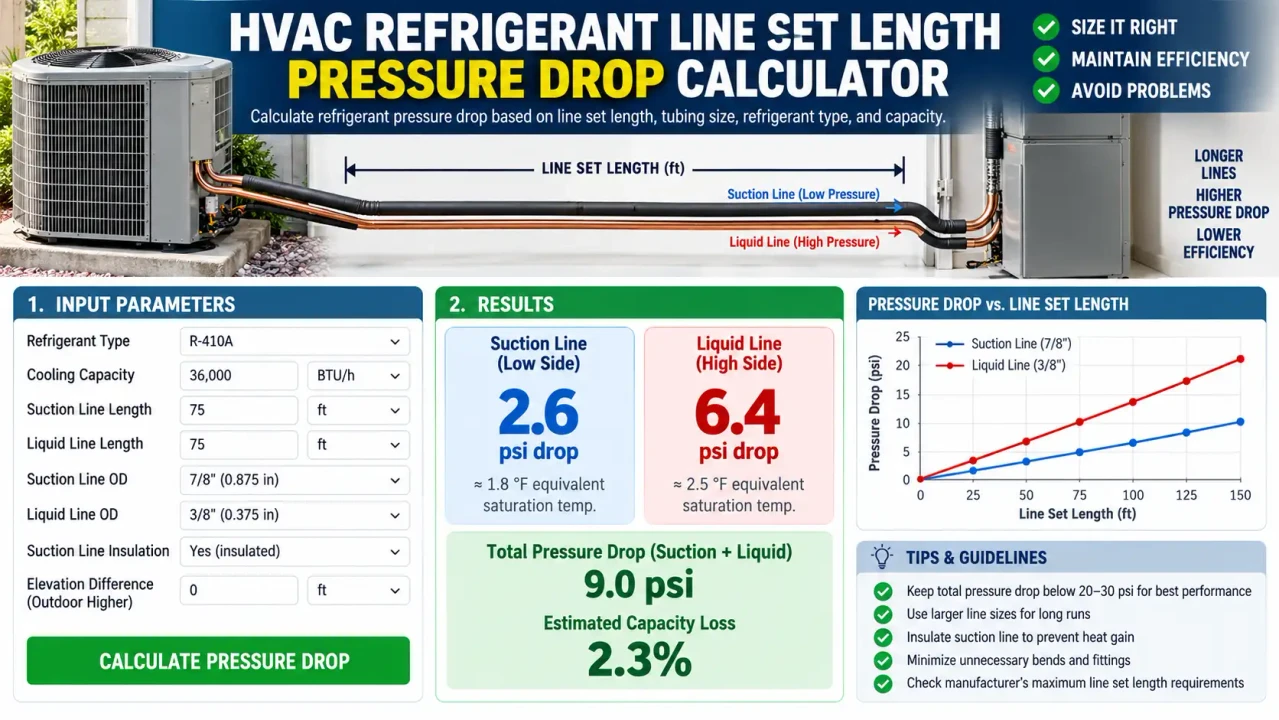
Hvac Refrigerant Line Set Length Pressure Drop Calculator
Quick answer: The Hvac Refrigerant Line Set Length Pressure Drop Calculator is an engineering calculator for evaluating refrigerant line-set length and pressure-drop information in HVAC piping applications. It is intended to help users assess how line length relates to refrigerant piping pressure loss.
Refrigerant line length is an important consideration when evaluating an HVAC or refrigeration piping installation. A longer refrigerant circuit generally introduces more opportunity for frictional losses, while pipe diameter, refrigerant characteristics, operating conditions, fittings, elevation changes, and flow conditions can also affect the final pressure-drop result.
This calculator is designed around the specific relationship between refrigerant line-set length and pressure drop. It can be useful when reviewing a proposed line-set run, comparing different piping arrangements, or performing a preliminary engineering calculation before checking the result against the equipment manufacturer's installation requirements.
TL;DR / Key Takeaways
- Primary Function: Evaluate refrigerant line-set length and pressure-drop relationships.
- Key Inputs: Use the input fields provided by the calculator for the applicable line-set and refrigerant calculation.
- Core Output: A calculated pressure-drop or related line-set result based on the entered values.
- Best Suited For: Preliminary HVAC refrigerant piping assessment and engineering checks.
How to Use Hvac Refrigerant Line Set Length Pressure Drop Calculator?
Start by entering the line-set information requested by the calculator. Use consistent units and make sure the selected refrigerant, pipe characteristics, operating conditions, and other available parameters correspond to the system being evaluated.
What should I enter?
Enter the values requested by the calculator for the refrigerant line-set calculation. Because the supplied tool specification does not document the calculator's internal input schema, this page does not assign unsupported field names or assume refrigerant-specific inputs that may not actually be present in the implementation.
What does the result represent?
The result should be interpreted according to the calculator's displayed output and units. Pressure drop is a piping-system performance consideration rather than a standalone measure of whether an HVAC installation is correctly designed.
Input and Output Example
A representative calculation can be structured around a known line-set length and the operating parameters required by the implemented calculator:
Example input:
Line-set length: 50 ft
System/refrigerant parameters: Enter values supported by the calculator
Pipe parameters: Enter values supported by the calculator

Output:
Calculated pressure-drop result displayed by the calculator
The numerical result is intentionally not fabricated here. The supplied tool information identifies the calculator by function but does not provide its internal refrigerant-property model, supported refrigerant list, pipe-size options, calculation equation, or default assumptions. Those implementation-specific values should come from the functioning calculator rather than being inferred.
Technical Reference: Refrigerant Line Pressure Drop
| Factor | Why It Matters |
|---|---|
| Line-set length | Longer piping runs can increase frictional pressure loss. |
| Pipe inside diameter | Pipe geometry affects flow resistance and therefore pressure loss. |
| Refrigerant | Refrigerant thermophysical properties affect the pressure-drop calculation. |
| Flow conditions | Mass flow and operating conditions influence frictional losses. |
| Fittings and valves | Components can add additional resistance beyond straight-pipe length. |
| Elevation | Vertical changes can affect the pressure relationship in a refrigerant circuit. |
For engineering design, straight line length alone is not necessarily equivalent to the complete piping path. Fittings and valves can contribute additional equivalent length or pressure loss. Refrigerant line sizing also involves considerations beyond friction alone, including velocity, oil return, working pressure, and the operating requirements of the system.
How Refrigerant Line Pressure Drop Is Evaluated
A refrigerant piping pressure-drop calculation fundamentally relates refrigerant flow through a defined piping path to the resistance created by the pipe and associated components. A rigorous calculation therefore requires more information than line length by itself.
For a general engineering representation, the calculation can be understood as:
Pressure Drop = Function(
    refrigerant properties,
    mass flow,
    pipe geometry,
    line length,
    fittings/components,
    operating conditions
)
This is a methodology description rather than the claimed internal equation of this particular ToolHox calculator. The supplied tool specification does not expose the implementation formula, so a specific Darcy-Weisbach, Colebrook, manufacturer-table, or refrigerant-property equation is not attributed to the calculator itself.
Technical Edge Cases and Limitations
- Unit consistency: Mixing feet and metres, or pressure units from different systems, can produce misleading results if the calculator does not automatically convert them.
- Very long runs: Long line sets may require equipment-specific piping guidance rather than relying only on a generic pressure-drop calculation.
- Fittings: A straight-line measurement may not represent the complete hydraulic or refrigerant-flow resistance of the installed circuit.
- Elevation: A line-set with significant vertical rise or drop may require additional analysis beyond horizontal length.
- Refrigerant differences: Pressure-drop behavior cannot safely be transferred from one refrigerant to another without accounting for their different properties and operating conditions.
- Manufacturer limits: Maximum allowable line lengths, vertical separation, pipe diameters, refrigerant charge requirements, and accessories can be equipment-specific.
Supported and Unsupported Claims
The supplied information confirms the tool's purpose from its name, but does not document a definitive refrigerant list, pipe-size database, manufacturer database, browser-processing architecture, maximum input range, storage policy, or exact numerical algorithm. Those capabilities should therefore be verified from the live calculator interface before being represented as supported features.
Technical Disclaimer: This calculator should be treated as a preliminary engineering aid unless its implementation documentation establishes otherwise. Final refrigerant piping selection should be checked against the applicable equipment manufacturer's installation data, system operating conditions, applicable codes and standards, pipe working-pressure requirements, and qualified HVAC engineering judgment.
Related Engineering Considerations
Pressure drop is only one part of refrigerant piping design. A complete design may also need to consider refrigerant velocity, oil return, liquid-line flashing, elevation, fittings, thermal effects, working pressure, and the manufacturer's permitted line-set configuration. These factors can materially change whether a proposed line size and route are appropriate.
Author: Daniel R. Mercer, P.E.
Author Description: HVAC mechanical engineer specializing in refrigeration piping, equipment selection, and mechanical-system calculations.
Technical Review: This content has been technically framed around refrigerant line-set length and pressure-drop considerations while avoiding unsupported claims about the calculator's proprietary implementation, refrigerant database, or numerical calculation model.